This article applies game theory to a firm, demonstrating how a fair bonus distribution system can create a self-enforcing Nash equilibrium for teamwork.This article applies game theory to a firm, demonstrating how a fair bonus distribution system can create a self-enforcing Nash equilibrium for teamwork.

Game Theory in the Workplace: Using Bonuses to Ensure a Self-Enforcing Equilibrium

Abstract and 1. Introduction

  1. A free and fair economy: definition, existence and uniqueness

    2.1 A free economy

    2.2 A free and fair economy

  2. Equilibrium existence in a free and fair economy

    3.1 A free and fair economy as a strategic form game

    3.2 Existence of an equilibrium

  3. Equilibrium efficiency in a free and fair economy

  4. A free economy with social justice and inclusion

    5.1 Equilibrium existence and efficiency in a free economy with social justice

    5.2 Choosing a reference point to achieve equilibrium efficiency

  5. Some applications

    6.1 Teamwork: surplus distribution in a firm

    6.2 Contagion and self-enforcing lockdown in a networked economy

    6.3 Bias in academic publishing

    6.4 Exchange economies

  6. Contributions to the closely related literature

  7. Conclusion and References

Appendix

6 Some applications

There a wide variety of applications of our theory. In this section, we provide applications to the distribution of surplus in a firm, exchange economies, self-enforcing lockdowns in a networked economy facing a pandemic, and publication bias in the academic peer-review system.

6.1 Teamwork: surplus distribution in a firm

In this first application, we use our theory to show how bonuses can be distributed among workers in a way that incentivizes them to work efficiently.

\
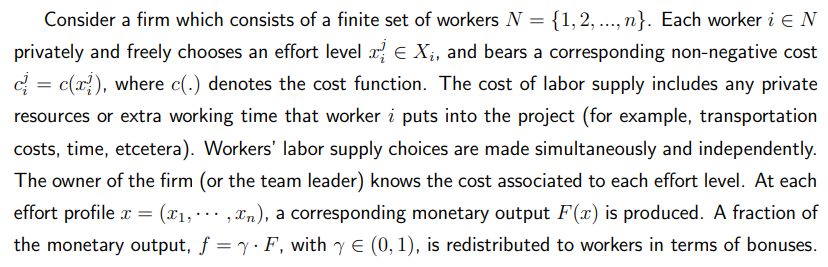
\ The existence of a pure strategy Nash equilibrium in this teamwork game follows from Lemma 1. To see this, observe that the payoff function of a worker can be decomposed in two parts: the bonus that is determined by the Shapley payoff and the cost function. Lemma 1 shows that the sum of excess payoffs in any cycle of deviations equals 0 in any free and fair economy (or any strategic game with Shapley payoffs). The reader can check that the sum of excess costs in any cycle of strategy profiles is zero as well in the game. The latter implies that the sum of excess payoffs in any cycle of strategy profiles of the teamwork game is equal to 0. Therefore, the teamwork game admits no cycle of deviations. As the game is finite, we conclude that it admits at least a Nash equilibrium profile in pure strategies. (Recall that the total output of the firm, F, and the total bonus, f, are perfectly correlated.) We should point out that a pure strategy Nash equilibrium always exists in the teamwork game, even if costs are high. In the latter case, some workers, if not all, might find it optimal to remain inactive at the equilibrium. In such a situation, the owner might want to raise the total bonus to be redistributed to workers.

\
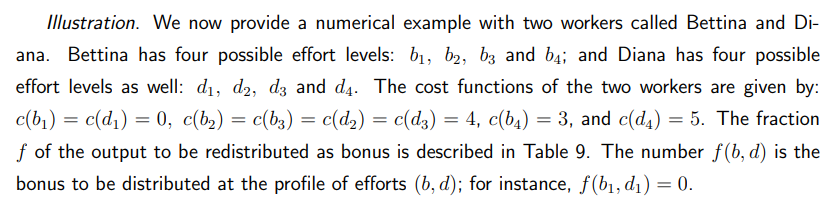
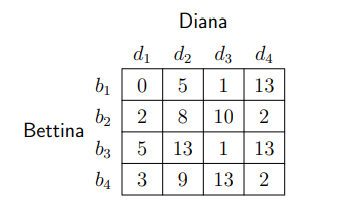
\ Table 9: Total bonus function in a teamwork game
\ The corresponding Shapley payoffs are described in Table 10 and the net payoffs of Bettina and Diana in the teamwork game are described in Table 11.

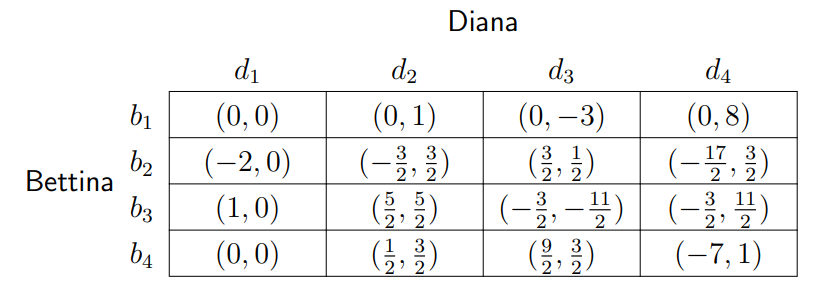
\ The profile (b4, d3) is a pure strategy Nash equilibrium. Therefore, the owner of the firm can implement the profile (b4, d3) without any need of monitoring the actions of Bettina and Diana, as (b4, d3) is self-enforcing. The owner can implement the profile (b1, d4) as well. Note that the set of equilibrium effort profiles depend on the cost functions, and that no worker receives a non

\ Table 10: Shapley payoffs: redistribution of total bonus in a teamwork game
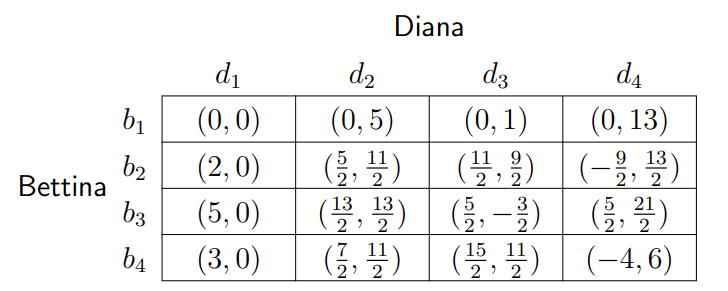
\ Table 11: Bettina and Diana’s net payoffs in a teamwork game

\ positive bonus at the equilibrium. The reason is that each worker i always has the option to remain inactive, which is equivalent to Bettina choosing b1 or Diana choosing d1 in this illustration. The two equilibria in this teamwork game are Pareto-efficient.

\

:::info Authors:

(1) Ghislain H. Demeze-Jouatsa, Center for Mathematical Economics, University of Bielefeld (demeze jouatsa@uni-bielefeld.de);

(2) Roland Pongou, Department of Economics, University of Ottawa (rpongou@uottawa.ca);

(3) Jean-Baptiste Tondji, Department of Economics and Finance, The University of Texas Rio Grande Valley (jeanbaptiste.tondji@utrgv.edu).

:::


:::info This paper is available on arxiv under CC BY 4.0 DEED license.

:::

\

Market Opportunity
SQUID MEME Logo
SQUID MEME Price(GAME)
$32.1077
$32.1077$32.1077
-18.36%
USD
SQUID MEME (GAME) Live Price Chart
Disclaimer: The articles reposted on this site are sourced from public platforms and are provided for informational purposes only. They do not necessarily reflect the views of MEXC. All rights remain with the original authors. If you believe any content infringes on third-party rights, please contact service@support.mexc.com for removal. MEXC makes no guarantees regarding the accuracy, completeness, or timeliness of the content and is not responsible for any actions taken based on the information provided. The content does not constitute financial, legal, or other professional advice, nor should it be considered a recommendation or endorsement by MEXC.

You May Also Like

Crypto News: Donald Trump-Aligned Fed Governor To Speed Up Fed Rate Cuts?

Crypto News: Donald Trump-Aligned Fed Governor To Speed Up Fed Rate Cuts?

The post Crypto News: Donald Trump-Aligned Fed Governor To Speed Up Fed Rate Cuts? appeared on BitcoinEthereumNews.com. In recent crypto news, Stephen Miran swore in as the latest Federal Reserve governor on September 16, 2025, slipping into the board’s last open spot right before the Federal Open Market Committee kicks off its two-day rate discussion. Traders are betting heavily on a 25-basis-point trim, which would bring the federal funds rate down to 4.00%-4.25%, based on CME FedWatch Tool figures from September 15, 2025. Miran, who’s been Trump’s top economic advisor and a supporter of his trade ideas, joins a seven-member board where just three governors come from Democratic picks, according to the Fed’s records updated that same day. Crypto News: Miran’s Background and Quick Path to Confirmation The Senate greenlit Miran on September 15, 2025, with a tight 48-47 vote, following his nomination on September 2, 2025, as per a recent crypto news update. His stint runs only until January 31, 2026, stepping in for Adriana D. Kugler, who stepped down in August 2025 for reasons not made public. Miran earned his economics Ph.D. from Harvard and worked at the Treasury back in Trump’s first go-around. Afterward, he moved to Hudson Bay Capital Management as an economist, then looped back to the White House in December 2024 to head the Council of Economic Advisers. There, he helped craft Trump’s “reciprocal tariffs” approach, aimed at fixing trade gaps with China and the EU. He wouldn’t quit his White House gig, which irked Senator Elizabeth Warren at the September 7, 2025, confirmation hearings. That limited time frame means Miran gets to cast a vote straight away at the FOMC session starting September 16, 2025. The full board now features Chair Jerome H. Powell (Trump pick, term ends 2026), Vice Chair Philip N. Jefferson (Biden, to 2036), and folks like Lisa D. Cook (Biden, to 2028) and Michael S. Barr…
Share
BitcoinEthereumNews2025/09/18 03:14
What Is Ripple Doing at Davos — and Who’s With Them?

What Is Ripple Doing at Davos — and Who’s With Them?

Ripple wasn’t just attending Davos — it sponsored the USA House event, a private hub for U.S. companies, policymakers, and influential global leaders to debate
Share
Coinstats2026/01/20 16:49
Vitalik Buterin Reveals Ethereum’s Long-Term Focus on Quantum Resistance

Vitalik Buterin Reveals Ethereum’s Long-Term Focus on Quantum Resistance

TLDR Ethereum focuses on quantum resistance to secure the blockchain’s future. Vitalik Buterin outlines Ethereum’s long-term development with security goals. Ethereum aims for improved transaction efficiency and layer-2 scalability. Ethereum maintains a strong market position with price stability above $4,000. Vitalik Buterin, the co-founder of Ethereum, has shared insights into the blockchain’s long-term development. During [...] The post Vitalik Buterin Reveals Ethereum’s Long-Term Focus on Quantum Resistance appeared first on CoinCentral.
Share
Coincentral2025/09/18 00:31