BlackRock has quietly turned its early foray into crypto into a lucrative venture, earning more than $260 million in annual revenue from digital asset products in less than two years. The windfall stems largely from the rapid success of its spot Bitcoin and Ethereum exchange-traded funds (ETFs), which dominate their respective markets and now rank among the most profitable products in the firm’s portfolio. How BlackRock Quietly Built One of Its Most Profitable Businesses Through Crypto ETFs According to Dragonfly partner Omar Kanji’s data, BlackRock’s iShares Bitcoin Trust (IBIT) generated about $218 million in fees at a 0.25% commission rate during its first year. Its Ethereum fund, ETHA, added another $42 million under the same fee structure. Kanji emphasized that the milestone is striking not only because of the size of the revenue. He noted that achieving it within a year of launch underscores how quickly BlackRock has entrenched itself in crypto finance. The success of these funds reflects a broader trend: investors are paying significantly more to access crypto products compared with traditional ETFs. While IBIT and ETHA charge 0.25% in annual fees, most of BlackRock’s established ETFs—including its flagship IVV fund—charge between 0.03% and 0.1%. This disparity highlights how institutional demand for Bitcoin and Ethereum exposure has translated into premium pricing power for the asset manager. Meanwhile, that strategy has coincided with investor enthusiasm for the market class. Launched in January 2024, IBIT has grown into the largest crypto ETF globally and now ranks as the 22nd largest ETF overall by assets, according to VettaFi. Additionally, SoSo Value data shows IBIT has attracted $60.6 billion in net inflows, representing nearly three-quarters of all US Bitcoin ETF flows. Today, it manages more than $88 billion in assets, cementing its role as the industry’s flagship product. BlackRock’s IBIT Flows. Source: SoSo Value Data On the other hand, BlackRock’s Ethereum product, ETHA, has also become a force in its category. Since its July 2024 debut, ETHA has drawn $13.4 billion in net inflows, giving it a commanding 72.5% share of all US ETH ETF flows.BlackRock has quietly turned its early foray into crypto into a lucrative venture, earning more than $260 million in annual revenue from digital asset products in less than two years. The windfall stems largely from the rapid success of its spot Bitcoin and Ethereum exchange-traded funds (ETFs), which dominate their respective markets and now rank among the most profitable products in the firm’s portfolio. How BlackRock Quietly Built One of Its Most Profitable Businesses Through Crypto ETFs According to Dragonfly partner Omar Kanji’s data, BlackRock’s iShares Bitcoin Trust (IBIT) generated about $218 million in fees at a 0.25% commission rate during its first year. Its Ethereum fund, ETHA, added another $42 million under the same fee structure. Kanji emphasized that the milestone is striking not only because of the size of the revenue. He noted that achieving it within a year of launch underscores how quickly BlackRock has entrenched itself in crypto finance. The success of these funds reflects a broader trend: investors are paying significantly more to access crypto products compared with traditional ETFs. While IBIT and ETHA charge 0.25% in annual fees, most of BlackRock’s established ETFs—including its flagship IVV fund—charge between 0.03% and 0.1%. This disparity highlights how institutional demand for Bitcoin and Ethereum exposure has translated into premium pricing power for the asset manager. Meanwhile, that strategy has coincided with investor enthusiasm for the market class. Launched in January 2024, IBIT has grown into the largest crypto ETF globally and now ranks as the 22nd largest ETF overall by assets, according to VettaFi. Additionally, SoSo Value data shows IBIT has attracted $60.6 billion in net inflows, representing nearly three-quarters of all US Bitcoin ETF flows. Today, it manages more than $88 billion in assets, cementing its role as the industry’s flagship product. BlackRock’s IBIT Flows. Source: SoSo Value Data On the other hand, BlackRock’s Ethereum product, ETHA, has also become a force in its category. Since its July 2024 debut, ETHA has drawn $13.4 billion in net inflows, giving it a commanding 72.5% share of all US ETH ETF flows.

BlackRock Earns $260 Million From Bitcoin and Ethereum ETFs Under 2 Years

BlackRock has quietly turned its early foray into crypto into a lucrative venture, earning more than $260 million in annual revenue from digital asset products in less than two years.

The windfall stems largely from the rapid success of its spot Bitcoin and Ethereum exchange-traded funds (ETFs), which dominate their respective markets and now rank among the most profitable products in the firm’s portfolio.

How BlackRock Quietly Built One of Its Most Profitable Businesses Through Crypto ETFs

According to Dragonfly partner Omar Kanji’s data, BlackRock’s iShares Bitcoin Trust (IBIT) generated about $218 million in fees at a 0.25% commission rate during its first year. Its Ethereum fund, ETHA, added another $42 million under the same fee structure.

Kanji emphasized that the milestone is striking not only because of the size of the revenue. He noted that achieving it within a year of launch underscores how quickly BlackRock has entrenched itself in crypto finance.

The success of these funds reflects a broader trend: investors are paying significantly more to access crypto products compared with traditional ETFs.

While IBIT and ETHA charge 0.25% in annual fees, most of BlackRock’s established ETFs—including its flagship IVV fund—charge between 0.03% and 0.1%.

This disparity highlights how institutional demand for Bitcoin and Ethereum exposure has translated into premium pricing power for the asset manager.

Meanwhile, that strategy has coincided with investor enthusiasm for the market class.

Launched in January 2024, IBIT has grown into the largest crypto ETF globally and now ranks as the 22nd largest ETF overall by assets, according to VettaFi.

Additionally, SoSo Value data shows IBIT has attracted $60.6 billion in net inflows, representing nearly three-quarters of all US Bitcoin ETF flows. Today, it manages more than $88 billion in assets, cementing its role as the industry’s flagship product.
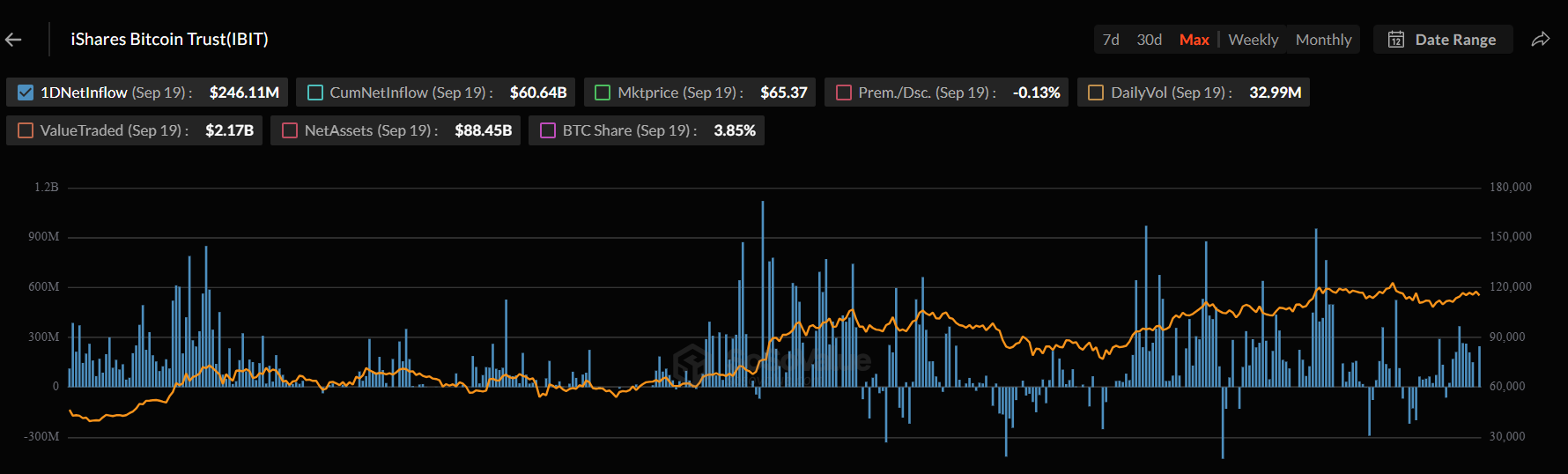
BlackRock's IBIT Flows.BlackRock’s IBIT Flows. Source: SoSo Value Data

On the other hand, BlackRock’s Ethereum product, ETHA, has also become a force in its category.

Since its July 2024 debut, ETHA has drawn $13.4 billion in net inflows, giving it a commanding 72.5% share of all US ETH ETF flows.

Market Opportunity
Moonveil Logo
Moonveil Price(MORE)
$0.001924
$0.001924$0.001924
-1.28%
USD
Moonveil (MORE) Live Price Chart
Disclaimer: The articles reposted on this site are sourced from public platforms and are provided for informational purposes only. They do not necessarily reflect the views of MEXC. All rights remain with the original authors. If you believe any content infringes on third-party rights, please contact service@support.mexc.com for removal. MEXC makes no guarantees regarding the accuracy, completeness, or timeliness of the content and is not responsible for any actions taken based on the information provided. The content does not constitute financial, legal, or other professional advice, nor should it be considered a recommendation or endorsement by MEXC.

You May Also Like

Microsoft Corp. $MSFT blue box area offers a buying opportunity

Microsoft Corp. $MSFT blue box area offers a buying opportunity

The post Microsoft Corp. $MSFT blue box area offers a buying opportunity appeared on BitcoinEthereumNews.com. In today’s article, we’ll examine the recent performance of Microsoft Corp. ($MSFT) through the lens of Elliott Wave Theory. We’ll review how the rally from the April 07, 2025 low unfolded as a 5-wave impulse followed by a 3-swing correction (ABC) and discuss our forecast for the next move. Let’s dive into the structure and expectations for this stock. Five wave impulse structure + ABC + WXY correction $MSFT 8H Elliott Wave chart 9.04.2025 In the 8-hour Elliott Wave count from Sep 04, 2025, we saw that $MSFT completed a 5-wave impulsive cycle at red III. As expected, this initial wave prompted a pullback. We anticipated this pullback to unfold in 3 swings and find buyers in the equal legs area between $497.02 and $471.06 This setup aligns with a typical Elliott Wave correction pattern (ABC), in which the market pauses briefly before resuming its primary trend. $MSFT 8H Elliott Wave chart 7.14.2025 The update, 10 days later, shows the stock finding support from the equal legs area as predicted allowing traders to get risk free. The stock is expected to bounce towards 525 – 532 before deciding if the bounce is a connector or the next leg higher. A break into new ATHs will confirm the latter and can see it trade higher towards 570 – 593 area. Until then, traders should get risk free and protect their capital in case of a WXY double correction. Conclusion In conclusion, our Elliott Wave analysis of Microsoft Corp. ($MSFT) suggested that it remains supported against April 07, 2025 lows and bounce from the blue box area. In the meantime, keep an eye out for any corrective pullbacks that may offer entry opportunities. By applying Elliott Wave Theory, traders can better anticipate the structure of upcoming moves and enhance risk management in volatile markets. Source: https://www.fxstreet.com/news/microsoft-corp-msft-blue-box-area-offers-a-buying-opportunity-202509171323
Share
BitcoinEthereumNews2025/09/18 03:50
WTI drifts higher above $59.50 on Kazakh supply disruptions

WTI drifts higher above $59.50 on Kazakh supply disruptions

The post WTI drifts higher above $59.50 on Kazakh supply disruptions appeared on BitcoinEthereumNews.com. West Texas Intermediate (WTI), the US crude oil benchmark
Share
BitcoinEthereumNews2026/01/21 11:24
Fed forecasts only one rate cut in 2026, a more conservative outlook than expected

Fed forecasts only one rate cut in 2026, a more conservative outlook than expected

The post Fed forecasts only one rate cut in 2026, a more conservative outlook than expected appeared on BitcoinEthereumNews.com. Federal Reserve Chairman Jerome Powell talks to reporters following the regular Federal Open Market Committee meetings at the Fed on July 30, 2025 in Washington, DC. Chip Somodevilla | Getty Images The Federal Reserve is projecting only one rate cut in 2026, fewer than expected, according to its median projection. The central bank’s so-called dot plot, which shows 19 individual members’ expectations anonymously, indicated a median estimate of 3.4% for the federal funds rate at the end of 2026. That compares to a median estimate of 3.6% for the end of this year following two expected cuts on top of Wednesday’s reduction. A single quarter-point reduction next year is significantly more conservative than current market pricing. Traders are currently pricing in at two to three more rate cuts next year, according to the CME Group’s FedWatch tool, updated shortly after the decision. The gauge uses prices on 30-day fed funds futures contracts to determine market-implied odds for rate moves. Here are the Fed’s latest targets from 19 FOMC members, both voters and nonvoters: Zoom In IconArrows pointing outwards The forecasts, however, showed a large difference of opinion with two voting members seeing as many as four cuts. Three officials penciled in three rate reductions next year. “Next year’s dot plot is a mosaic of different perspectives and is an accurate reflection of a confusing economic outlook, muddied by labor supply shifts, data measurement concerns, and government policy upheaval and uncertainty,” said Seema Shah, chief global strategist at Principal Asset Management. The central bank has two policy meetings left for the year, one in October and one in December. Economic projections from the Fed saw slightly faster economic growth in 2026 than was projected in June, while the outlook for inflation was updated modestly higher for next year. There’s a lot of uncertainty…
Share
BitcoinEthereumNews2025/09/18 02:59