

Paxos and Toku Enable Yield on Stablecoin Payroll Balances
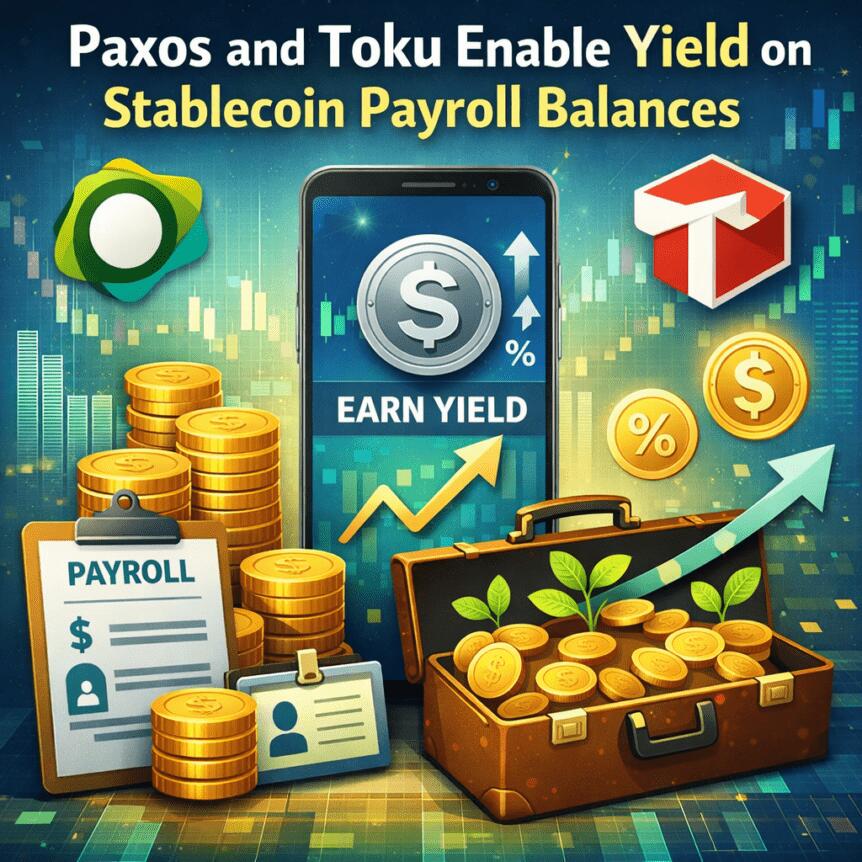
Paxos Labs has integrated its Amplify platform with Toku to enable employees to earn yield on their stablecoin salaries at the moment of payment. The feature applies to balances held in Toku wallets, allowing users to opt in and earn yield on USDC, USDT and USDG without lockups or withdrawal delays. The rollout covers Toku’s payroll network, which processes more than $1 billion annually for workers in over 100 countries and already integrates with systems such as ADP, Workday, Gusto and UKG.
The update tackles a common constraint of stablecoin payrolls: funds often sit idle between pay cycles. By embedding yield directly into balances, employees can accrue earnings on their salaries without leaving their wallets or engaging with external platforms. Paxos and Toku did not disclose the yield source or the specific rates users can expect.
Toku supplies stablecoin payroll infrastructure via an API that connects to existing enterprise systems, enabling employers to offer crypto-denominated salaries without altering payroll workflows. The new capability operates on Paxos Labs’ Amplify platform, which is designed to let companies plug in services such as yield and borrowing through a single connection.
In this arrangement, Toku remains a stablecoin payroll and employer-of-record platform, while Paxos Labs functions as a financial utility stack for digital assets incubated within Paxos.
Related: MiCA-licensed Banking Circle joins bank stablecoin settlement race in Europe
Key takeaways
- Embedded yield in payroll—Paxos Amplify and Toku enable yield on USDC, USDT, and USDG balances directly in employee wallets, with no lockups or off-platform transfers.
- Global payroll reach—Toku’s network processes over $1 billion annually for workers in more than 100 countries and connects with major HR platforms such as ADP, Workday, Gusto and UKG.
- Opacity on mechanics—Neither the yield generation method nor the rate is disclosed, leaving readers cautious about risk and variability.
- Broader payroll adoption trend—The move reflects rising interest in stablecoin payroll, echoed by other players integrating crypto salary rails into existing infrastructure.
- Market context—Industry data show growing stablecoin use for income and payments, with ongoing regulatory interest shaping how these solutions scale.
Embedded yield and the rise of stablecoin payroll
Stablecoins have increasingly become a core part of payroll and everyday payments for a segment of the workforce. A recent BVNK-commissioned YouGov survey, conducted across 15 countries, found that 39% of crypto users and prospective users report receiving income in stablecoins, while 27% use them for payments. Respondents on average held about $200 in stablecoins, with higher-income cohorts holding closer to $1,000. Those paid in stablecoins reported that stablecoin income accounts for roughly 35% of their annual earnings, and cited around 40% savings on cross-border transfers compared with traditional remittance channels.
The broader momentum toward crypto-enabled payroll is illustrated by Deel’s February announcement of stablecoin salary payouts in Europe and the UK, with plans to expand to the United States. Deel, which processes roughly $22 billion in annual payroll, is partnering with MoonPay to provide crypto settlement rails that allow employees to receive part or all of their wages in stablecoins directly to non-custodial wallets, while MoonPay handles conversion and on-chain settlement. The move signals how employers are trying to blend traditional payroll workflows with crypto-native settlement options without sacrificing compliance or payroll integrity.
Industry data also point to a growing market for stablecoins. DeFiLlama’s data show the total stablecoin market cap rising to roughly $320 billion, up from about $259 billion in July 2025—the period around which the GENIUS Act was enacted—highlighting the expanding scale of on/off-ramp and on-chain settlement activity that underpins payroll use cases. This backdrop helps explain why more payroll providers and employers are experimenting with on-chain salary rails and embedded yield features as a way to improve cash flow, reduce currency conversion costs, and shorten settlement timelines for workers worldwide.
As this segment evolves, observers note that the regulatory environment will play a crucial role in shaping adoption. The European Union’s MiCA framework, for instance, has begun to influence how banks and payment service providers engage with stablecoins and related settlement capabilities, a topic that has been covered in related industry coverage. The ongoing regulatory dialogue will influence whether features like on-wallet yield become standard components of crypto payroll offerings or remain niche innovations.
For employers and workers alike, the promise of on-demand yield within payroll balances presents a compelling value proposition: earnings that begin compounding immediately, without the friction of moving assets between wallets or custodial platforms. Yet the lack of visibility into yield mechanics invites careful consideration of risk, volatility in ancillary yields, and the need for robust treasury and risk management practices as more companies pilot these solutions.
What comes next could hinge on how payroll platforms balance user experience with prudence—ensuring clarity around yield sources, safeguarding custody, and delivering transparent terms to employees. As the ecosystem matures, more enterprises may follow Toku and Paxos into integrated yield-enabled payroll, potentially redefining how workers across the globe are compensated in a digital-asset world.
Readers should watch for further disclosures from Paxos Labs and Toku about yield structures and rate ranges, as well as updates from Deel and other payroll incumbents expanding stablecoin salary options. Regulator-led clarity and interoperability across payroll systems will likely determine how quickly embedded-yield payroll becomes a mainstream feature rather than a bespoke offering.
This article was originally published as Paxos and Toku Enable Yield on Stablecoin Payroll Balances on Crypto Breaking News – your trusted source for crypto news, Bitcoin news, and blockchain updates.


You May Also Like

The Block New CEO: Steve Chung Appointed

Trump unhappy with latest peace proposal, says Iran ‘figuring out its leadership’




