

Must Read
News groups across Southeast Asia engage in meetings to collaboratively face the crisis that journalism finds itself in todayNews groups across Southeast Asia engage in meetings to collaboratively face the crisis that journalism finds itself in today
Tech regulation, newsroom collaboration keys to journalism’s ‘existential crisis’
For feedback or concerns regarding this content, please contact us at crypto.news@mexc.com
MANILA, Philippines – Journalism is at a critical juncture, with newsrooms facing mounting economic instability as artificial intelligence continues to reshape how audiences access information.
On World Press Freedom Day, Southeast Asian newsrooms took a step forward towards an ecosystem of collaboration to face this challenge head-on.
The Philippines’ Daily Guardian, Mabuhay, Mindanews, Mountain Beacon, Palawan News, Rappler, Sunstar Cebu, PressOne, and Davao Today; Cambodia’s Kiripost, Malaysia’s Malaysiakini; Myanmar’s Mizzima Media; and Indonesia’s Tempo signed a manifesto that brings attention to how tech monopolies, shifting algorithms, social media deprioritizing news content, and the continued flow of AI-fueled disinformation fuel this crisis.
“Let’s build an internet where humans thrive,” signatory newsgroups stressed, while calling for the need for a “digital space where facts and high-quality information are amplified, not buried” and for “solutions that will enable independent public interest media to thrive and remain resilient in the face of monopolistic competition from Big Tech and authoritarian attacks.”
Along with the manifesto, the groups collaborated on a new podcast “Good As News” to further the calls for a more equitable news ecosystem. In the debut episode, Rappler, Malaysiakini, and Tempo were the main participants, coming together to discuss what they described as journalism’s “existential crisis” in the age of AI.
Host Pia Ranada said that while news remains visible to audiences, the situation behind the scenes is more fragile.
“You might be surprised to hear about this crisis…you still see news in your feeds…but news organizations are really struggling,” she said. In 2025, “the World Press Freedom Index, for the first time in its existence, has categorized the global state of press freedom as ‘difficult,’” she added.
Across the globe, newsrooms are under pressure as traditional online traffic sources continue to decline. Social media platforms like Facebook have been prioritizing entertainment content more, while search engines such as Google now offer AI-generated summaries that often remove the need for users to click through to original reporting.
The result is fewer clicks and fewer views, which then affects advertising, which has long been a major revenue source for newsrooms.
 GOOD AS NEWS. Rappler’s Pia Ranada, Glenda Gloria (top row) and Tempo’s Wahyu Dhyatmika, and Malaysiakini’s Seen Hau Tham (bottom row) discuss the difficulties facing newsrooms in the age of AI
“AI is stealing our audiences, it’s really blocking our direct communication with them,” said Rappler executive editor Glenda Gloria.
She explained that this shift is also changing how people consume information.
“The readers now are made to believe that what they’re seeing… is the correct information and they don’t feel the need to go to the website which gathered the first information in the first place,” she said. “So that kills the audience relationship of news sites with its communities…it kills our business.”
Gaps in policy and protection
Gloria said the issue is not just technological but also about governance.
Trying to negotiate with tech companies individually, she said, is “a game of whack-a-mole,” and doesn’t really lead to broader solutions.
Instead, she emphasized the need for stronger policies to regulate AI companies, particularly those that scrape content from news organizations without compensation. She described the situation as a “very dark period,” largely because of the lack of oversight and transparency in how these systems are developed and used.
Rappler CEO Maria Ressa has been pushing for global governance efforts with the United Nations, which Gloria pointed to as part of a wider effort to address these issues.
For Tempo CEO Wahyu Dhyatmika, the lack of legal protection is also a concern.
“There’s no legal requirement or not enough legal protection for publishers [in Indonesia]…[stories are] being scraped, being utilized by AI platforms,” he said.
He also raised concerns about how AI systems tend to prioritize certain languages.
“The large language model [is] focusing on high resource languages mostly English. So for our own languages, there is very little interest to really include our languages into the model,” Dhyatmika said.
At the same time, the editors pointed out that AI still depends heavily on journalism.
Seen Hau Tham, head of operations at Malaysiakini, described journalism as an essential service.
“Journalism is an essential service…much like how clean water is needed, how clean air is important, how electricity is important…accurate information dissemination is also important for us to form and inform society,” she said.
She added that AI companies will eventually have to recognize this.
“Ultimately, AI companies need to engage with newsrooms and pay for the content because their machines are getting smarter because of the good quality of work that we produce,” she said.
“If we all die out and no one is there to produce good quality journalism, what would happen to AI bots?”
 News groups across Southeast Asia engage in meetings to collaboratively face the crisis that journalism finds itself in today
Events, newsletters, other ways to build bridges for the audience
While policy solutions may take time, newsrooms are already making adjustments.
Hau Tham described how Malaysiakini went through a “very, very painful” restructuring after traffic declined, driven by changing user behavior, reduced social media referrals, and the rise of AI tools.
“It was also a wake-up call,” she said.
Following that, journalists began experimenting more with formats like video. Some who were previously “quite camera shy” started stepping forward, which reflected how much the situation had shifted.
Dhyatmika noted, however, that adapting content is not always straightforward.
“How do you then transfer this knowledge without creating more noise, without creating misperception?” he said.
There has also been a rethink in how much newsrooms rely on platforms.
“We let other companies to take care of our distribution, and then we lose the very important relationship that we should have between us as the newsroom and our audience,” he said.
Because of this, newsrooms are trying to rebuild more direct connections through newsletters, apps, and even in-person events.
Gloria described Rappler’s approach as a “sugar-free low-carb diet,” referring to efforts to reduce dependence on platforms, and to counter their monopoly.
She said the Rappler app is meant to be a “safe space… where algorithms do not rule the game.”
Many of these efforts are centered on reconnecting with audiences.
“We cannot live without our audience. We have been taking them for granted,” Dhyatmika said.
Collaboration is also becoming more important.
Gloria said news organizations need to “have each other’s back,” especially since “no single newsroom can do it alone.”
Even as platforms like TikTok and Facebook remain important for reach, there is a growing push to rely less on them over time. In the end, journalism’s future will likely depend both on policy changes and how well newsrooms adjust — especially when it comes to maintaining trust and staying connected with their audiences. – Rappler.com


Disclaimer: The articles reposted on this site are sourced from public platforms and are provided for informational purposes only. They do not necessarily reflect the views of MEXC. All rights remain with the original authors. If you believe any content infringes on third-party rights, please contact crypto.news@mexc.com for removal. MEXC makes no guarantees regarding the accuracy, completeness, or timeliness of the content and is not responsible for any actions taken based on the information provided. The content does not constitute financial, legal, or other professional advice, nor should it be considered a recommendation or endorsement by MEXC.
You May Also Like
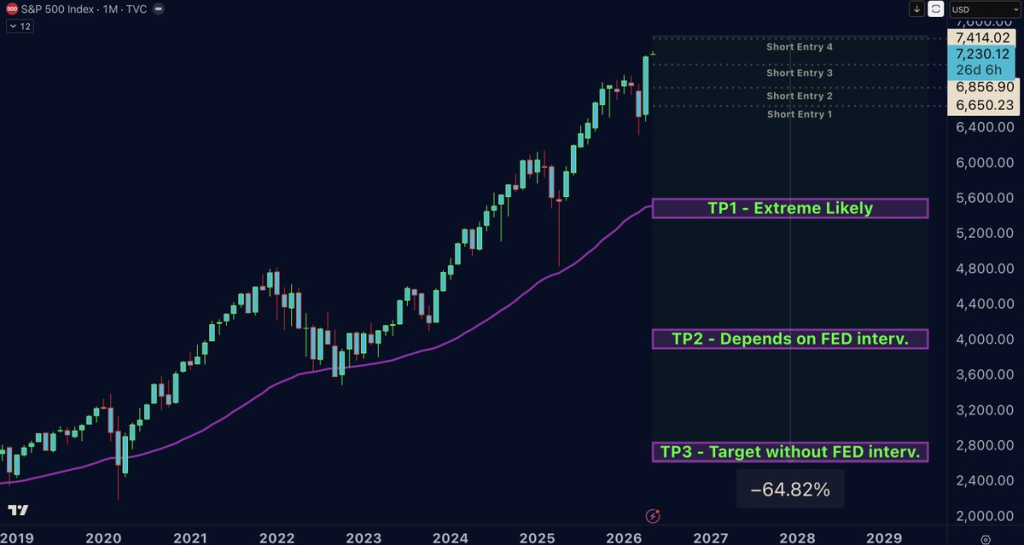
Why the Stock Market Is Going to Crash – Doctor Profit’s Warning
Doctor Profit, a well‑known crypto and macro analyst, released a detailed “Big Sunday Report” explaining why he believes the stock market is headed for a major
Share
Captainaltcoin2026/05/04 13:56

GOP lawmakers want nothing to do with Trump's ballroom chaos: report
Donald Trump’s obsession with getting his $400 million ballroom built is not shared by Congressional Republicans, who are reportedly keeping an arm's distance from
Share
Rawstory2026/04/02 18:37
XRP Price Prediction: Is a $2 Rally Still Possible This Month or Is AlphaPepe the Better Bet?
XRP is back in the headlines as traders ask whether a move to $2 is still realistic this month. The token has been consolidating around $1.85, institutional inflows
Share
Captainaltcoin2026/05/04 13:07



