TLDR Brent crude fell 6.2% to $103.04 and WTI dropped 6.6% to $95.55 on reports of a U.S.-Iran deal The U.S. and Iran are close to a one-page memorandum of understandingTLDR Brent crude fell 6.2% to $103.04 and WTI dropped 6.6% to $95.55 on reports of a U.S.-Iran deal The U.S. and Iran are close to a one-page memorandum of understanding

Oil Prices Fall 6% as U.S. and Iran Near Deal to End War and Reopen Strait of Hormuz

2026/05/06 17:29
3 min read
For feedback or concerns regarding this content, please contact us at crypto.news@mexc.com

TLDR

  • Brent crude fell 6.2% to $103.04 and WTI dropped 6.6% to $95.55 on reports of a U.S.-Iran deal
  • The U.S. and Iran are close to a one-page memorandum of understanding to end the conflict
  • Iran would pause nuclear enrichment; the U.S. would lift sanctions and release frozen funds
  • Trump paused “Project Freedom,” the U.S. operation to escort ships through the Strait of Hormuz
  • U.S. crude inventories fell 8.1 million barrels last week, the biggest draw since mid-February

Oil prices fell sharply on Wednesday after reports that the U.S. and Iran are close to a deal that could end the war and reopen oil flows through the Strait of Hormuz.

Brent crude dropped 6.2% to $103.04 per barrel. West Texas Intermediate fell 6.6% to $95.55. Both contracts had already fallen nearly 4% the day before.
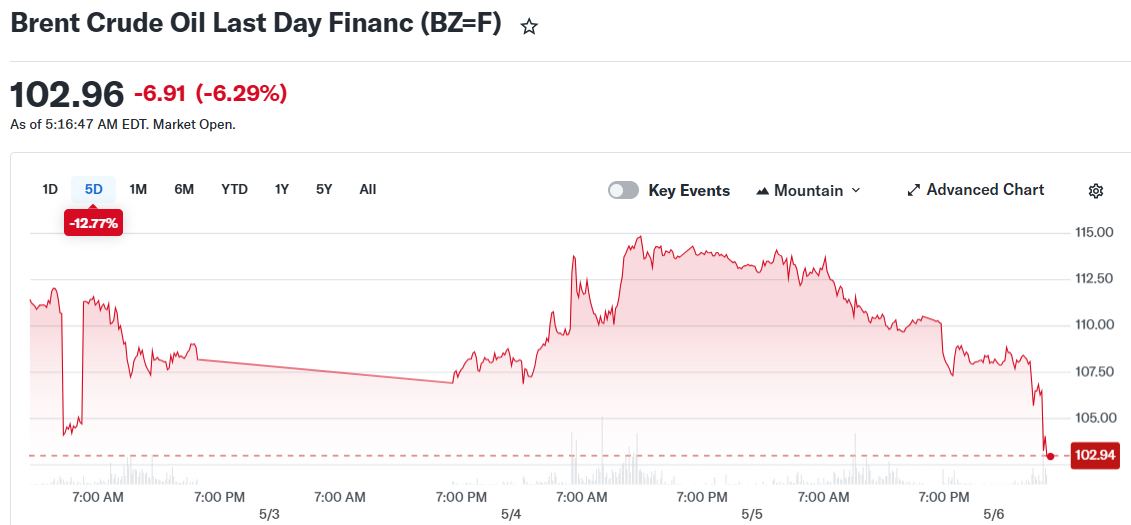
Brent Crude Oil Last Day Financ (BZ=F)Brent Crude Oil Last Day Financ (BZ=F)

The sell-off followed an Axios report saying the White House is nearing a one-page memorandum of understanding with Iran. The deal would set the stage for wider nuclear talks.

U.S. officials said they expect responses from Tehran on key issues within 48 hours. No final agreement has been signed, but officials described this as the closest both sides have come to a deal since fighting began.

The proposed framework includes Iran agreeing to pause nuclear enrichment. In return, the U.S. would lift sanctions and release billions of dollars in frozen Iranian funds.

Both sides would also ease restrictions on shipping through the Strait of Hormuz. The strait is a critical passage for global oil exports.

Oil prices have risen around 50% since the conflict started in late February. The war cut off hundreds of millions of barrels of Persian Gulf oil from world markets.

More than 1,550 commercial vessels carrying around 22,000 sailors are currently trapped in the Persian Gulf, according to General Dan Caine, chairman of the Joint Chiefs of Staff.

Hormuz Blockade Paused, But Supply Recovery Will Take Time

President Trump said the U.S. would pause “Project Freedom,” its operation to escort commercial ships through the strait, while deal talks continue.

Secretary of State Marco Rubio told reporters that “Operation Epic Fury is concluded,” 66 days after the U.S. and Israel began military action against Iran.

ING analysts warned that roughly 13 million barrels per day of disrupted supply is being offset by falling inventories. “Tighter stocks will only leave the oil market trading in an ever more volatile manner,” they said.

U.S. Crude Stocks See Large Drop

Despite the price drop, U.S. supply data offered some support to the market. The American Petroleum Institute reported crude inventories fell 8.1 million barrels last week. Gasoline stocks dropped 6.1 million barrels and distillate stocks fell 4.6 million barrels.

Official inventory data from the Energy Information Administration was due later Wednesday.

Saudi Arabia cut the price of its main oil grade for Asian buyers in June, though prices remain elevated due to ongoing Middle East supply disruptions.

The post Oil Prices Fall 6% as U.S. and Iran Near Deal to End War and Reopen Strait of Hormuz appeared first on CoinCentral.


Market Opportunity
United Stables Logo
United Stables Price(U)
$1,0002
$1,0002$1,0002
+%0,03
USD
United Stables (U) Live Price Chart
Disclaimer: The articles reposted on this site are sourced from public platforms and are provided for informational purposes only. They do not necessarily reflect the views of MEXC. All rights remain with the original authors. If you believe any content infringes on third-party rights, please contact crypto.news@mexc.com for removal. MEXC makes no guarantees regarding the accuracy, completeness, or timeliness of the content and is not responsible for any actions taken based on the information provided. The content does not constitute financial, legal, or other professional advice, nor should it be considered a recommendation or endorsement by MEXC.
Tags:

You May Also Like

Dovish patience with geopolitical risks – TD Securities

Dovish patience with geopolitical risks – TD Securities

The post Dovish patience with geopolitical risks – TD Securities appeared on BitcoinEthereumNews.com. TD Securities analysts characterize the Bank of Canada’s (
Share
BitcoinEthereumNews2026/04/02 21:22
Cashing In On University Patents Means Giving Up On Our Innovation Future

Cashing In On University Patents Means Giving Up On Our Innovation Future

The post Cashing In On University Patents Means Giving Up On Our Innovation Future appeared on BitcoinEthereumNews.com. “It’s a raid on American innovation that would deliver pennies to the Treasury while kneecapping the very engine of our economic and medical progress,” writes Pipes. Getty Images Washington is addicted to taxing success. Now, Commerce Secretary Howard Lutnick is floating a plan to skim half the patent earnings from inventions developed at universities with federal funding. It’s being sold as a way to shore up programs like Social Security. In reality, it’s a raid on American innovation that would deliver pennies to the Treasury while kneecapping the very engine of our economic and medical progress. Yes, taxpayer dollars support early-stage research. But the real payoff comes later—in the jobs created, cures discovered, and industries launched when universities and private industry turn those discoveries into real products. By comparison, the sums at stake in patent licensing are trivial. Universities collectively earn only about $3.6 billion annually in patent income—less than the federal government spends on Social Security in a single day. Even confiscating half would barely register against a $6 trillion federal budget. And yet the damage from such a policy would be anything but trivial. The true return on taxpayer investment isn’t in licensing checks sent to Washington, but in the downstream economic activity that federally supported research unleashes. Thanks to the bipartisan Bayh-Dole Act of 1980, universities and private industry have powerful incentives to translate early-stage discoveries into real-world products. Before Bayh-Dole, the government hoarded patents from federally funded research, and fewer than 5% were ever licensed. Once universities could own and license their own inventions, innovation exploded. The result has been one of the best returns on investment in government history. Since 1996, university research has added nearly $2 trillion to U.S. industrial output, supported 6.5 million jobs, and launched more than 19,000 startups. Those companies pay…

Share
BitcoinEthereumNews2025/09/18 03:26
Unpacking The ‘Extreme Fear’ Gripping Digital Asset Markets

Unpacking The ‘Extreme Fear’ Gripping Digital Asset Markets

The post Unpacking The ‘Extreme Fear’ Gripping Digital Asset Markets appeared on BitcoinEthereumNews.com. Crypto Fear & Greed Index Plummets To 9: Unpacking The
Share
BitcoinEthereumNews2026/04/03 09:13

Starter Gold Rush: Win $2,500!

Starter Gold Rush: Win $2,500!Starter Gold Rush: Win $2,500!

Start your first trade & capture every Alpha move

