

Ethereum (ETH) Price Prediction: Where Could It Be in 5 Years?
TLDR
- ETH trades near $2,324 today with a market cap of roughly $280 billion
- The base case 5-year price target is $6,500, valuing Ethereum at around $785 billion
- The bull case reaches $12,000 if institutional demand and tokenization grow strongly
- The bear case sits at $1,800 if Layer-2 growth weakens ETH’s value capture
- Key growth drivers include staking, ETF demand, real-world asset tokenization, and network upgrades
Ethereum (ETH) currently trades around $2,324. With roughly 120.7 million ETH in circulation, that puts the network’s market cap near $280 billion.
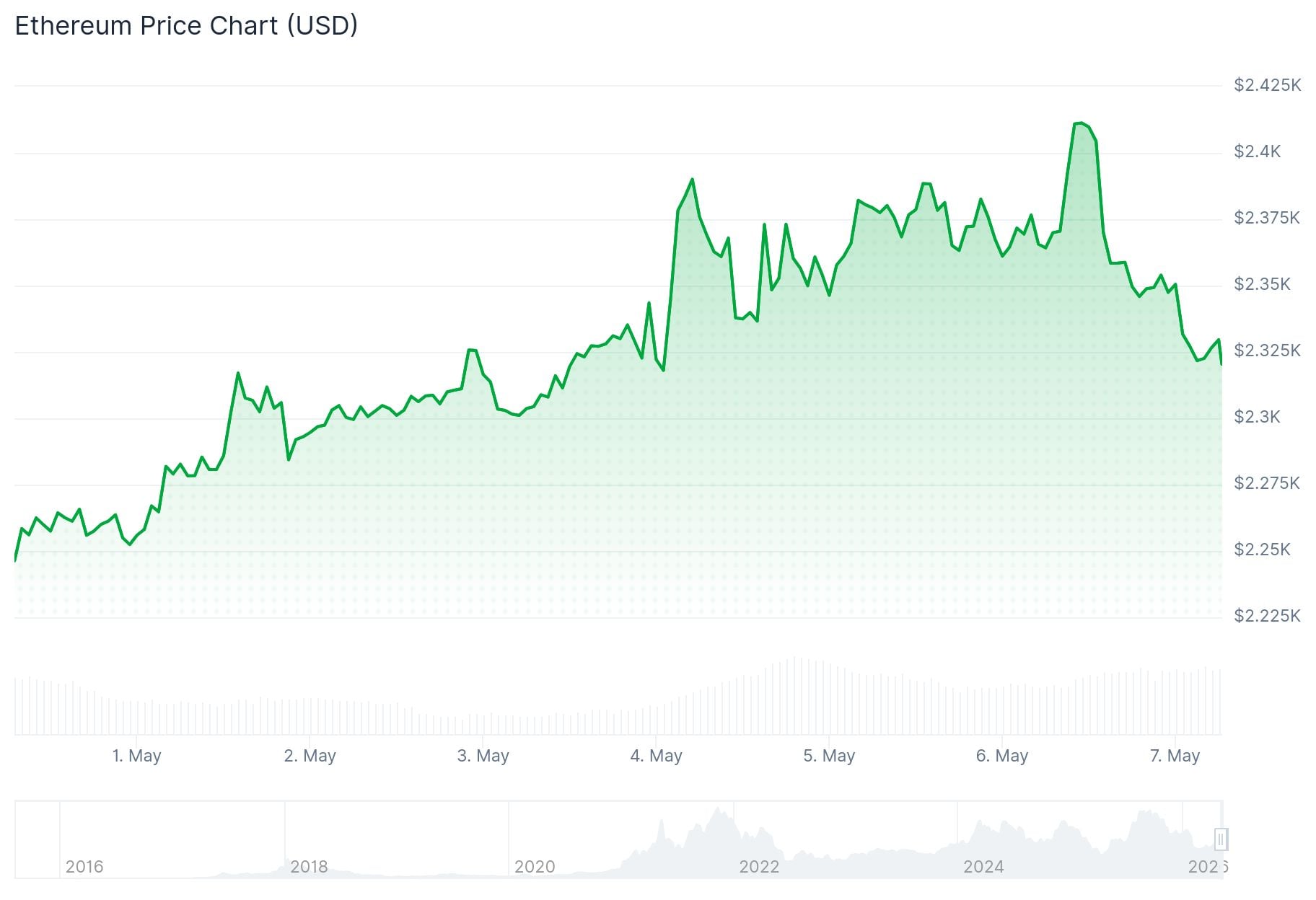 Ethereum (ETH) Price
Ethereum remains the leading platform for DeFi, stablecoins, NFTs, and Layer-2 networks. But how the next five years play out depends on one central question: can ETH continue to capture value as the base layer for crypto finance?
Unlike Bitcoin, ETH has no fixed maximum supply. However, the EIP-1559 burn mechanism can reduce supply when on-chain activity is high, which acts as a deflationary pressure on the token.
A realistic 5-year base case puts ETH at $6,500, based on continued growth in ETF adoption, staking, Layer-2 usage, stablecoin activity, and real-world asset tokenization. That would value Ethereum at around $785 billion.
What Could Drive ETH Higher
The bull case targets $12,000, implying a market cap of around $1.45 trillion.
That scenario requires Ethereum to become the primary settlement layer for tokenized financial assets. BlackRock has already launched an iShares Staked Ethereum Trust ETF, signaling that major asset managers are building Ethereum-linked investment products.
In March 2026, the SEC said it was clarifying how federal securities laws apply to protocol staking and non-security crypto assets. Greater regulatory clarity could open the door to wider institutional participation.
In the bull case, ETF inflows grow quickly, staking locks up more supply, and tokenized assets move onto Ethereum at scale.
What Could Hold ETH Back
The bear case sits at $1,800, putting the market cap near $217 billion.
In this scenario, Layer-2 networks draw activity away from Ethereum mainnet, weakening fee revenue. Solana and other fast Layer-1 chains take market share. ETF demand softens, and crypto enters a prolonged sideways cycle.
The main structural risk is that while Layer-2 networks benefit from Ethereum’s security, most of the economic activity — and fees — stay on those secondary networks rather than flowing back to ETH.
Recent network upgrades including Pectra and Fusaka have targeted account abstraction, blob throughput, validator improvements, and Layer-2 data availability. These upgrades aim to keep Ethereum competitive as a settlement layer.
The most recent data point remains ETH trading near $2,324, with institutional interest building through ETF products and the SEC actively working on clearer rules for crypto assets including staking.
The post Ethereum (ETH) Price Prediction: Where Could It Be in 5 Years? appeared first on CoinCentral.


You May Also Like

Not a loophole: Singapore AI export controls let China tap US AI legally

Exclusive interview with Smokey The Bera, co-founder of Berachain: How the innovative PoL public chain solves the liquidity problem and may be launched in a few months

NYSE-Listed Bitgo Rolls out Stablecoin Minting Platform for Institutional Clients – Bitcoin News



