

This Trader Makes a Shocking Silver Price Prediction
A trader named Dr. Potassium posted a shocking silver price prediction on May 17. He shared a 65-year chart of silver going back to 1968. His claim: the silver price will reach between $1,481 and $2,361 per ounce by 2032-2036. That is a 20- to 30-fold increase from current prices around $76.
He says the measured move of the breakout above the 1980-2011 resistance line in 2025 puts silver in that range. “We’re just getting warmed up,” he wrote. “Buy silver, do nothing.” Let’s analyze his chart and then give our honest opinion.
Dr. Potassium’s Chart and Measured Move Logic
The chart (provided) is a 3-month logarithmic scale of silver prices from 1968 to 2040. It shows a multi-decade resistance line connecting the 1980 peak near $50 and the 2011 peak near $49. That resistance line held for over 30 years. In 2025, silver broke above that line. Dr. Potassium draws a measured move from that breakout.
Here is how measured move works. You measure the vertical distance from the breakout point down to the previous support level. Then you add that distance upward from the breakout to get a price target. On the chart, the breakout occurred near $30-$35 in 2025. The previous support was the long-term uptrend line from 1971-2002 around $4-$5. The vertical distance is roughly $25-$30. Adding that to the breakout gives a target near $55-$65, which silver already reached.
But Dr. Potassium appears to use a much larger measured move: from the 1980-2011 resistance line down to the 1971-2002 support line, then projecting upward.
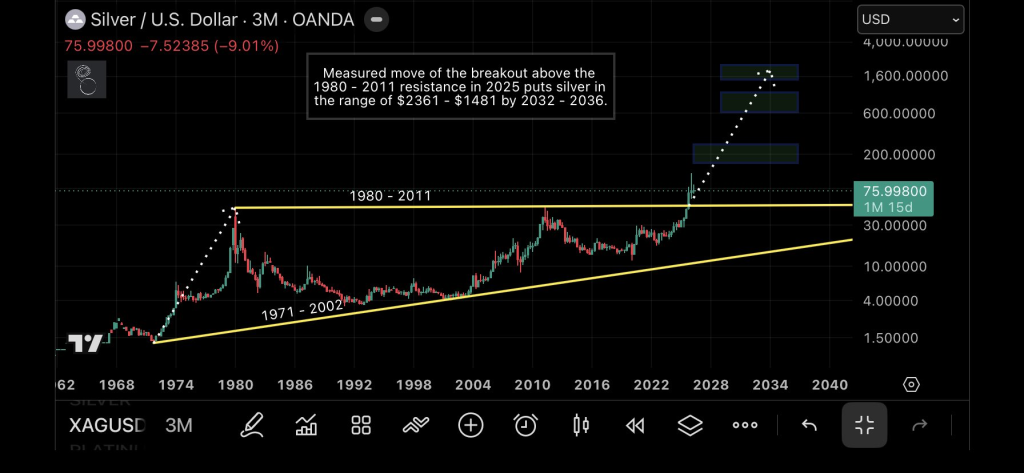 Source: X/@potassium_phd
The chart shows the measured move targeting the range of $1,481 to $2,361 by 2032-2036. The upper line of the target zone is around $2,361, the lower around $1,481. He labels this as “measured move of the breakout above the 1980-2011 resistance in 2025.” The chart also shows a smaller measured move from 2025 breakout to around $236, but his long-term target is much higher.
The logic is extreme but not unheard of in technical analysis. Breakouts from multi-decade bases can produce enormous percentage moves. Gold did something similar after breaking above $1,000 in 2009, eventually reaching $2,000+. Silver’s 1970s breakout from $2 to $50 was a 25x move. So a 20x move from $76 to $1,500 is not mathematically impossible over a 10-year span. But the conditions must be perfect.
What Would Need to Happen for $2,000 Silver
For silver to reach $2,000+ per ounce within 6-10 years, you would need an extreme combination of monetary, industrial, and market-dislocation conditions far beyond a normal bull cycle. It would likely require a global monetary reset, severe currency debasement, or a major physical supply crisis rather than just strong jewelry or solar demand.
Major collapse in fiat purchasing power. Silver at $2,000 implies not just higher nominal prices, but a world where the dollar has lost a huge amount of real value. Even bullish 2026 forecasts cluster around $80-$150, with some outliers higher if shortages intensify. Nothing near $2,000 as a base case.
Severe and persistent physical shortage. The market would need repeated and widening deficits, with above-ground inventories drawn down to the point of panic buying and delivery stress. The Silver Institute expects a sixth straight deficit year in 2026, but the projected deficit is measured in tens of millions of ounces, not the kind of collapse that would justify a 20x-25x move from already elevated levels.
Gold itself would need to explode higher. If silver remained within a plausible gold/silver ratio framework, $2,000 silver would imply gold at absurd levels too (ratio of 50 gives gold at $100,000; ratio of 30 gives gold at $60,000). That means the scenario is not really “silver outperforms a bit,” but rather “the entire monetary system is repriced.”
Loss of confidence in sovereign debt and central banks. To get that kind of move, investors would need to treat silver as emergency money, not an industrial metal. That usually requires a crisis involving persistent inflation, capital controls, banking stress, or currency breakdown.
Related Silver news: Silver Price on Alert as China’s Silver Imports Hit Record
Our Opinion: Shocking Silver Price Prediction, But Not Impossible
Dr. Potassium’s silver price prediction is shocking. $2,000 silver is hard to imagine when the metal trades at $76. That said, technical analysis of multi-decade breakouts has a strong track record. Silver broke a 30-year resistance line in 2025. The measured move from the 1970s low is real math, not random hope.
But the gap from current prices to $1,500 is enormous. At current prices, silver is already discussed in terms of $80-$150 outcomes in bullish cases, with some outliers higher if shortages intensify. The gap from there to $2,000 is so large that it would need a regime shift, not a conventional bull market.
The biggest structural constraint is that silver is also an industrial metal. Very high prices trigger substitution, thrifting, recycling, and demand destruction. In other words, the higher silver goes, the more the market fights back against further gains. Copper is a good example: high prices bring new supply and substitution.
Our take: Dr. Potassium’s time horizon is 6-10 years. A lot can happen. If the dollar loses reserve status, or if central banks abandon fiat currencies, $2,000 silver becomes possible. But those are low-probability, high-impact events. For most investors, a more realistic target is $100-$150 by 2030. Buying silver and doing nothing is a fine strategy for long-term wealth preservation. Expecting a 20x return in a decade is optimistic. Use his prediction as a conversation starter, not a financial plan.
FAQs

Most major banks recently lowered their 2026–2027 silver forecasts on rising yields, a stronger dollar, and shrinking supply deficits, though the long-term structural story remains intact.
If you need short‑term capital, trimming on strength toward the $85+ resistance zone makes sense given the current weakness, but longer‑term holders with a low cost basis should ignore the noise and wait for the next bullish catalyst.
Yes, but only with a global monetary reset, severe currency debasement, or a major physical supply crisis. It is not a base case.
Subscribe to our YouTube channel for daily crypto updates, market insights, and expert analysis.
The post This Trader Makes a Shocking Silver Price Prediction appeared first on CaptainAltcoin.


You May Also Like

Cathie Wood’s ARK Invest Buys $13.7M in Circle Shares While Selling Robinhood Stock

The changing face of elder care in Malaysia — Sayed Mohammad Reza Yamani Sayed Umar

Not a loophole: Singapore AI export controls let China tap US AI legally



