Why AI Literacy Initiatives Are Expanding Beyond Employees to Their Families
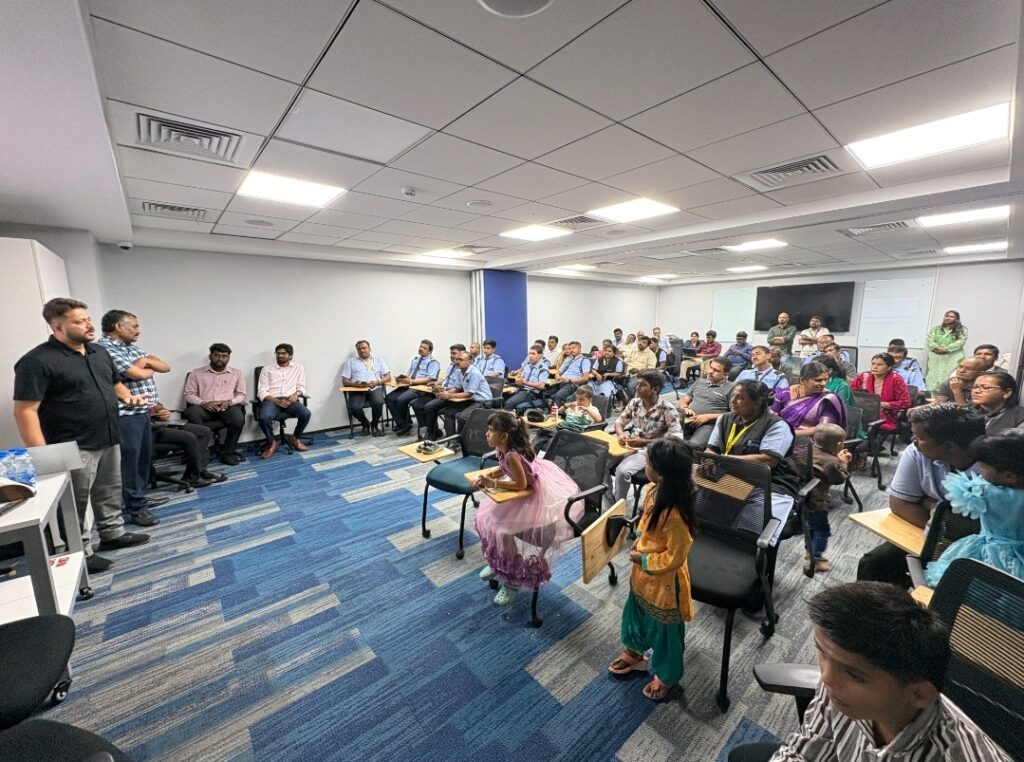
Flatworld Solutions launched an AI literacy initiatives for the families of security and housekeeping staff.
In most companies, AI conversations begin in conference rooms.
Executives discuss productivity gains. Engineers debate models and automation layers. Consultants map transformation roadmaps. HR teams worry about reskilling knowledge workers before disruption accelerates.
But a quieter question is beginning to emerge beneath those conversations:
Who gets prepared for the AI era — and who gets left behind?
That question sits at the center of an initiative recently launched by in . The company introduced “AiME – AI for My Excellence,” an AI literacy initiative aimed not at executives or software engineers, but at the families of its security and housekeeping staff.
On the surface, the programme looks like a modest internal education effort. But underneath it lies a larger signal about how enterprises may begin redefining responsibility in the age of artificial intelligence.
Because AI transformation is no longer just a technology story.
It is becoming a social preparedness story.
The Real Meaning Behind an AI Literacy Initiative
For years, digital transformation inside enterprises followed a familiar hierarchy. Training investments typically concentrated on managerial staff, technical teams, and customer-facing professionals. The assumption was straightforward: those closest to technology needed the most preparation.
But AI is disrupting that logic.
Unlike earlier enterprise software waves, AI systems influence not only workflows but also economic expectations, educational aspirations, and perceptions of future opportunity. Children encounter generative AI tools before entering universities. Parents hear contradictory narratives ranging from “AI will replace jobs” to “AI will create entirely new industries.” Workers outside formal knowledge economies increasingly face uncertainty without structured access to understanding.
That creates a new form of inequality: not merely access to technology, but access to comprehension.
The significance of this AI literacy initiative may therefore lie less in technical training and more in psychological inclusion.
This is where Flatworld Solutions’ approach becomes noteworthy. The inaugural session reportedly brought employees and their children together in a shared learning environment focused on curiosity rather than technical specialization. That detail matters more than it initially appears.
Most corporate education programmes isolate professional learning from family ecosystems. Yet behavioral research consistently shows that educational confidence compounds socially. When parents and children learn simultaneously, technology becomes less intimidating and more culturally normalized.
In practical terms, that may influence far more than immediate AI understanding.
It can affect:
- educational confidence
- digital participation
- career imagination
- long-term adaptability
The broader implication is subtle but important: AI literacy may become an early form of resilience infrastructure.
Why AI Literacy Initiatives Matter in India’s Workforce Transition
That is especially relevant in India, where technological transformation often advances faster than institutional adaptation. The country simultaneously hosts some of the world’s largest AI talent ecosystems and some of its deepest digital access disparities. Elite technology exposure and limited technological familiarity frequently coexist within the same urban geography.
represents that contradiction particularly well.
The city is celebrated globally as a technology hub, yet many support workers sustaining its corporate infrastructure remain structurally distant from the innovation economy operating around them. Security staff, housekeeping workers, cafeteria personnel, and contract laborers often enable digital enterprises without directly participating in their educational advantages.
That gap matters more in the AI era because AI is fundamentally different from earlier workplace technologies.
Cloud computing transformed infrastructure. Mobile transformed access. AI transforms perceived capability.
People who understand AI — even at a foundational level — may gain disproportionate confidence navigating future systems, employment environments, and educational opportunities. Those excluded from early familiarity risk experiencing AI primarily as fear, opacity, or displacement.
This is why AI literacy initiatives deserve closer attention.
Many enterprises currently discuss AI readiness in operational terms:
- workforce efficiency
- automation integration
- productivity scaling
- governance frameworks
But another layer is emerging beneath those priorities: social legitimacy.
Companies deploying AI aggressively while failing to educate surrounding workforce ecosystems may eventually face cultural resistance, trust erosion, or internal anxiety. Workers do not experience technological change as abstract strategy. They experience it through perceived personal vulnerability.
An organization that introduces AI systems without building literacy may unintentionally widen psychological divides inside its own workforce.
The Modern Paradox of AI Accessibility
That creates an uncomfortable modern paradox.
The more accessible AI tools become technologically, the more unequal their societal understanding may become.
Generative AI interfaces appear simple on the surface. Anyone can type a prompt. But understanding limitations, hallucinations, ethical implications, data concerns, and real-world applicability requires contextual literacy. Without that literacy, usage often oscillates between overconfidence and fear.
This is where initiatives like AiME may signal an important transition: from AI deployment to AI socialization.
Historically, large technological shifts eventually required public literacy layers. Industrialization demanded mass education systems. Internet adoption required digital literacy campaigns. Financialization produced financial literacy ecosystems.
AI may follow the same trajectory.
The difference is speed.
Organizations are implementing AI capabilities faster than societies are building shared understanding around them. That creates a widening interpretation gap between technology creators and adjacent populations.
Several global institutions have already warned about this imbalance. The has repeatedly highlighted the growing importance of reskilling and adaptive learning as AI reshapes labor markets. Meanwhile, companies such as and have invested heavily in AI education ecosystems aimed at broader workforce enablement rather than purely technical specialization.
Yet most enterprise AI education still targets formal employees.
The notable shift here is extending that conversation to families.
That may sound symbolic, but symbols matter during technological transitions.
When children from non-technical households encounter AI in a structured, low-pressure environment, it changes future orientation. AI stops being a distant elite concept and becomes something discussable, understandable, and potentially navigable.
Equally important, parents become participants rather than observers in that transition.
How AI Literacy Initiatives Connect to Customer Experience
There is also a customer experience dimension hidden inside this discussion.
Companies increasingly recognize that employee experience and customer experience are deeply interconnected. A workforce ecosystem experiencing insecurity, confusion, or exclusion around AI adoption can indirectly affect organizational culture, morale, and service quality.
In other words: AI trust inside organizations may become as important as AI capability.
That shifts the conversation beyond philanthropy.
Initiatives like these may eventually influence:
- employer branding
- retention
- workforce cohesion
- organizational trust
- community perception
The long-term strategic question is whether an AI literacy initiative becomes a standard component of workforce welfare.
That possibility would have seemed unlikely only a few years ago. But technological transitions tend to normalize once-radical expectations. Health insurance, mental wellness support, and digital upskilling all evolved from optional benefits into mainstream organizational considerations over time.
AI familiarity could follow a similar trajectory.
Still, skepticism is necessary.
Corporate AI education programmes can easily drift into symbolic branding exercises disconnected from measurable impact. One-off workshops often generate publicity without sustained learning outcomes. Real literacy requires continuity, contextualization, and progressive engagement.
Flatworld Solutions appears aware of that risk, at least conceptually, by framing AiME as a long-term initiative rather than a standalone session. Whether such programmes ultimately create meaningful capability will depend on consistency, accessibility, and practical relevance over time.
Could AI Literacy Initiatives Become a New Enterprise Responsibility?
Another important question concerns scalability.
Can inclusive AI education models expand meaningfully across industries where outsourced labor, contract staffing, and fragmented workforce structures dominate? Or will these remain isolated examples limited to organizations with unusually strong cultural leadership?
The answer matters because AI disruption itself will not remain isolated.
Automation debates frequently focus on white-collar professions, but secondary effects ripple across entire economic ecosystems. Administrative restructuring affects support services. Digital operations reshape urban labor patterns. Educational shifts influence intergenerational mobility.
Preparing only core technical teams for AI may therefore prove strategically shortsighted.
The deeper challenge is societal adaptation.
And that is what makes this AI literacy initiative editorially relevant beyond corporate communications.
It reveals an emerging shift in how organizations may begin defining technological responsibility. Not merely building AI systems. Not merely deploying AI tools. But helping surrounding human ecosystems develop enough familiarity to participate in the transition with less fear and greater agency.
That distinction is crucial.
Because the defining divide of the AI era may not simply be between companies that use AI and companies that do not.
It may increasingly become the divide between institutions that widen technological confidence — and those that unintentionally concentrate it.
The post Why AI Literacy Initiatives Are Expanding Beyond Employees to Their Families appeared first on CX Quest.


You May Also Like

Why Businesses Need Professional Machine Design and Development Services

Siren (SIREN) Plunges 26.7% in 24 Hours: On-Chain Data Reveals Troubling Pattern