

SEC tokenized stock exemption to let equities move onto crypto rails
The SEC is expected to release an innovation exemption for tokenized stocks as soon as this week.
SEC Chair Paul Atkins and Commissioner Hester Peirce had already sketched the plan in February, describing a temporary, limited framework with volume caps, white-listed buyers and sellers, automated market makers, and temporary relief while the SEC develops longer-term rules.
Atkins confirmed in April that the agency was “on the cusp” of releasing a cabined framework for compliant on-chain trading of tokenized securities.
Bloomberg Law reported the move on May 18, which represents the clearest crypto-adjacent securities policy signal in years, with implications that run well beyond token prices.
What the exemption actually is
SEC staff defined tokenized securities in January 2026 as traditional securities represented as crypto assets, with crypto networks maintaining ownership records, in whole or in part.
The legal status of the asset follows it regardless of its form, so federal securities laws apply whether a share resides on a blockchain or in a DTC account.
The innovation exemption would allow qualifying firms to test tokenized securities trading on novel venues, including AMMs and, potentially, public permissionless blockchains, within defined parameters.
Atkins explicitly discussed embedding compliance checks directly into smart contract code, including resale restrictions and issuer-holder communications.
A tokenized security can include its own eligibility rules, transfer restrictions, and compliance logic, delivered automatically at the point of transfer.
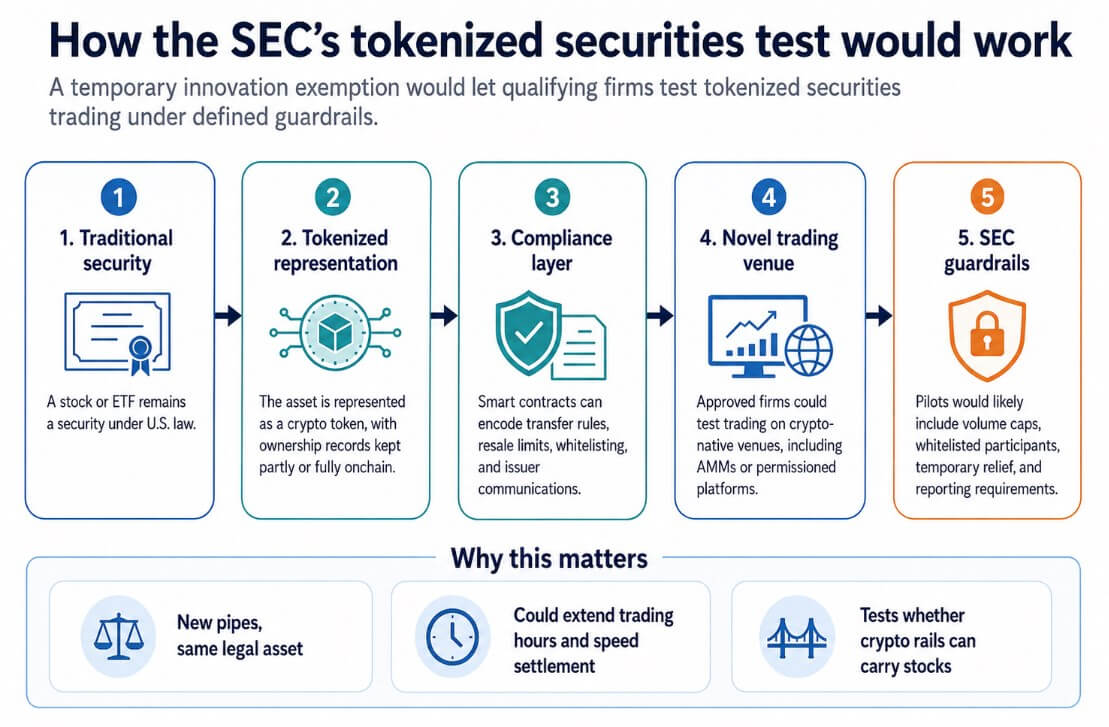 The SEC's proposed innovation exemption would route traditional securities through tokenization, smart-contract compliance, and crypto-native trading venues under volume caps and whitelisting guardrails.
US equities already moved from T+2 to T+1 settlement in 2024, and the SEC framed that move as making market plumbing more resilient by reducing time, credit exposure, and liquidity risk.
Tokenization extends this logic further with longer trading windows, near-instant settlement, fractional access, and programmable post-trade processing.
Nasdaq received SEC approval in March 2026 to allow certain DTC-eligible securities to trade in tokenized form on the same order book as traditional shares, with T+1 settlement preserved.
NYSE-parent ICE is separately developing a tokenized securities platform targeting 24/7 operations, instant settlement, dollar-sized orders, and stablecoin-based funding, pending regulatory approval.
Incumbent exchanges are building their own versions of the next pipe before crypto platforms can claim the market.
Coinbase sought SEC approval in 2025 to offer tokenized equities, a move that would reportedly put it in direct competition with retail brokerages.
Kraken's xStocks platform already offers 100 fully backed tokenized US stocks and ETFs outside the US market, and Robinhood has launched EU stock tokens while building a layer-2 blockchain for real-world asset tokenization.
The SEC exemption would determine whether those crypto-native models can compete for US investors under a regulated framework.
The window
DefiLlama data puts the on-chain RWA market at close to $30 billion, which represents just 0.02% of global equity value, against SIFMA's 2024 global equity market capitalization of $126.7 trillion.
The stock-token segment is still early, and the exemption could determine if tokenized stocks expand into a regulated extension of US equities or stay a crypto side market.
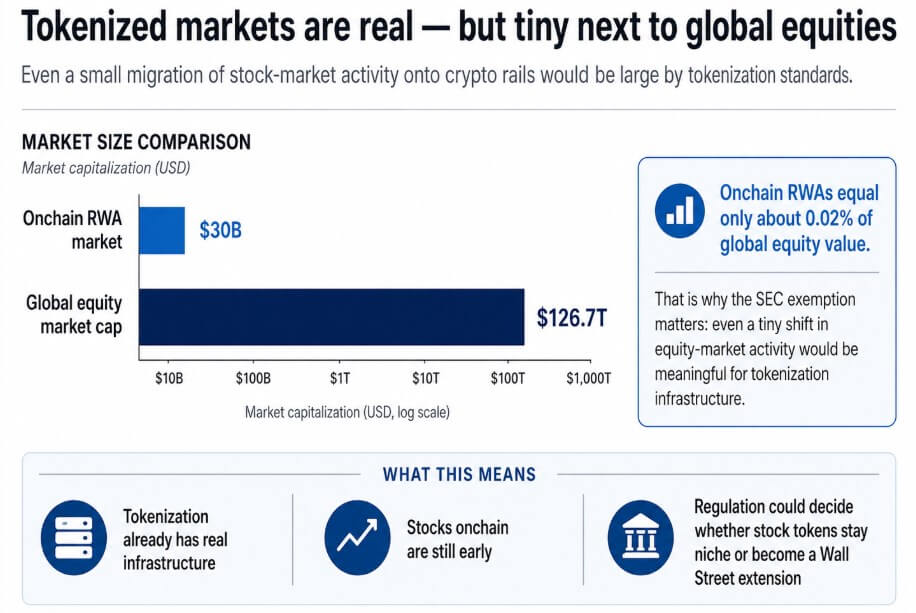 The on-chain RWA market stands at $30 billion, just 0.02% of global equity market capitalization of $126.7 trillion, underscoring how early tokenized stocks remain.
SEC staff distinguishes issuer-sponsored tokenized securities, in which the token represents a direct claim on the underlying share, from third-party products, including custodial receipts, linked securities, and synthetic derivatives.
Robinhood's EU stock tokens explicitly carry that distinction in their disclosures: they are derivatives that expose investors to counterparty and insolvency risks tied to Robinhood's financial position.
A tokenized stock can look identical in an app and carry entirely different legal rights depending on its structure.
Crypto rails enter the securities stack, or incumbents control the upgrade?
If pilots succeed and the exemption expands, issuer-sponsored tokenized shares and custodial tokenized securities will have clearer regulatory pathways, and crypto-native platforms will compete for tokenized equity flows alongside Nasdaq's DTC-compatible model and ICE's parallel digital venue.
Stablecoin settlement becomes a standard post-trade mechanism for liquid securities, and smart contract networks that carry tokenized equities become a durable infrastructure.
The winners extend beyond the firms that launch products. Stablecoin issuers gain a settlement use case inside regulated securities markets, and high-throughput programmable chains gain sustained demand from securities settlement activity.
Wallet providers and tokenization agents enter a market previously controlled by broker-dealers, and the crypto-native trading stack gains a securities-grade use case, legitimizing it across jurisdictions.
However, if the SEC allows tokenization primarily through Nasdaq's DTC-compatible model and ICE's regulated venue. The innovation exemption for crypto-native and AMM-based trading stays narrow, heavily volume-capped, or restricted to institutional participants.
Tokenization modernizes settlement mechanics, and the competitive opening for crypto-native platforms stays narrow.
Broad exemptions for tokenized trading could undermine investor protection and market stability if tokenized securities trade outside the long-standing protections of the securities markets.
Peirce warned that third-party tokenized stocks can expose holders to counterparty and insolvency risks tied to the tokenizing intermediary's own financial position.
Those risks provide regulators with a durable justification for keeping crypto-native venues at the margins while incumbents absorb the technological upgrade.
The competitive map
Three models are now competing for the next securities pipe.
Nasdaq's DTC-compatible approach keeps tokenized and traditional shares on the same order book, with incumbents controlling settlement. ICE's parallel digital venue targets 24/7 operations and stablecoin funding. The crypto-native model tests whether securities can trade on-chain through crypto infrastructure under SEC conditions.
| Model | Main players | How it works | What it means |
|---|---|---|---|
| Nasdaq / DTC-compatible model | Nasdaq, DTC, broker-dealers | Tokenized and traditional shares trade on the same order book; T+1 settlement preserved | Incumbents modernize the pipe without changing the market structure too much |
| ICE / NYSE digital venue model | ICE, NYSE, regulated intermediaries | Parallel tokenized securities platform targeting 24/7 operations, instant settlement, dollar-sized orders, and stablecoin funding | Wall Street builds its own onchain venue before crypto platforms take the lead |
| Crypto-native model | Coinbase-style platforms, Kraken-style products, AMMs, wallets, tokenization agents | Tokenized securities trade through crypto infrastructure under SEC exemption conditions | Crypto rails get a chance to compete for stock-market flow |
The SEC exemption determines which of these models can legally compete, and the scope of that determination sets the boundary of the opening.
Atkins framed the exemption as letting the market discover whether crypto infrastructure can carry stocks more efficiently than the current venue-clearing-custody sequence.
That test, run under regulatory supervision with white-listed participants and volume limits, is the policy event Bloomberg reported.
The SEC is letting crypto rails compete for the business of carrying stocks, and the exemption will measure if they can win.
The post SEC tokenized stock exemption to let equities move onto crypto rails appeared first on CryptoSlate.


You May Also Like

Not a loophole: Singapore AI export controls let China tap US AI legally

LIST: Bayanihan initiatives amid soaring oil prices

Crypto Hack: Drift Protocol Drained Over $200M in Private Key Breach



