When people claim “Bitcoin will replace the dollar,” they rarely consider how much money actually exists. Economists measure money in layers (M0–M4), most of it digital rather than cash. The dollar remains the world’s reference currency: it dominates reserves, global trade, and even crypto markets. By mid-2025, Bitcoin’s market cap is about $2.1T, while the top 10 cryptos together reach $3.3T — just ~2% of global broad money (M3 ~$140–150T). Small in share, but huge in impact: crypto introduces a new, decentralized model of money that works 24/7 without banks or central control. It doesn’t need to replace the dollar to matter. Even at 1–2%, crypto already changes the rules of the game.When people claim “Bitcoin will replace the dollar,” they rarely consider how much money actually exists. Economists measure money in layers (M0–M4), most of it digital rather than cash. The dollar remains the world’s reference currency: it dominates reserves, global trade, and even crypto markets. By mid-2025, Bitcoin’s market cap is about $2.1T, while the top 10 cryptos together reach $3.3T — just ~2% of global broad money (M3 ~$140–150T). Small in share, but huge in impact: crypto introduces a new, decentralized model of money that works 24/7 without banks or central control. It doesn’t need to replace the dollar to matter. Even at 1–2%, crypto already changes the rules of the game.

Money and Crypto: How Much Actually Exists in 2025

The answer depends on what we count as money: only paper bills or everything — from deposits to digital assets.

From Cash to Digital: What Money Really Is Today

Many still think of money as cash. But in today’s economy that is just a small fraction. Most of it is digital: in accounts, in deposits, circulating through financial platforms.

Economists split money supply into levels from M0 to M4. Each next one includes the previous and adds new forms.

M0 — cash \n M1 — plus checking accounts \n M2 — savings included \n M3 — large deposits and market instruments \n M4 — everything plus credit elements

The higher the level, the less physical it is and the more it reflects real economic circulation.

Why the World Still Counts in Dollars

To compare scales, we need a common reference point. That is the dollar. Not because other currencies don’t exist, but because the system works this way.

About 85% of global FX transactions involve the dollar. More than 58% of international reserves are also held in USD, making it the universal settlement tool for the world economy. Most global debt is denominated in dollars as well.

Oil, gas, gold, and other commodities are almost always priced in USD. Even if the settlement is in euros or yuan, the reference price is still the dollar.

Crypto works the same. Exchanges, stablecoins, and DeFi protocols all use USD as the main metric. That is why when people compare crypto to money supply, they use dollars. It is convenient, clear, and objective.

Bitcoin and Crypto on the Global Scale in 2025

Now comes the key part. What is all crypto worth, and how does it compare to global money?

By mid-2025bitcoin market cap ranges between $2.05 and $2.05–2.18 trln. The top 10 cryptocurrencies, including ether and BNB, are worth about $3.3 trln. That is roughly 90% of the entire digital asset market, with the rest split among thousands of smaller projects.

Broad money (M3) in 2025 is around $140–150 trln. Some wider estimates of total assets, including non-financial, go up to $500 trln, but those are beyond classic monetary aggregates.

The result: against M3 bitcoin is about 1.4%. The top 10 cryptos combined — about 2.2 %. That is small in absolute terms, but for a young industry it is significant growth. Yes, the numbers rise, but compared to the whole system, it is still a tiny slice.
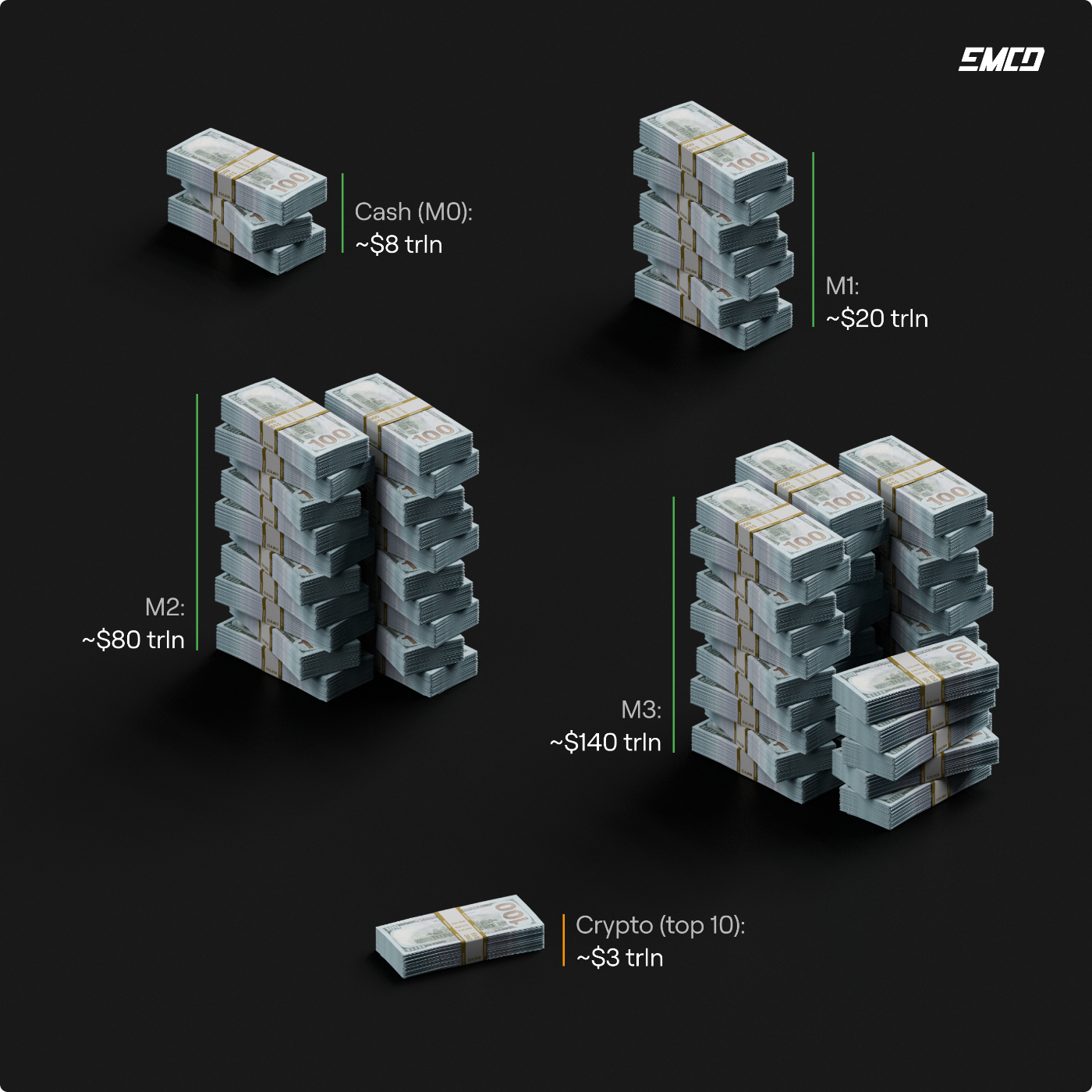
Money Supply vs Crypto

Small Share, Big Shift: The Real Power of Crypto

Cryptocurrencies do not need to take over the world instantly. Their strength is not in share of money supply, but in the model. This is an alternative money architecture — no central control, open-source code, independent logic. For the first time in history money can exist without being issued by a state.

Yes, crypto is just 1–2% today. But this is the percent you can move without a bank or centralized intermediaries, 24/7, anywhere in the world. And that bonus is not just numbers — it is a rule change.

A question I keep asking myself: are we ready for that share to grow much bigger?

I’ll keep sharing numbers, trends, and personal insights here — follow me to keep up.

Market Opportunity
ConstitutionDAO Logo
ConstitutionDAO Price(PEOPLE)
$0.009596
$0.009596$0.009596
-0.43%
USD
ConstitutionDAO (PEOPLE) Live Price Chart
Disclaimer: The articles reposted on this site are sourced from public platforms and are provided for informational purposes only. They do not necessarily reflect the views of MEXC. All rights remain with the original authors. If you believe any content infringes on third-party rights, please contact service@support.mexc.com for removal. MEXC makes no guarantees regarding the accuracy, completeness, or timeliness of the content and is not responsible for any actions taken based on the information provided. The content does not constitute financial, legal, or other professional advice, nor should it be considered a recommendation or endorsement by MEXC.

You May Also Like

Q4 2025 May Have Marked the End of the Crypto Bear Market: Bitwise

Q4 2025 May Have Marked the End of the Crypto Bear Market: Bitwise

The fourth quarter of 2025 may have quietly signaled the end of the crypto bear market, according to a new report from digital asset manager Bitwise, even as prices
Share
CryptoNews2026/01/22 15:06
CEO Sandeep Nailwal Shared Highlights About RWA on Polygon

CEO Sandeep Nailwal Shared Highlights About RWA on Polygon

The post CEO Sandeep Nailwal Shared Highlights About RWA on Polygon appeared on BitcoinEthereumNews.com. Polygon CEO Sandeep Nailwal highlighted Polygon’s lead in global bonds, Spiko US T-Bill, and Spiko Euro T-Bill. Polygon published an X post to share that its roadmap to GigaGas was still scaling. Sentiments around POL price were last seen to be bearish. Polygon CEO Sandeep Nailwal shared key pointers from the Dune and RWA.xyz report. These pertain to highlights about RWA on Polygon. Simultaneously, Polygon underlined its roadmap towards GigaGas. Sentiments around POL price were last seen fumbling under bearish emotions. Polygon CEO Sandeep Nailwal on Polygon RWA CEO Sandeep Nailwal highlighted three key points from the Dune and RWA.xyz report. The Chief Executive of Polygon maintained that Polygon PoS was hosting RWA TVL worth $1.13 billion across 269 assets plus 2,900 holders. Nailwal confirmed from the report that RWA was happening on Polygon. The Dune and https://t.co/W6WSFlHoQF report on RWA is out and it shows that RWA is happening on Polygon. Here are a few highlights: – Leading in Global Bonds: Polygon holds 62% share of tokenized global bonds (driven by Spiko’s euro MMF and Cashlink euro issues) – Spiko U.S.… — Sandeep | CEO, Polygon Foundation (※,※) (@sandeepnailwal) September 17, 2025 The X post published by Polygon CEO Sandeep Nailwal underlined that the ecosystem was leading in global bonds by holding a 62% share of tokenized global bonds. He further highlighted that Polygon was leading with Spiko US T-Bill at approximately 29% share of TVL along with Ethereum, adding that the ecosystem had more than 50% share in the number of holders. Finally, Sandeep highlighted from the report that there was a strong adoption for Spiko Euro T-Bill with 38% share of TVL. He added that 68% of returns were on Polygon across all the chains. Polygon Roadmap to GigaGas In a different update from Polygon, the community…
Share
BitcoinEthereumNews2025/09/18 01:10
BlackRock Increases U.S. Stock Exposure Amid AI Surge

BlackRock Increases U.S. Stock Exposure Amid AI Surge

The post BlackRock Increases U.S. Stock Exposure Amid AI Surge appeared on BitcoinEthereumNews.com. Key Points: BlackRock significantly increased U.S. stock exposure. AI sector driven gains boost S&P 500 to historic highs. Shift may set a precedent for other major asset managers. BlackRock, the largest asset manager, significantly increased U.S. stock and AI sector exposure, adjusting its $185 billion investment portfolios, according to a recent investment outlook report.. This strategic shift signals strong confidence in U.S. market growth, driven by AI and anticipated Federal Reserve moves, influencing significant fund flows into BlackRock’s ETFs. The reallocation increases U.S. stocks by 2% while reducing holdings in international developed markets. BlackRock’s move reflects confidence in the U.S. stock market’s trajectory, driven by robust earnings and the anticipation of Federal Reserve rate cuts. As a result, billions of dollars have flowed into BlackRock’s ETFs following the portfolio adjustment. “Our increased allocation to U.S. stocks, particularly in the AI sector, is a testament to our confidence in the growth potential of these technologies.” — Larry Fink, CEO, BlackRock The financial markets have responded favorably to this adjustment. The S&P 500 Index recently reached a historic high this year, supported by AI-driven investment enthusiasm. BlackRock’s decision aligns with widespread market speculation on the Federal Reserve’s next moves, further amplifying investor interest and confidence. AI Surge Propels S&P 500 to Historic Highs At no other time in history has the S&P 500 seen such dramatic gains driven by a single sector as the recent surge spurred by AI investments in 2023. Experts suggest that the strategic increase in U.S. stock exposure by BlackRock may set a precedent for other major asset managers. Historically, shifts of this magnitude have influenced broader market behaviors as others follow suit. Market analysts point to the favorable economic environment and technological advancements that are propelling the AI sector’s momentum. The continued growth of AI technologies is…
Share
BitcoinEthereumNews2025/09/18 02:49
