Michael Saylor’s $BTC ambitions continue accelerating. Now, he plans for his company – Strategy (formerly MicroStrategy) – to stack up $1T of the world’s largest crypto asset. Even as critics get louder about the company’s $BTC buying strategy, Saylor seems unfazed. And as more $BTC is scooped up, projects building on Bitcoin, such as Bitcoin […]Michael Saylor’s $BTC ambitions continue accelerating. Now, he plans for his company – Strategy (formerly MicroStrategy) – to stack up $1T of the world’s largest crypto asset. Even as critics get louder about the company’s $BTC buying strategy, Saylor seems unfazed. And as more $BTC is scooped up, projects building on Bitcoin, such as Bitcoin […]

Michael Saylor’s $1T Bitcoin Goal Propels L2 Scaling Solution Bitcoin Hyper

2025/10/01 18:59

Michael Saylor’s $BTC ambitions continue accelerating. Now, he plans for his company – Strategy (formerly MicroStrategy) – to stack up $1T of the world’s largest crypto asset.

Even as critics get louder about the company’s $BTC buying strategy, Saylor seems unfazed.

And as more $BTC is scooped up, projects building on Bitcoin, such as Bitcoin Hyper, are bound to see their utility and demand accelerate.

Bitcoin Hyper is a Layer-2 (L2) scaling solution being developed to address the Bitcoin network’s pain points, of which is particularly useful during peak demand, after all.

Strategy’s $47.35B $BTC Stash Generates $25B in Returns

In 2020, Strategy boldly pivoted from business software to a digital asset-focused balance sheet. And boy, has it paid off. The company is now the largest corporate holder of $BTC worldwide.

Currently, it holds a total of 640,031 $BTC, following a recent purchase of 196 $BTC worth approximately $22.1M.

The total stash was accumulated for roughly $47.35B at an average price of about $73,983. But with $BTC now trading at $114K, Strategy is sitting on over $25B in unrealized gains.

Michael Saylor announced Strategy’s Bitcoin holdings on X.

Regardless of the humongous profit, Strategy’s large $BTC buys receive backlash. Take short-seller Jim Chano, for instance. He slammed the company’s valuation by calling it ‘financial gibberish.’

Not helping matters, Chanos argues that Strategy’s market cap shouldn’t exceed the value of its $BTC holdings. Yet, in June, the company’s $108B valuation was around 1.74x its $62.27B worth of $BTC – a cap critics say creates an arbitrage opportunity.

Peter Schiff, chief economist at Euro Pacific Capital, also criticizes Strategy. In an X post last week, he called the firm’s approach ‘harebrained’ and noted that Strategy ($MSTR) is down 45% from its November 2024 peak.
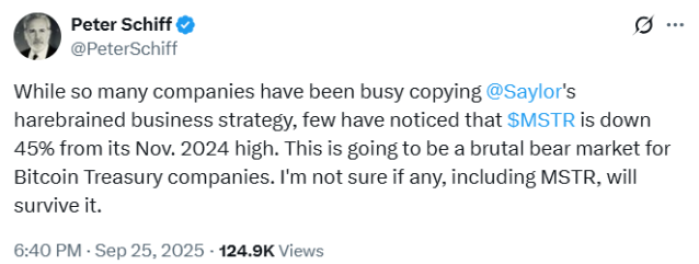
Peter Schiff criticized Strategy on X.

Still, ongoing criticism doesn’t deter other firms from betting big on the crypto king.

108 Public Companies Now Hold $119.5B Worth of $BTC

CoinMarketCap data shows that 108 public companies now hold 1,029,413 $BTC worth over $119.5B – 4.90% of the asset’s total supply.

Bitcoin treasury companies on CoinMarketCap.

Behind Strategy, MARA Holdings is the second-largest $BTC treasury, holding 52,477 $BTC, valued at over $6B.

Meanwhile, XXI is firmly in third place, holding 43,514 $BTC worth roughly $5.05B.
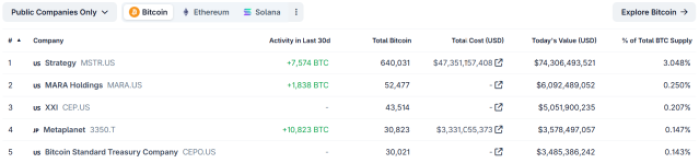
 Largest Bitcoin public companies on CoinMarketCap.

These companies, along with others like Metaplanet (which recently established a US subsidiary to expand its $BTC income business), view the crypto leader as a long-term investment with high profit potential.

But as more capital flows into the Bitcoin ecosystem, the network often becomes congested. In turn, this results in slow transaction speeds, high fees, and thus a less-than-ideal setup for investors.

This is where Bitcoin Hyper steps in.

Bitcoin Hyper to Make Bitcoin as Efficient as Solana

Bitcoin Hyper is on a mission to address the Bitcoin network’s biggest limitations through its upcoming L2 solution.

Once launched this quarter, it’ll leverage the Solana Virtual Machine (SVM) to make the network faster, cheaper, and more scalable. And at Solana-level speeds, of course.

And it’s no wonder that the L2 aims to match the speed of the second largest blockchain with $11.629B Total Value Locked (TVL).

Right now, Bitcoin can only process 4.2 transactions per second (tps), a sizable ~18,521% less than Solana’s 782.1 tps.

In fact, Solana far outpaces Bitcoin in many key performance areas. The network’s maximum throughput reaches 4,709 tps, roughly 357x higher than Bitcoin’s 13.2 tps peak.

The gap is even wider in theoretical capacity; Solana can handle up to an eye-boggling 65K tps versus Bitcoin’s 7 tps.
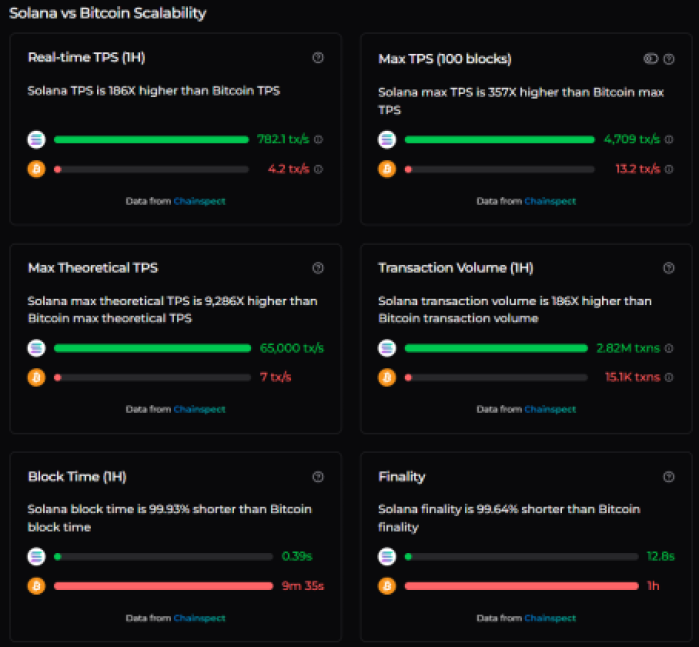
Solana vs Bitcoin scalability on Chainspect.

And that’s not all. Solana’s block time average is much higher at 0.39 seconds compared to Bitcoin’s 9 minutes and 35 seconds.

The time it takes for a transaction to be fully confirmed on Solana is also just 12.8 seconds, nearly 100% shorter than Bitcoin’s one hour.

But it’s not just the utilization of the SVM that’ll make the L2 more scalable – the addition of a Canonical Bridge will help, too.
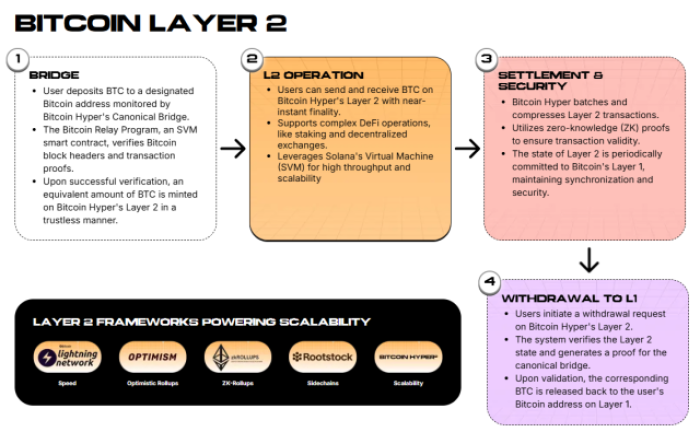
Bitcoin Hyper Canonical Bridge.

The bridge will enable the movement of wrapped versions of $BTC across the Bitcoin mainnet and the L2 network. In doing so, $BTC can be used across DeFi, dApps, NFTs, and other Web3 ecosystems at a fast pace.

Not only will it unlock new use cases previously unseen on Bitcoin, but it will also bring greater liquidity.

Plus, all will be achieved while preserving the security of Bitcoin’s base layer, a strength the network doesn’t lack.

Its Proof-of-Work (PoW) consensus, tremendous global mining network, and decentralized validator base make the network highly resistant to attacks and manipulation.

As a consequence, you can rest easy knowing that the L2 is building on one of the most secure and battle-tested networks in the entire blockchain sector.

$HYPER Powers the Bitcoin L2’s Utility, Scalability & Growth

At the core of the entire ecosystem is $HYPER, the project’s native token that drives utility, sustainability, and scalability.

The reason is that a hefty 30% of its total token supply is earmarked to fund ongoing development, while an extra 25% is reserved for the ecosystem treasury.

Bitcoin Hyper tokenomics.

To top it off, purchasing $HYPER on presale – currently available for just $0.013005 – opens an abundance of additional perks.

Whether you’re after lower gas fees, governance rights, or passive income at a 60% APY through staking (or all three!), holding $HYPER opens attractive, exclusive benefits for all.

If you’re interested in staking for gains, there’s no better time to do precisely that; the APY will drop as more investors catch on.

Our Bitcoin Hyper price prediction also anticipates $HYPER to reach $0.32 after it’s listed on some of the best crypto exchanges. This alone could generate over 24x returns, and that’s without factoring in any staking income.

Weighing all these points together, it makes perfect sense that $HYPER has already raised over $19.5M, recently backed by three major whale buys: $113.8K, $109.9K, and $105.4K.

Join Bitcoin Hyper today.

Disclaimer: The information provided is solely for educational and informational purposes. We’re not financial advisors, so always do your own research and don’t invest more than you’d be sad to lose. Crypto investments are highly volatile and can carry significant risks.

Authored by Leah Waters, Bitcoinist – https://bitcoinist.com/saylor-trillion-dollar-bitcoin-empire-pumps-hyper


Market Opportunity
Hyperlane Logo
Hyperlane Price(HYPER)
$0.13436
$0.13436$0.13436
-1.08%
USD
Hyperlane (HYPER) Live Price Chart
Disclaimer: The articles reposted on this site are sourced from public platforms and are provided for informational purposes only. They do not necessarily reflect the views of MEXC. All rights remain with the original authors. If you believe any content infringes on third-party rights, please contact service@support.mexc.com for removal. MEXC makes no guarantees regarding the accuracy, completeness, or timeliness of the content and is not responsible for any actions taken based on the information provided. The content does not constitute financial, legal, or other professional advice, nor should it be considered a recommendation or endorsement by MEXC.

You May Also Like

Wormhole Unveils W Token 2.0 with Enhanced Tokenomics

Wormhole Unveils W Token 2.0 with Enhanced Tokenomics

The post Wormhole Unveils W Token 2.0 with Enhanced Tokenomics appeared on BitcoinEthereumNews.com. Joerg Hiller Sep 17, 2025 13:57 Wormhole introduces W Token 2.0, featuring upgraded tokenomics, a strategic Wormhole Reserve, and a 4% base yield, aiming to optimize ecosystem growth and align incentives. Wormhole has announced a significant upgrade to its native token, unveiling the W Token 2.0. This upgrade introduces new tokenomics including the establishment of a Wormhole Reserve, a 4% base yield, and an optimized unlock schedule, marking a pivotal development in the ecosystem, according to Wormhole. The W Token Evolution Launched in October 2020, Wormhole’s W token has been central to the platform’s mission of creating a connected internet economy. The latest upgrade aims to enhance the token’s utility across more than 40 blockchains. With a capped supply of 10 billion, the W token supports governance, staking, and ecosystem growth, aligning incentives for network security and development. Introducing the Wormhole Reserve The Wormhole Reserve will accumulate value from both onchain and offchain activities, supporting the ecosystem’s expansion. As Wormhole adoption grows, the token will capture value through network expansions and ecosystem applications, ensuring that growth is directly reflected in the token’s value. 4% Base Yield and Governance Rewards Wormhole 2.0 introduces a 4% base yield for W holders who actively participate in governance. The yield, derived from existing token supplies and protocol revenues, is designed to incentivize active participation without inflating the token supply. Optimized Unlock Schedule Updating its token release schedule, Wormhole replaces annual cliffs with bi-weekly unlocks, starting October 3, 2025. This change aims to reduce market pressure and provide a more stable environment for investors and contributors. The bi-weekly schedule will span over 4.5 years, affecting categories such as Guardian Nodes and Community & Launch. Wormhole’s Future Vision With these upgrades, Wormhole aims to expand its role as…
Share
BitcoinEthereumNews2025/09/18 15:48
[OPINION] US National Security Strategy 2025: An iconoclastic document

[OPINION] US National Security Strategy 2025: An iconoclastic document

Trump's national security strategy signals a radical shift in US foreign policy, prioritizing economic power and regional interests over global commitments
Share
Rappler2025/12/16 12:30
Crucial US Stock Market Update: What Wednesday’s Mixed Close Reveals

Crucial US Stock Market Update: What Wednesday’s Mixed Close Reveals

BitcoinWorld Crucial US Stock Market Update: What Wednesday’s Mixed Close Reveals The financial world often keeps us on our toes, and Wednesday was no exception. Investors watched closely as the US stock market concluded the day with a mixed performance across its major indexes. This snapshot offers a crucial glimpse into current investor sentiment and economic undercurrents, prompting many to ask: what exactly happened? Understanding the Latest US Stock Market Movements On Wednesday, the closing bell brought a varied picture for the US stock market. While some indexes celebrated gains, others registered slight declines, creating a truly mixed bag for investors. The Dow Jones Industrial Average showed resilience, climbing by a notable 0.57%. This positive movement suggests strength in some of the larger, more established companies. Conversely, the S&P 500, a broader benchmark often seen as a barometer for the overall market, experienced a modest dip of 0.1%. The technology-heavy Nasdaq Composite also saw a slight retreat, sliding by 0.33%. This particular index often reflects investor sentiment towards growth stocks and the tech sector. These divergent outcomes highlight the complex dynamics currently at play within the American economy. It’s not simply a matter of “up” or “down” for the entire US stock market; rather, it’s a nuanced landscape where different sectors and company types are responding to unique pressures and opportunities. Why Did the US Stock Market See Mixed Results? When the US stock market delivers a mixed performance, it often points to a tug-of-war between various economic factors. Several elements could have contributed to Wednesday’s varied closings. For instance, positive corporate earnings reports from certain industries might have bolstered the Dow. At the same time, concerns over inflation, interest rate policies by the Federal Reserve, or even global economic uncertainties could have pressured growth stocks, affecting the S&P 500 and Nasdaq. Key considerations often include: Economic Data: Recent reports on employment, manufacturing, or consumer spending can sway market sentiment. Corporate Announcements: Strong or weak earnings forecasts from influential companies can significantly impact their respective sectors. Interest Rate Expectations: The prospect of higher or lower interest rates directly influences borrowing costs for businesses and consumer spending, affecting future profitability. Geopolitical Events: Global tensions or trade policies can introduce uncertainty, causing investors to become more cautious. Understanding these underlying drivers is crucial for anyone trying to make sense of daily market fluctuations in the US stock market. Navigating Volatility in the US Stock Market A mixed close, while not a dramatic downturn, serves as a reminder that market volatility is a constant companion for investors. For those involved in the US stock market, particularly individuals managing their portfolios, these days underscore the importance of a well-thought-out strategy. It’s important not to react impulsively to daily movements. Instead, consider these actionable insights: Diversification: Spreading investments across different sectors and asset classes can help mitigate risk when one area underperforms. Long-Term Perspective: Focusing on long-term financial goals rather than short-term gains can help weather daily market swings. Stay Informed: Keeping abreast of economic news and company fundamentals provides context for market behavior. Consult Experts: Financial advisors can offer personalized guidance based on individual risk tolerance and objectives. Even small movements in major indexes can signal shifts that require attention, guiding future investment decisions within the dynamic US stock market. What’s Next for the US Stock Market? Looking ahead, investors will be keenly watching for further economic indicators and corporate announcements to gauge the direction of the US stock market. Upcoming inflation data, statements from the Federal Reserve, and quarterly earnings reports will likely provide more clarity. The interplay of these factors will continue to shape investor confidence and, consequently, the performance of the Dow, S&P 500, and Nasdaq. Remaining informed and adaptive will be key to understanding the market’s trajectory. Conclusion: Wednesday’s mixed close in the US stock market highlights the intricate balance of forces influencing financial markets. While the Dow showed strength, the S&P 500 and Nasdaq experienced slight declines, reflecting a nuanced economic landscape. This reminds us that understanding the ‘why’ behind these movements is as important as the movements themselves. As always, a thoughtful, informed approach remains the best strategy for navigating the complexities of the market. Frequently Asked Questions (FAQs) Q1: What does a “mixed close” mean for the US stock market? A1: A mixed close indicates that while some major stock indexes advanced, others declined. It suggests that different sectors or types of companies within the US stock market are experiencing varying influences, rather than a uniform market movement. Q2: Which major indexes were affected on Wednesday? A2: On Wednesday, the Dow Jones Industrial Average gained 0.57%, while the S&P 500 edged down 0.1%, and the Nasdaq Composite slid 0.33%, illustrating the mixed performance across the US stock market. Q3: What factors contribute to a mixed stock market performance? A3: Mixed performances in the US stock market can be influenced by various factors, including specific corporate earnings, economic data releases, shifts in interest rate expectations, and broader geopolitical events that affect different market segments uniquely. Q4: How should investors react to mixed market signals? A4: Investors are generally advised to maintain a long-term perspective, diversify their portfolios, stay informed about economic news, and avoid impulsive decisions. Consulting a financial advisor can also provide personalized guidance for navigating the US stock market. Q5: What indicators should investors watch for future US stock market trends? A5: Key indicators to watch include upcoming inflation reports, statements from the Federal Reserve regarding monetary policy, and quarterly corporate earnings reports. These will offer insights into the future direction of the US stock market. Did you find this analysis of the US stock market helpful? Share this article with your network on social media to help others understand the nuances of current financial trends! To learn more about the latest stock market trends, explore our article on key developments shaping the US stock market‘s future performance. This post Crucial US Stock Market Update: What Wednesday’s Mixed Close Reveals first appeared on BitcoinWorld.
Share
Coinstats2025/09/18 05:30