Michael Saylor is urging popular YouTuber Jimmy Donaldson, also known as MrBeast, to buy Bitcoin even as Strategy hits the brakes on its own BTC [...]Michael Saylor is urging popular YouTuber Jimmy Donaldson, also known as MrBeast, to buy Bitcoin even as Strategy hits the brakes on its own BTC [...]

GENIUS Stablecoin Act Seen Ending Bank Interest ”Rip Off,” Apple, Google, Meta Poised To Pounce

The GENIUS stablecoin act could stop banks ripping off retail depositors, with tech giants Apple, Google, and Meta set to challenge them by embedding high-yield stablecoins into their platforms.

That’s according to Tushar Jain, a co-founder of crypto fund manger Multicoin Capital.

“The GENIUS Bill is the beginning of the end for banks’ ability to rip off their retail depositors with minimal interest,” Jain wrote in an X post. ”Banks are going to have to pay more interest to depositors and their earnings will significantly suffer as a result.”

Tech Giants Will Compete With Banks Using “Mega Distribution” Platforms

Jain said the tech giants will use their ”mega distribution” platforms to offer better yields to depositors, provide 24/7 payments, and improved digital experiences.

His post follows a June article by Fortune magazine that said that Apple, Google, Airbnb, and X were among some of the top tech companies exploring issuing their own stablecoins. 

Bitwise Chief Executive Officer (CEO) Hunter Horsley has come to the same conclusion as Jain, arguing in a Oct. 6 post on X that the tech giants will likely launch their own wallets and then add stablecoin integration into them as the first move to take on banks. 

“Software is eating the world,” he said. ”The financial system is next.”

Stripe CEO Patrick Collison wrote in a post on X over the weekend that the average interest rate for savings accounts in the US is 0.40%, and only 0.25% in Europe.

Rates for Tether’s USDT and Circle’s USD Coin (USDC) on the decentralized finance (DeFi) platform Aave stand at 4.02% and 3.69%, respectively. 

“Consumer hostile” banks are in a ”losing position,” he said

$6.6 Trillion Could Leave The Banking System, US Treasury Warns

The US Department of the Treasury estimated in April that the mass adoption of stablecoins could lead to $6.6 trillion in outflows from the traditional banking system.

The market capitalization of stablecoins stands at a record high $302.411 billion, up from around $255 billion in July, according to DefiLlama. 
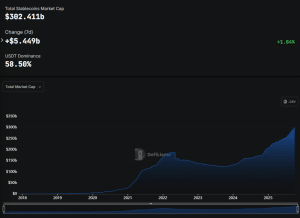
Stablecoin market cap

Stablecoin market cap (Source: DefiLlama)

The sector’s market cap climbed by more than $5.4 billion in the past week alone. 

But the continued growth of the stablecoin market may end up amplifying deposit flight risk, “especially in times of stress, that will undermine credit creation throughout the economy,” the Bank Policy Institute warned in August. 

“The corresponding reduction in credit supply means higher interest rates, fewer loans, and increased costs for Main Street businesses and households,” it said.

Banking Groups Already Tried To Shutdown Stablecoin Yields

The GENIUS Act, which was enacted in July this year, establishes the regulatory guidelines for stablecoin firms looking to issue their tokens in the US. 

It also prohibits stablecoin issuers from offering interest or yield to token holders, but doesn’t explicitly extend the ban to third parties such as crypto exchanges or business affiliates. This leaves the door open for stablecoin issuers to circumvent the ban and still offer yields to their clients.

For example, USD Coin (USDC) issuer Circle is not allowed to offer direct yields, but crypto exchange Coinbase can.

“The banking lobby tried to protect their profits with the Genius Act’s prohibition on passing interest to stablecoin holders but that is easily circumvented as you can see by Coinbase’s yield sharing with customers,” said Jain.


Market Opportunity
The AI Prophecy Logo
The AI Prophecy Price(ACT)
$0,01546
$0,01546$0,01546
-0,32%
USD
The AI Prophecy (ACT) Live Price Chart
Disclaimer: The articles reposted on this site are sourced from public platforms and are provided for informational purposes only. They do not necessarily reflect the views of MEXC. All rights remain with the original authors. If you believe any content infringes on third-party rights, please contact service@support.mexc.com for removal. MEXC makes no guarantees regarding the accuracy, completeness, or timeliness of the content and is not responsible for any actions taken based on the information provided. The content does not constitute financial, legal, or other professional advice, nor should it be considered a recommendation or endorsement by MEXC.

You May Also Like

The Channel Factories We’ve Been Waiting For

The Channel Factories We’ve Been Waiting For

The post The Channel Factories We’ve Been Waiting For appeared on BitcoinEthereumNews.com. Visions of future technology are often prescient about the broad strokes while flubbing the details. The tablets in “2001: A Space Odyssey” do indeed look like iPads, but you never see the astronauts paying for subscriptions or wasting hours on Candy Crush.  Channel factories are one vision that arose early in the history of the Lightning Network to address some challenges that Lightning has faced from the beginning. Despite having grown to become Bitcoin’s most successful layer-2 scaling solution, with instant and low-fee payments, Lightning’s scale is limited by its reliance on payment channels. Although Lightning shifts most transactions off-chain, each payment channel still requires an on-chain transaction to open and (usually) another to close. As adoption grows, pressure on the blockchain grows with it. The need for a more scalable approach to managing channels is clear. Channel factories were supposed to meet this need, but where are they? In 2025, subnetworks are emerging that revive the impetus of channel factories with some new details that vastly increase their potential. They are natively interoperable with Lightning and achieve greater scale by allowing a group of participants to open a shared multisig UTXO and create multiple bilateral channels, which reduces the number of on-chain transactions and improves capital efficiency. Achieving greater scale by reducing complexity, Ark and Spark perform the same function as traditional channel factories with new designs and additional capabilities based on shared UTXOs.  Channel Factories 101 Channel factories have been around since the inception of Lightning. A factory is a multiparty contract where multiple users (not just two, as in a Dryja-Poon channel) cooperatively lock funds in a single multisig UTXO. They can open, close and update channels off-chain without updating the blockchain for each operation. Only when participants leave or the factory dissolves is an on-chain transaction…
Share
BitcoinEthereumNews2025/09/18 00:09
Ethereum Price Prediction: ETH Targets $10,000 In 2026 But Layer Brett Could Reach $1 From $0.0058

Ethereum Price Prediction: ETH Targets $10,000 In 2026 But Layer Brett Could Reach $1 From $0.0058

Ethereum price predictions are turning heads, with analysts suggesting ETH could climb to $10,000 by 2026 as institutional demand and network upgrades drive growth. While Ethereum remains a blue-chip asset, investors looking for sharper multiples are eyeing Layer Brett (LBRETT). Currently in presale at just $0.0058, the Ethereum Layer 2 meme coin is drawing huge [...] The post Ethereum Price Prediction: ETH Targets $10,000 In 2026 But Layer Brett Could Reach $1 From $0.0058 appeared first on Blockonomi.
Share
Blockonomi2025/09/17 23:45
IP Hits $11.75, HYPE Climbs to $55, BlockDAG Surpasses Both with $407M Presale Surge!

IP Hits $11.75, HYPE Climbs to $55, BlockDAG Surpasses Both with $407M Presale Surge!

The post IP Hits $11.75, HYPE Climbs to $55, BlockDAG Surpasses Both with $407M Presale Surge! appeared on BitcoinEthereumNews.com. Crypto News 17 September 2025 | 18:00 Discover why BlockDAG’s upcoming Awakening Testnet launch makes it the best crypto to buy today as Story (IP) price jumps to $11.75 and Hyperliquid hits new highs. Recent crypto market numbers show strength but also some limits. The Story (IP) price jump has been sharp, fueled by big buybacks and speculation, yet critics point out that revenue still lags far behind its valuation. The Hyperliquid (HYPE) price looks solid around the mid-$50s after a new all-time high, but questions remain about sustainability once the hype around USDH proposals cools down. So the obvious question is: why chase coins that are either stretched thin or at risk of retracing when you could back a network that’s already proving itself on the ground? That’s where BlockDAG comes in. While other chains are stuck dealing with validator congestion or outages, BlockDAG’s upcoming Awakening Testnet will be stress-testing its EVM-compatible smart chain with real miners before listing. For anyone looking for the best crypto coin to buy, the choice between waiting on fixes or joining live progress feels like an easy one. BlockDAG: Smart Chain Running Before Launch Ethereum continues to wrestle with gas congestion, and Solana is still known for network freezes, yet BlockDAG is already showing a different picture. Its upcoming Awakening Testnet, set to launch on September 25, isn’t just a demo; it’s a live rollout where the chain’s base protocols are being stress-tested with miners connected globally. EVM compatibility is active, account abstraction is built in, and tools like updated vesting contracts and Stratum integration are already functional. Instead of waiting for fixes like other networks, BlockDAG is proving its infrastructure in real time. What makes this even more important is that the technology is operational before the coin even hits exchanges. That…
Share
BitcoinEthereumNews2025/09/18 00:32