The Ethereum ETF landscape just shifted in a way few saw coming. Grayscale Investments has officially introduced staking to its Ethereum Exchange-Traded Funds, a first in the U.S. market. This move, announced on October 6, signals a new era where traditional investors can finally earn staking rewards directly through regulated ETF structures. In simple terms, Grayscale is blending Wall Street’s favorite vehicle, ETFs, with one of blockchain’s core reward mechanisms. That combination could redefine how institutional capital interacts with Ethereum. Ethereum ETFs Just Got an Upgrade Grayscale confirmed that both its Ethereum Mini Trust (ETH) and Ethereum Trust (ETHE) now include staking features. Investors can either have rewards automatically reinvested to compound gains or receive them as cash payouts. The firm also extended staking to its Solana Trust (GSOL), pending regulatory clearance to list it as a spot product. Once approved, it will be among the first Solana-based ETFs in the United States to support staking. According to Grayscale, this dual-option model was crafted to give investors flexibility, from those seeking long-term growth to others prioritizing short-term liquidity. The move comes as Ethereum’s staking yield averages around 3.2%, giving ETF issuers an avenue to offset management fees and pass on savings to investors. Regulatory Shift Opens the Door For years, U.S. regulators treated staking as a gray zone. Under the previous SEC chair, some staking programs were classified as unregistered securities. That stance led to enforcement actions and forced several exchanges to shut down or restructure their staking services. But tides are changing. Over the past year, regulators have softened their tone. Liquid staking, when properly structured, is no longer automatically considered a securities offering. The shift, coupled with friendlier crypto rhetoric under the Trump administration, gave firms like Grayscale the green light to innovate. Ethereum’s proof-of-stake design rewards validators who help secure the network. By integrating that directly into ETFs, Grayscale is essentially bridging DeFi yields with the comfort of traditional finance. Institutional Stakes Rise Market analysts believe this could reshape competition in the Ethereum ETF sector. Lower fees, coupled with yield potential, make ETH-based funds more attractive than ever. As of early October, about 36 million ETH, roughly 30% of the total supply, is staked, with liquid staking protocols like Lido leading the pack. Institutional involvement through ETFs could push that number even higher. “Ethereum staking through ETFs introduces a new standard for yield exposure in regulated markets,” wrote market analyst Ryan Selkis on X, calling it “a long-awaited bridge between crypto utility and traditional asset management.” If major players like BlackRock or Fidelity follow Grayscale’s lead, the competition could compress fees industry-wide, a win for investors and a potential catalyst for fresh inflows into ETH. Risks and Realities Despite optimism, experts warn that staking isn’t risk-free. Validator concentration could create centralization risks, and yield fluctuations may impact fund performance. Redemption management is another challenge; ETFs must maintain enough liquid ETH to process withdrawals while staking a meaningful portion to earn rewards. Still, Grayscale’s institutional staking setup, using vetted validator networks and custodians, is designed to balance compliance with yield generation. It marks a careful but confident step into a more mature era of crypto finance. Conclusion Grayscale’s integration of staking into Ethereum ETFs is more than a corporate tweak; it’s a statement. It suggests that crypto yield products can exist inside the rules, not around them. For Ethereum, it could mean new layers of liquidity, demand, and long-term network stability. For investors, it’s a taste of passive income without leaving the comfort zone of regulated markets. As the race for ETF innovation heats up, Grayscale may have just given Ethereum a new growth narrative, one where staking isn’t just for crypto natives anymore. Frequently Asked Questions 1. What does staking in an ETF mean?It allows investors to earn yield from blockchain validation directly within an ETF structure, without managing tokens themselves. 2. Is staking in ETFs safe?While it adds yield potential, risks like validator performance, network slashing, and liquidity constraints remain. 3. How does this affect Ethereum’s price?More staking can reduce circulating supply, which may support long-term price stability if demand grows. 4. Will other asset managers follow?Yes, many analysts expect competitors like BlackRock or Fidelity to explore similar staking integrations. Glossary of Key Terms ETF (Exchange-Traded Fund):A pooled investment vehicle traded on stock exchanges, offering exposure to assets like crypto. Staking:The process of locking up crypto to validate transactions on proof-of-stake networks and earn rewards. ETH:The native cryptocurrency of the Ethereum network, used for transactions and staking. Validator:A network participant who helps confirm transactions and maintain blockchain security in exchange for rewards. Read More: Why Grayscale’s Ethereum ETF Staking Could Spark the Next Institutional Wave">Why Grayscale’s Ethereum ETF Staking Could Spark the Next Institutional WaveThe Ethereum ETF landscape just shifted in a way few saw coming. Grayscale Investments has officially introduced staking to its Ethereum Exchange-Traded Funds, a first in the U.S. market. This move, announced on October 6, signals a new era where traditional investors can finally earn staking rewards directly through regulated ETF structures. In simple terms, Grayscale is blending Wall Street’s favorite vehicle, ETFs, with one of blockchain’s core reward mechanisms. That combination could redefine how institutional capital interacts with Ethereum. Ethereum ETFs Just Got an Upgrade Grayscale confirmed that both its Ethereum Mini Trust (ETH) and Ethereum Trust (ETHE) now include staking features. Investors can either have rewards automatically reinvested to compound gains or receive them as cash payouts. The firm also extended staking to its Solana Trust (GSOL), pending regulatory clearance to list it as a spot product. Once approved, it will be among the first Solana-based ETFs in the United States to support staking. According to Grayscale, this dual-option model was crafted to give investors flexibility, from those seeking long-term growth to others prioritizing short-term liquidity. The move comes as Ethereum’s staking yield averages around 3.2%, giving ETF issuers an avenue to offset management fees and pass on savings to investors. Regulatory Shift Opens the Door For years, U.S. regulators treated staking as a gray zone. Under the previous SEC chair, some staking programs were classified as unregistered securities. That stance led to enforcement actions and forced several exchanges to shut down or restructure their staking services. But tides are changing. Over the past year, regulators have softened their tone. Liquid staking, when properly structured, is no longer automatically considered a securities offering. The shift, coupled with friendlier crypto rhetoric under the Trump administration, gave firms like Grayscale the green light to innovate. Ethereum’s proof-of-stake design rewards validators who help secure the network. By integrating that directly into ETFs, Grayscale is essentially bridging DeFi yields with the comfort of traditional finance. Institutional Stakes Rise Market analysts believe this could reshape competition in the Ethereum ETF sector. Lower fees, coupled with yield potential, make ETH-based funds more attractive than ever. As of early October, about 36 million ETH, roughly 30% of the total supply, is staked, with liquid staking protocols like Lido leading the pack. Institutional involvement through ETFs could push that number even higher. “Ethereum staking through ETFs introduces a new standard for yield exposure in regulated markets,” wrote market analyst Ryan Selkis on X, calling it “a long-awaited bridge between crypto utility and traditional asset management.” If major players like BlackRock or Fidelity follow Grayscale’s lead, the competition could compress fees industry-wide, a win for investors and a potential catalyst for fresh inflows into ETH. Risks and Realities Despite optimism, experts warn that staking isn’t risk-free. Validator concentration could create centralization risks, and yield fluctuations may impact fund performance. Redemption management is another challenge; ETFs must maintain enough liquid ETH to process withdrawals while staking a meaningful portion to earn rewards. Still, Grayscale’s institutional staking setup, using vetted validator networks and custodians, is designed to balance compliance with yield generation. It marks a careful but confident step into a more mature era of crypto finance. Conclusion Grayscale’s integration of staking into Ethereum ETFs is more than a corporate tweak; it’s a statement. It suggests that crypto yield products can exist inside the rules, not around them. For Ethereum, it could mean new layers of liquidity, demand, and long-term network stability. For investors, it’s a taste of passive income without leaving the comfort zone of regulated markets. As the race for ETF innovation heats up, Grayscale may have just given Ethereum a new growth narrative, one where staking isn’t just for crypto natives anymore. Frequently Asked Questions 1. What does staking in an ETF mean?It allows investors to earn yield from blockchain validation directly within an ETF structure, without managing tokens themselves. 2. Is staking in ETFs safe?While it adds yield potential, risks like validator performance, network slashing, and liquidity constraints remain. 3. How does this affect Ethereum’s price?More staking can reduce circulating supply, which may support long-term price stability if demand grows. 4. Will other asset managers follow?Yes, many analysts expect competitors like BlackRock or Fidelity to explore similar staking integrations. Glossary of Key Terms ETF (Exchange-Traded Fund):A pooled investment vehicle traded on stock exchanges, offering exposure to assets like crypto. Staking:The process of locking up crypto to validate transactions on proof-of-stake networks and earn rewards. ETH:The native cryptocurrency of the Ethereum network, used for transactions and staking. Validator:A network participant who helps confirm transactions and maintain blockchain security in exchange for rewards. Read More: Why Grayscale’s Ethereum ETF Staking Could Spark the Next Institutional Wave">Why Grayscale’s Ethereum ETF Staking Could Spark the Next Institutional Wave

Why Grayscale’s Ethereum ETF Staking Could Spark the Next Institutional Wave

The Ethereum ETF landscape just shifted in a way few saw coming. Grayscale Investments has officially introduced staking to its Ethereum Exchange-Traded Funds, a first in the U.S. market. This move, announced on October 6, signals a new era where traditional investors can finally earn staking rewards directly through regulated ETF structures.

In simple terms, Grayscale is blending Wall Street’s favorite vehicle, ETFs, with one of blockchain’s core reward mechanisms. That combination could redefine how institutional capital interacts with Ethereum.

Ethereum ETFs Just Got an Upgrade

Grayscale confirmed that both its Ethereum Mini Trust (ETH) and Ethereum Trust (ETHE) now include staking features. Investors can either have rewards automatically reinvested to compound gains or receive them as cash payouts.

The firm also extended staking to its Solana Trust (GSOL), pending regulatory clearance to list it as a spot product. Once approved, it will be among the first Solana-based ETFs in the United States to support staking.

According to Grayscale, this dual-option model was crafted to give investors flexibility, from those seeking long-term growth to others prioritizing short-term liquidity. The move comes as Ethereum’s staking yield averages around 3.2%, giving ETF issuers an avenue to offset management fees and pass on savings to investors.
Grayscale Ethereum ETF

Regulatory Shift Opens the Door

For years, U.S. regulators treated staking as a gray zone. Under the previous SEC chair, some staking programs were classified as unregistered securities. That stance led to enforcement actions and forced several exchanges to shut down or restructure their staking services.

But tides are changing. Over the past year, regulators have softened their tone. Liquid staking, when properly structured, is no longer automatically considered a securities offering. The shift, coupled with friendlier crypto rhetoric under the Trump administration, gave firms like Grayscale the green light to innovate.

Ethereum’s proof-of-stake design rewards validators who help secure the network. By integrating that directly into ETFs, Grayscale is essentially bridging DeFi yields with the comfort of traditional finance.

Institutional Stakes Rise

Market analysts believe this could reshape competition in the Ethereum ETF sector. Lower fees, coupled with yield potential, make ETH-based funds more attractive than ever.

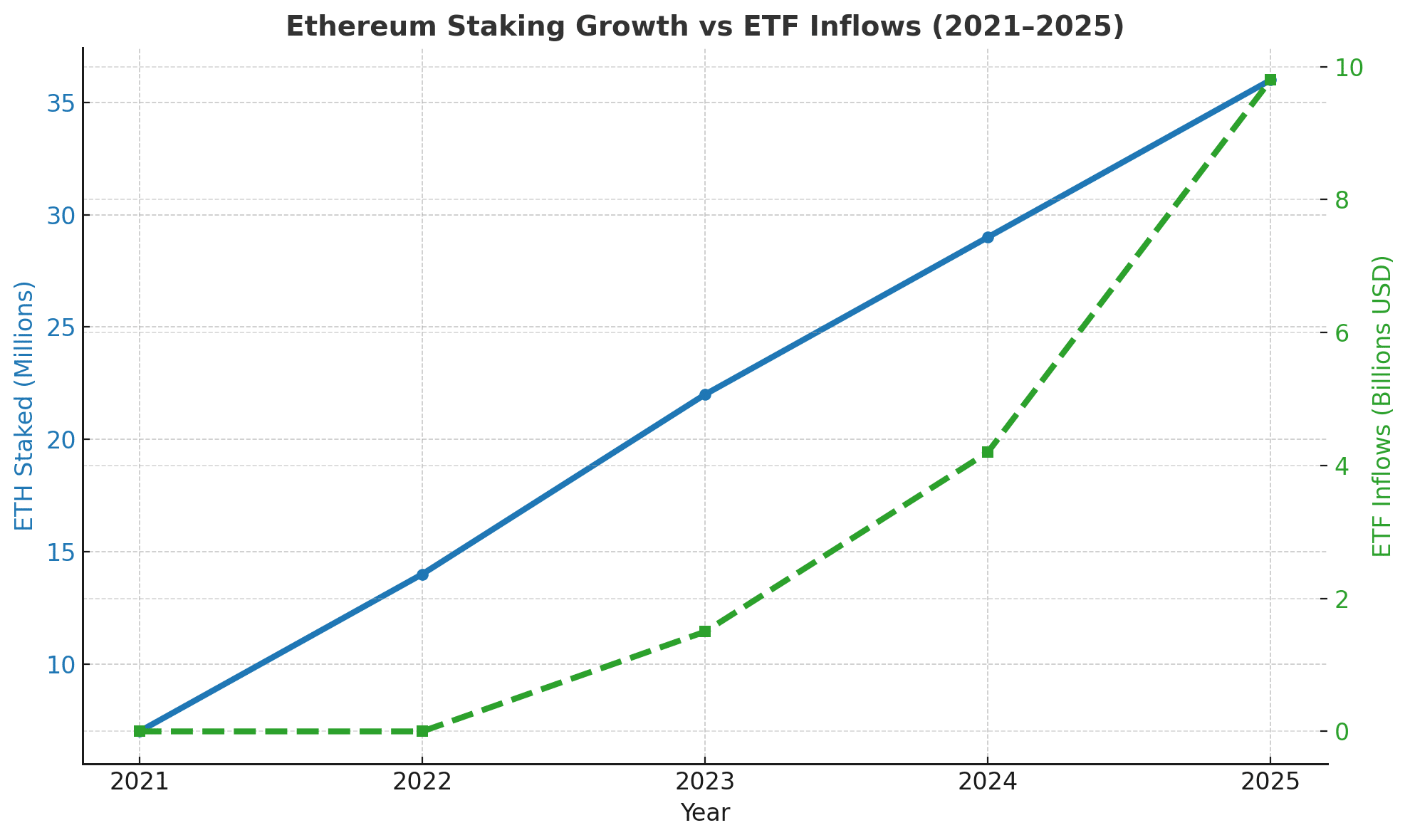
As of early October, about 36 million ETH, roughly 30% of the total supply, is staked, with liquid staking protocols like Lido leading the pack. Institutional involvement through ETFs could push that number even higher.

“Ethereum staking through ETFs introduces a new standard for yield exposure in regulated markets,” wrote market analyst Ryan Selkis on X, calling it “a long-awaited bridge between crypto utility and traditional asset management.”

If major players like BlackRock or Fidelity follow Grayscale’s lead, the competition could compress fees industry-wide, a win for investors and a potential catalyst for fresh inflows into ETH.

Risks and Realities

Despite optimism, experts warn that staking isn’t risk-free. Validator concentration could create centralization risks, and yield fluctuations may impact fund performance. Redemption management is another challenge; ETFs must maintain enough liquid ETH to process withdrawals while staking a meaningful portion to earn rewards.

Still, Grayscale’s institutional staking setup, using vetted validator networks and custodians, is designed to balance compliance with yield generation. It marks a careful but confident step into a more mature era of crypto finance.

Conclusion

Grayscale’s integration of staking into Ethereum ETFs is more than a corporate tweak; it’s a statement. It suggests that crypto yield products can exist inside the rules, not around them. For Ethereum, it could mean new layers of liquidity, demand, and long-term network stability. For investors, it’s a taste of passive income without leaving the comfort zone of regulated markets.

As the race for ETF innovation heats up, Grayscale may have just given Ethereum a new growth narrative, one where staking isn’t just for crypto natives anymore.

Frequently Asked Questions

1. What does staking in an ETF mean?
It allows investors to earn yield from blockchain validation directly within an ETF structure, without managing tokens themselves.

2. Is staking in ETFs safe?
While it adds yield potential, risks like validator performance, network slashing, and liquidity constraints remain.

3. How does this affect Ethereum’s price?
More staking can reduce circulating supply, which may support long-term price stability if demand grows.

4. Will other asset managers follow?
Yes, many analysts expect competitors like BlackRock or Fidelity to explore similar staking integrations.

Glossary of Key Terms

ETF (Exchange-Traded Fund):
A pooled investment vehicle traded on stock exchanges, offering exposure to assets like crypto.

Staking:
The process of locking up crypto to validate transactions on proof-of-stake networks and earn rewards.

ETH:
The native cryptocurrency of the Ethereum network, used for transactions and staking.

Validator:
A network participant who helps confirm transactions and maintain blockchain security in exchange for rewards.

Read More: Why Grayscale’s Ethereum ETF Staking Could Spark the Next Institutional Wave">Why Grayscale’s Ethereum ETF Staking Could Spark the Next Institutional Wave


Market Opportunity
Illusion of Life Logo
Illusion of Life Price(SPARK)
$0.002415
$0.002415$0.002415
-7.15%
USD
Illusion of Life (SPARK) Live Price Chart
Disclaimer: The articles reposted on this site are sourced from public platforms and are provided for informational purposes only. They do not necessarily reflect the views of MEXC. All rights remain with the original authors. If you believe any content infringes on third-party rights, please contact service@support.mexc.com for removal. MEXC makes no guarantees regarding the accuracy, completeness, or timeliness of the content and is not responsible for any actions taken based on the information provided. The content does not constitute financial, legal, or other professional advice, nor should it be considered a recommendation or endorsement by MEXC.

You May Also Like

The Channel Factories We’ve Been Waiting For

The Channel Factories We’ve Been Waiting For

The post The Channel Factories We’ve Been Waiting For appeared on BitcoinEthereumNews.com. Visions of future technology are often prescient about the broad strokes while flubbing the details. The tablets in “2001: A Space Odyssey” do indeed look like iPads, but you never see the astronauts paying for subscriptions or wasting hours on Candy Crush.  Channel factories are one vision that arose early in the history of the Lightning Network to address some challenges that Lightning has faced from the beginning. Despite having grown to become Bitcoin’s most successful layer-2 scaling solution, with instant and low-fee payments, Lightning’s scale is limited by its reliance on payment channels. Although Lightning shifts most transactions off-chain, each payment channel still requires an on-chain transaction to open and (usually) another to close. As adoption grows, pressure on the blockchain grows with it. The need for a more scalable approach to managing channels is clear. Channel factories were supposed to meet this need, but where are they? In 2025, subnetworks are emerging that revive the impetus of channel factories with some new details that vastly increase their potential. They are natively interoperable with Lightning and achieve greater scale by allowing a group of participants to open a shared multisig UTXO and create multiple bilateral channels, which reduces the number of on-chain transactions and improves capital efficiency. Achieving greater scale by reducing complexity, Ark and Spark perform the same function as traditional channel factories with new designs and additional capabilities based on shared UTXOs.  Channel Factories 101 Channel factories have been around since the inception of Lightning. A factory is a multiparty contract where multiple users (not just two, as in a Dryja-Poon channel) cooperatively lock funds in a single multisig UTXO. They can open, close and update channels off-chain without updating the blockchain for each operation. Only when participants leave or the factory dissolves is an on-chain transaction…
Share
BitcoinEthereumNews2025/09/18 00:09
XRP Price Prediction: Ripple CEO at Davos Predicts Crypto ATHs This Year – $5 XRP Next?

XRP Price Prediction: Ripple CEO at Davos Predicts Crypto ATHs This Year – $5 XRP Next?

XRP has traded near $1.90 as Ripple CEO Brad Garlinghouse has predicted from Davos that the crypto market will reach new highs this year. Analysts have pointed
Share
Coinstats2026/01/22 04:49
Supreme Court rejected Trump’s attempt to fire Fed Governor Lisa Cook

Supreme Court rejected Trump’s attempt to fire Fed Governor Lisa Cook

The Supreme Court has refused to support President Donald Trump in his attempt to fire Federal Reserve Governor Lisa Cook, after justices raised serious doubts
Share
Cryptopolitan2026/01/22 05:30