Crypto salaries and token incentives declined across nearly all roles and regions in 2024 and early 2025 despite Bitcoin’s record-breaking rally, according to Dragonfly Capital’s latest compensation report released on Thursday. The survey compiled data from 85 companies and approximately 3,400 employee and candidate datapoints collected in late 2024 and Q1 2025, revealing what researchers called “a down market” with compensation practices “still relatively immature compared to traditional sectors.” Entry-Level Workers Hit Hardest as Executive Pay Climbs Entry-level positions accounted for only 10% of total roles, with these junior employees bearing the brunt of cuts through lower salaries and reduced token packages.Source: Dragonfly Senior and principal-level positions comprised the largest share at 37%, while engineering remained the dominant function, accounting for roughly 67% of total headcount. The report found that only meaningful increases came at the executive level, creating what Dragonfly described as “a barbell effect” most visible across product and engineering roles. International engineering executives out-earned U.S. peers for the first time, with total compensation ranging from $530,000 to $780,000, driven by token packages approaching 3%. Product Management executives posted the highest salary of any role, between $390,000 and $484,000. However, mid-level roles experienced flat growth while entry-level positions absorbed the steepest cuts, concentrating gains at the top while most of the workforce saw stagnating or shrinking pay. The pullback contrasts sharply with earlier hiring booms documented in mid-2025, when crypto job postings surged 60% year-over-year according to CryptoJobs data. A separate Taurex study from July showed the US topping the global list with 292 active job listings and an average salary of $148,100, while the UAE offered the second-highest average at $111,483. Founder Compensation Surges While Entry-Level Positions Contract Average founder salaries increased approximately 37% year-over-year, rising from $144,000 in 2023 to $197,000 in 2024/25. Seed-stage U.S. founders held the highest equity ownership at 32%, while token ownership at Seed remained consistent across geographies at 9%. At Series A, international founders earned higher salaries at $244,000 compared to U.S. founders at $198,000, though U.S. founders held more tokens at 13% versus 9%. Bonus usage declined with company scale, peaking at the smallest company sizes of one to five employees and early stages, especially among companies with $5 million to $19.9 million in funding.Source: Dragonfly CeFi had the highest bonus adoption at 71%, while DeFi adoption sat at 50%. Infrastructure, Layer 1, and Layer 2 adoption was lower between 15% and 30%. The report found hiring momentum was stable or increasing for the majority of companies, with 50% stable and 47% increasing. Engineering-led growth with about 78% of teams expanding and only 1% cutting. However, hiring speed averaged 3.8 weeks, involving about four interview steps, with 68% of offers accepted. Compensation drove 83% of declines, split between compensation below expectations at 44% and better competing offers at 39%. Geographic Shift Sees Asia Double Hiring Share as Remote Work Dominates Western Europe remained the dominant international hiring hub, with 84% of Series B through E companies employing people there. However, Asia’s presence nearly doubled year-over-year, rising from 20% to 41%. Eastern Europe was utilized by 63% of later-stage companies, while Canada expansion was seen in 38% of companies between Series B and E.Source: Dragonfly The geographic expansion occurred as 81% of companies adopted global-first hiring strategies, recruiting in both the U.S. and internationally. US-only hiring was virtually non-existent at 6%. Work policies remained heavily remote, with 54% fully remote, 30% hybrid, 14% remote-first, and only 2% fully in-office.Source: Dragonfly Cost-of-living adjustment adoption held steady year-over-year at 35% in 2023 versus 38% in 2024/25. The average attrition rate stood at 7.8%, spiking at companies with 21 to 50 full-time employees at 9.2% and climbing to 10.6% at 100-plus employees. International companies achieved stronger retention at 6.0% versus 8.9% for U.S. firms. Primary attrition drivers were job mismatch or role expectations at 25% and better competing offers at 17%. The top recruiting challenge was finding qualified candidates at 66%, while compensation expectations were the second biggest hurdle at 18%.Source: Dragonfly Despite the broader compensation pullback, specialized roles remain in high demand with premium pay. Zero-knowledge cryptographers command salaries reaching $300,000 annually, while blockchain developers earn between $150,000 and $210,000. Smart contract engineers can make $160,000 to $250,000 for senior positions, with entry-level roles starting at $80,000. Token economists earn $130,000 to $210,000, while compliance officers and legal counsel make $110,000 to $190,000 annually as regulatory frameworks solidify globallyCrypto salaries and token incentives declined across nearly all roles and regions in 2024 and early 2025 despite Bitcoin’s record-breaking rally, according to Dragonfly Capital’s latest compensation report released on Thursday. The survey compiled data from 85 companies and approximately 3,400 employee and candidate datapoints collected in late 2024 and Q1 2025, revealing what researchers called “a down market” with compensation practices “still relatively immature compared to traditional sectors.” Entry-Level Workers Hit Hardest as Executive Pay Climbs Entry-level positions accounted for only 10% of total roles, with these junior employees bearing the brunt of cuts through lower salaries and reduced token packages.Source: Dragonfly Senior and principal-level positions comprised the largest share at 37%, while engineering remained the dominant function, accounting for roughly 67% of total headcount. The report found that only meaningful increases came at the executive level, creating what Dragonfly described as “a barbell effect” most visible across product and engineering roles. International engineering executives out-earned U.S. peers for the first time, with total compensation ranging from $530,000 to $780,000, driven by token packages approaching 3%. Product Management executives posted the highest salary of any role, between $390,000 and $484,000. However, mid-level roles experienced flat growth while entry-level positions absorbed the steepest cuts, concentrating gains at the top while most of the workforce saw stagnating or shrinking pay. The pullback contrasts sharply with earlier hiring booms documented in mid-2025, when crypto job postings surged 60% year-over-year according to CryptoJobs data. A separate Taurex study from July showed the US topping the global list with 292 active job listings and an average salary of $148,100, while the UAE offered the second-highest average at $111,483. Founder Compensation Surges While Entry-Level Positions Contract Average founder salaries increased approximately 37% year-over-year, rising from $144,000 in 2023 to $197,000 in 2024/25. Seed-stage U.S. founders held the highest equity ownership at 32%, while token ownership at Seed remained consistent across geographies at 9%. At Series A, international founders earned higher salaries at $244,000 compared to U.S. founders at $198,000, though U.S. founders held more tokens at 13% versus 9%. Bonus usage declined with company scale, peaking at the smallest company sizes of one to five employees and early stages, especially among companies with $5 million to $19.9 million in funding.Source: Dragonfly CeFi had the highest bonus adoption at 71%, while DeFi adoption sat at 50%. Infrastructure, Layer 1, and Layer 2 adoption was lower between 15% and 30%. The report found hiring momentum was stable or increasing for the majority of companies, with 50% stable and 47% increasing. Engineering-led growth with about 78% of teams expanding and only 1% cutting. However, hiring speed averaged 3.8 weeks, involving about four interview steps, with 68% of offers accepted. Compensation drove 83% of declines, split between compensation below expectations at 44% and better competing offers at 39%. Geographic Shift Sees Asia Double Hiring Share as Remote Work Dominates Western Europe remained the dominant international hiring hub, with 84% of Series B through E companies employing people there. However, Asia’s presence nearly doubled year-over-year, rising from 20% to 41%. Eastern Europe was utilized by 63% of later-stage companies, while Canada expansion was seen in 38% of companies between Series B and E.Source: Dragonfly The geographic expansion occurred as 81% of companies adopted global-first hiring strategies, recruiting in both the U.S. and internationally. US-only hiring was virtually non-existent at 6%. Work policies remained heavily remote, with 54% fully remote, 30% hybrid, 14% remote-first, and only 2% fully in-office.Source: Dragonfly Cost-of-living adjustment adoption held steady year-over-year at 35% in 2023 versus 38% in 2024/25. The average attrition rate stood at 7.8%, spiking at companies with 21 to 50 full-time employees at 9.2% and climbing to 10.6% at 100-plus employees. International companies achieved stronger retention at 6.0% versus 8.9% for U.S. firms. Primary attrition drivers were job mismatch or role expectations at 25% and better competing offers at 17%. The top recruiting challenge was finding qualified candidates at 66%, while compensation expectations were the second biggest hurdle at 18%.Source: Dragonfly Despite the broader compensation pullback, specialized roles remain in high demand with premium pay. Zero-knowledge cryptographers command salaries reaching $300,000 annually, while blockchain developers earn between $150,000 and $210,000. Smart contract engineers can make $160,000 to $250,000 for senior positions, with entry-level roles starting at $80,000. Token economists earn $130,000 to $210,000, while compliance officers and legal counsel make $110,000 to $190,000 annually as regulatory frameworks solidify globally

Crypto Salaries Drop Across All Roles Despite Bitcoin Rally – Only 10% of Jobs Are Entry-Level

4 min read

Crypto salaries and token incentives declined across nearly all roles and regions in 2024 and early 2025 despite Bitcoin’s record-breaking rally, according to Dragonfly Capital’s latest compensation report released on Thursday.

The survey compiled data from 85 companies and approximately 3,400 employee and candidate datapoints collected in late 2024 and Q1 2025, revealing what researchers called “a down market” with compensation practices “still relatively immature compared to traditional sectors.”

Entry-Level Workers Hit Hardest as Executive Pay Climbs

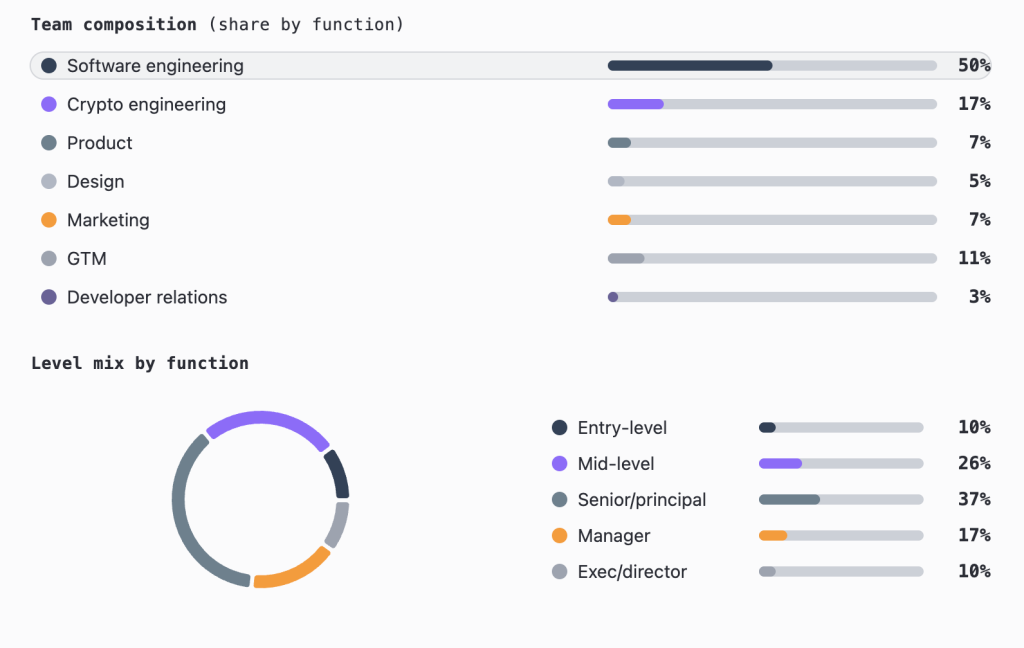
Entry-level positions accounted for only 10% of total roles, with these junior employees bearing the brunt of cuts through lower salaries and reduced token packages.
Crypto Salaries Drop Across All Roles Despite Bitcoin Rally – Only 10% of Jobs Are Entry-LevelSource: Dragonfly

Senior and principal-level positions comprised the largest share at 37%, while engineering remained the dominant function, accounting for roughly 67% of total headcount.

The report found that only meaningful increases came at the executive level, creating what Dragonfly described as “a barbell effect” most visible across product and engineering roles.

International engineering executives out-earned U.S. peers for the first time, with total compensation ranging from $530,000 to $780,000, driven by token packages approaching 3%.

Product Management executives posted the highest salary of any role, between $390,000 and $484,000.

However, mid-level roles experienced flat growth while entry-level positions absorbed the steepest cuts, concentrating gains at the top while most of the workforce saw stagnating or shrinking pay.

The pullback contrasts sharply with earlier hiring booms documented in mid-2025, when crypto job postings surged 60% year-over-year according to CryptoJobs data.

A separate Taurex study from July showed the US topping the global list with 292 active job listings and an average salary of $148,100, while the UAE offered the second-highest average at $111,483.

Founder Compensation Surges While Entry-Level Positions Contract

Average founder salaries increased approximately 37% year-over-year, rising from $144,000 in 2023 to $197,000 in 2024/25.

Seed-stage U.S. founders held the highest equity ownership at 32%, while token ownership at Seed remained consistent across geographies at 9%.

At Series A, international founders earned higher salaries at $244,000 compared to U.S. founders at $198,000, though U.S. founders held more tokens at 13% versus 9%.

Bonus usage declined with company scale, peaking at the smallest company sizes of one to five employees and early stages, especially among companies with $5 million to $19.9 million in funding.

Crypto Salaries Drop Across All Roles Despite Bitcoin Rally – Only 10% of Jobs Are Entry-LevelSource: Dragonfly

CeFi had the highest bonus adoption at 71%, while DeFi adoption sat at 50%. Infrastructure, Layer 1, and Layer 2 adoption was lower between 15% and 30%.

The report found hiring momentum was stable or increasing for the majority of companies, with 50% stable and 47% increasing.

Engineering-led growth with about 78% of teams expanding and only 1% cutting.

However, hiring speed averaged 3.8 weeks, involving about four interview steps, with 68% of offers accepted.

Compensation drove 83% of declines, split between compensation below expectations at 44% and better competing offers at 39%.

Geographic Shift Sees Asia Double Hiring Share as Remote Work Dominates

Western Europe remained the dominant international hiring hub, with 84% of Series B through E companies employing people there.

However, Asia’s presence nearly doubled year-over-year, rising from 20% to 41%.

Eastern Europe was utilized by 63% of later-stage companies, while Canada expansion was seen in 38% of companies between Series B and E.

Crypto Salaries Drop Across All Roles Despite Bitcoin Rally – Only 10% of Jobs Are Entry-LevelSource: Dragonfly

The geographic expansion occurred as 81% of companies adopted global-first hiring strategies, recruiting in both the U.S. and internationally.

US-only hiring was virtually non-existent at 6%. Work policies remained heavily remote, with 54% fully remote, 30% hybrid, 14% remote-first, and only 2% fully in-office.

Crypto Salaries Drop Across All Roles Despite Bitcoin Rally – Only 10% of Jobs Are Entry-LevelSource: Dragonfly

Cost-of-living adjustment adoption held steady year-over-year at 35% in 2023 versus 38% in 2024/25.

The average attrition rate stood at 7.8%, spiking at companies with 21 to 50 full-time employees at 9.2% and climbing to 10.6% at 100-plus employees.

International companies achieved stronger retention at 6.0% versus 8.9% for U.S. firms.

Primary attrition drivers were job mismatch or role expectations at 25% and better competing offers at 17%.

The top recruiting challenge was finding qualified candidates at 66%, while compensation expectations were the second biggest hurdle at 18%.

Crypto Salaries Drop Across All Roles Despite Bitcoin Rally – Only 10% of Jobs Are Entry-LevelSource: Dragonfly

Despite the broader compensation pullback, specialized roles remain in high demand with premium pay.

Zero-knowledge cryptographers command salaries reaching $300,000 annually, while blockchain developers earn between $150,000 and $210,000. Smart contract engineers can make $160,000 to $250,000 for senior positions, with entry-level roles starting at $80,000.

Token economists earn $130,000 to $210,000, while compliance officers and legal counsel make $110,000 to $190,000 annually as regulatory frameworks solidify globally.


Disclaimer: The articles reposted on this site are sourced from public platforms and are provided for informational purposes only. They do not necessarily reflect the views of MEXC. All rights remain with the original authors. If you believe any content infringes on third-party rights, please contact service@support.mexc.com for removal. MEXC makes no guarantees regarding the accuracy, completeness, or timeliness of the content and is not responsible for any actions taken based on the information provided. The content does not constitute financial, legal, or other professional advice, nor should it be considered a recommendation or endorsement by MEXC.

You May Also Like

FCA komt in 2026 met aangepaste cryptoregels voor Britse markt

FCA komt in 2026 met aangepaste cryptoregels voor Britse markt

De Britse financiële waakhond, de FCA, komt in 2026 met nieuwe regels speciaal voor crypto bedrijven. Wat direct opvalt: de toezichthouder laat enkele klassieke financiële verplichtingen los om beter aan te sluiten op de snelle en grillige wereld van digitale activa. Tegelijkertijd wordt er extra nadruk gelegd op digitale beveiliging,... Het bericht FCA komt in 2026 met aangepaste cryptoregels voor Britse markt verscheen het eerst op Blockchain Stories.
Share
Coinstats2025/09/18 00:33
Cashing In On University Patents Means Giving Up On Our Innovation Future

Cashing In On University Patents Means Giving Up On Our Innovation Future

The post Cashing In On University Patents Means Giving Up On Our Innovation Future appeared on BitcoinEthereumNews.com. “It’s a raid on American innovation that would deliver pennies to the Treasury while kneecapping the very engine of our economic and medical progress,” writes Pipes. Getty Images Washington is addicted to taxing success. Now, Commerce Secretary Howard Lutnick is floating a plan to skim half the patent earnings from inventions developed at universities with federal funding. It’s being sold as a way to shore up programs like Social Security. In reality, it’s a raid on American innovation that would deliver pennies to the Treasury while kneecapping the very engine of our economic and medical progress. Yes, taxpayer dollars support early-stage research. But the real payoff comes later—in the jobs created, cures discovered, and industries launched when universities and private industry turn those discoveries into real products. By comparison, the sums at stake in patent licensing are trivial. Universities collectively earn only about $3.6 billion annually in patent income—less than the federal government spends on Social Security in a single day. Even confiscating half would barely register against a $6 trillion federal budget. And yet the damage from such a policy would be anything but trivial. The true return on taxpayer investment isn’t in licensing checks sent to Washington, but in the downstream economic activity that federally supported research unleashes. Thanks to the bipartisan Bayh-Dole Act of 1980, universities and private industry have powerful incentives to translate early-stage discoveries into real-world products. Before Bayh-Dole, the government hoarded patents from federally funded research, and fewer than 5% were ever licensed. Once universities could own and license their own inventions, innovation exploded. The result has been one of the best returns on investment in government history. Since 1996, university research has added nearly $2 trillion to U.S. industrial output, supported 6.5 million jobs, and launched more than 19,000 startups. Those companies pay…
Share
BitcoinEthereumNews2025/09/18 03:26
Trump foe devises plan to starve him of what he 'craves' most

Trump foe devises plan to starve him of what he 'craves' most

A longtime adversary of President Donald Trump has a plan for a key group to take away what Trump craves the most — attention. EX-CNN journalist Jim Acosta, who
Share
Rawstory2026/02/04 01:19





