WormHole is a novel algorithm designed for answering multiple shortest path queries efficiently across large-scale social and information networks. It offers sublinear query complexity, rapid setup (up to 100x faster than PLL and MLL), and strong accuracy guarantees. By storing exact paths on a small “core” subset of vertices, WormHole achieves both theoretical soundness and exceptional empirical performance—even on billion-edge graphs—making it a breakthrough in scalable network analysis.WormHole is a novel algorithm designed for answering multiple shortest path queries efficiently across large-scale social and information networks. It offers sublinear query complexity, rapid setup (up to 100x faster than PLL and MLL), and strong accuracy guarantees. By storing exact paths on a small “core” subset of vertices, WormHole achieves both theoretical soundness and exceptional empirical performance—even on billion-edge graphs—making it a breakthrough in scalable network analysis.

How WormHole Speeds Up Pathfinding in Billion-Edge Graphs

2025/10/15 20:00

Abstract and 1. Introduction

1.1 Our Contribution

1.2 Setting

1.3 The algorithm

  1. Related Work

  2. Algorithm

    3.1 The Structural Decomposition Phase

    3.2 The Routing Phase

    3.3 Variants of WormHole

  3. Theoretical Analysis

    4.1 Preliminaries

    4.2 Sublinearity of Inner Ring

    4.3 Approximation Error

    4.4 Query Complexity

  4. Experimental Results

    5.1 WormHole𝐸, WormHole𝐻 and BiBFS

    5.2 Comparison with index-based methods

    5.3 WormHole as a primitive: WormHole𝑀

References

1.1 Our Contribution

We design a new algorithm, WormHole, that creates a data structure allowing us to answer multiple shortest path inquiries by exploiting the typical structure of many social and information networks. WormHole is simple, easy to implement, and theoretically backed. We provide several variants of it, each suitable for a different setting, showing excellent empirical results on a variety of network datasets. Below are some of its key features:

\ • Performance-accuracy tradeoff. To the best of our knowledge, ours is the first approximate sublinear shortest paths algorithm in large networks. The fact that we allow small additive error, gives rise to a trade-off between preprocessing time/space and per-inquiry time, and allows us to come

\ Figure 2: (a) a comparison of the footprint in terms of disk space for different methods. The indexing based methods did not terminate on graphs larger than these.For WormHole, we consider the sum of Cin and Cout binary files. Note that PLL here is the distance algorithm, solving a weaker problem. The red bar “Input" is the size of the
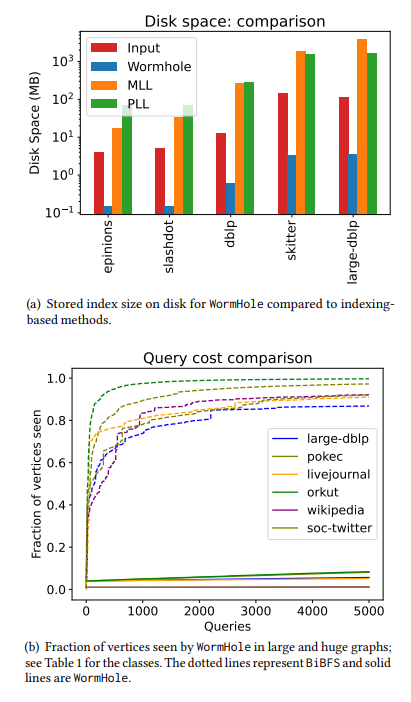
\ up with a solution with efficient preprocessing and fast perinquiry time. Notably, our most accurate (but slowest) variant, WormHole𝐸, has near-perfect accuracy: more than 90% of the inquiries are answered with no additive error, and in all networks, more than 99% of the inquiries are answered with additive error at most 2. See Table 3 for more details.

\ • Extremely rapid setup time. Our longest index construction time was just two minutes even for billion-edged graphs. For context, PLL and MLL timed out on half of the networks that we tested, and for moderately sized graphs where PLL and MLL did finish their runs, WormHole index construction was×100 faster. Namely, WormHole finished in seconds while PLL took hours. See Table 4 and Table 5. This rapid setup time is achieved due to the use of a sublinearly-sized index. For the largest networks we considered, it is sufficient to take an index of about 1% of the nodes to get small mean additive error – see Table 1. For smaller networks, it may be up to 6%.

\ • Fast inquiry time. Compared to BiBFS, the vanilla version WormHole𝐸 (without any index-based optimizations) is ×2 faster for almost all graphs and more than ×4 faster on the three largest graphs that we tested. A simple variant WormHole𝐻 achieves an order of magnitude improvement at some cost to accuracy: consistently 20× faster across almost all graphs, and more than 180× for the largest graph we have. See Table 3 for a full comparison. Indexing based methods typically answer inquiries in microseconds; both of the aforementioned variants are still in the millisecond regime.

\ • Combining WormHole and the state of the art. WormHole works by storing a small subset of vertices on which we compute the exact shortest paths. For arbitrary inquiries, we route our path through this subset, which we call the core. We use this insight to provide a third variant, WormHole𝑀 by implementing the state of the art for shortest paths, MLL, on the core. This achieves inquiry times that are comparable to MLL (with the same accuracy guarantee as WormHole𝐻 ) at a fraction of the setup cost, and runs for massive graphs where MLL does not terminate. We explore this combined approach in §5.3, and provide statistics in Table 6.

\ • Sublinear query complexity. The query complexity refers to the number of vertices queried by the algorithm. In a limited query access model where querying a node reveals its list of neighbors(see §1.2), the query complexity of our algorithm scales very well with the number of distance / shortest path inquiries made. To answer 5000 approximate shortest path inquiries, our algorithm only observes between 1% and 20% of the nodes for most networks. In comparison, BiBFS sees more than 90%of the graph to answer a few hundred shortest path inquiries. See Figure 2 and Figure 5 for a comparison.

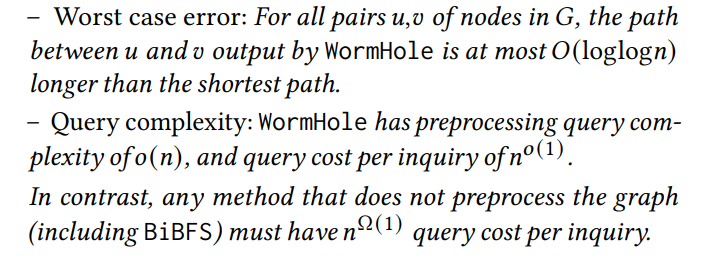
\ • Provable guarantees on error and performance. In §4 we prove a suite of theoretical results complementing and explaining the empirical performance. The results, stated informally below, are proved for the Chung-Lu model of random graphs with a power-law degree distribution [15–17].

\ Theorem 1.1 (Informal). In a Chung-Lu random graph𝐺 with power-law exponent 𝛽 ∈ (2,3) on 𝑛 vertices, WormHole has the following guarantees with high probability:

\
\

:::info Authors:

(1) Talya Eden, Bar-Ilan University (talyaa01@gmail.com);

(2) Omri Ben-Eliezer, MIT (omrib@mit.edu);

(3) C. Seshadhri, UC Santa Cruz (sesh@ucsc.edu).

:::


:::info This paper is available on arxiv under CC BY 4.0 license.

:::

\

Disclaimer: The articles reposted on this site are sourced from public platforms and are provided for informational purposes only. They do not necessarily reflect the views of MEXC. All rights remain with the original authors. If you believe any content infringes on third-party rights, please contact service@support.mexc.com for removal. MEXC makes no guarantees regarding the accuracy, completeness, or timeliness of the content and is not responsible for any actions taken based on the information provided. The content does not constitute financial, legal, or other professional advice, nor should it be considered a recommendation or endorsement by MEXC.

You May Also Like

CME Group to launch options on XRP and SOL futures

CME Group to launch options on XRP and SOL futures

The post CME Group to launch options on XRP and SOL futures appeared on BitcoinEthereumNews.com. CME Group will offer options based on the derivative markets on Solana (SOL) and XRP. The new markets will open on October 13, after regulatory approval.  CME Group will expand its crypto products with options on the futures markets of Solana (SOL) and XRP. The futures market will start on October 13, after regulatory review and approval.  The options will allow the trading of MicroSol, XRP, and MicroXRP futures, with expiry dates available every business day, monthly, and quarterly. The new products will be added to the existing BTC and ETH options markets. ‘The launch of these options contracts builds on the significant growth and increasing liquidity we have seen across our suite of Solana and XRP futures,’ said Giovanni Vicioso, CME Group Global Head of Cryptocurrency Products. The options contracts will have two main sizes, tracking the futures contracts. The new market will be suitable for sophisticated institutional traders, as well as active individual traders. The addition of options markets singles out XRP and SOL as liquid enough to offer the potential to bet on a market direction.  The options on futures arrive a few months after the launch of SOL futures. Both SOL and XRP had peak volumes in August, though XRP activity has slowed down in September. XRP and SOL options to tap both institutions and active traders Crypto options are one of the indicators of market attitudes, with XRP and SOL receiving a new way to gauge sentiment. The contracts will be supported by the Cumberland team.  ‘As one of the biggest liquidity providers in the ecosystem, the Cumberland team is excited to support CME Group’s continued expansion of crypto offerings,’ said Roman Makarov, Head of Cumberland Options Trading at DRW. ‘The launch of options on Solana and XRP futures is the latest example of the…
Share
BitcoinEthereumNews2025/09/18 00:56
SEC Approves Decision Concerning Bitcoin and 9 Altcoins – The Dow Jones of Cryptocurrencies May Have Arrived

SEC Approves Decision Concerning Bitcoin and 9 Altcoins – The Dow Jones of Cryptocurrencies May Have Arrived

The post SEC Approves Decision Concerning Bitcoin and 9 Altcoins – The Dow Jones of Cryptocurrencies May Have Arrived appeared on BitcoinEthereumNews.com. While the cryptocurrency market doesn’t yet have a comprehensive index like the Dow Jones or S&P 500, Bitwise is one step closer to filling this void. The company’s new exchange-traded product, Bitwise 10 Crypto Index ETF (BITW), has begun trading, offering individual investors and financial advisors access to the 10 largest crypto assets in a single product. BITW’s portfolio includes the following digital assets: Bitcoin, Ethereum, XRP, Solana, Chainlink, Litecoin, Cardano, Avalanche, Sui, and Polkadot. Bitwise CEO and co-founder Hunter Horsley told CNBC that this conversion makes the company the first to include altcoins like Cardano, Avalanche, Sui, and Polkadot, which don’t currently have spot ETFs, in an ETF from a major asset manager. “This step significantly broadens the investor base that can access various crypto assets,” Horsley said. “This is particularly important for assets without a spot ETF.” According to the CEO, this ETF also provides significant accessibility for smaller investors who invest through individual retirement accounts (IRAs) or pension funds and are only able to access ETFs. BITW, previously an index fund containing the same assets, has been converted to an ETF and is now listed on the stock exchange with $1.5 billion in assets under management. The ETF structure provides additional benefits to investors by offering greater trading flexibility, tax advantages, and lower costs, along with broader trading permissions. This development follows an expanded wave of ETFs that followed the U.S. Securities and Exchange Commission (SEC) approval of spot Bitcoin ETFs in January 2024. Since then, asset managers have sought approval for a wider range of ETFs, from altcoins like Sui and Aptos to Trump-themed tokens and memecoins like Dogecoin. However, as the market matures, crypto assets are beginning to take on their own dynamics, suggesting that broad-based products like BITW could offer a diversification tool similar…
Share
BitcoinEthereumNews2025/12/10 06:40