In a crypto market often filled with hidden founders and unclear management, one key question arises: who truly controls BlockDAG? […] The post Is BlockDAG Truly Decentralized or Founder-Governed? Here’s What the Data & Roadmap Show! appeared first on Coindoo.In a crypto market often filled with hidden founders and unclear management, one key question arises: who truly controls BlockDAG? […] The post Is BlockDAG Truly Decentralized or Founder-Governed? Here’s What the Data & Roadmap Show! appeared first on Coindoo.

Is BlockDAG Truly Decentralized or Founder-Governed? Here’s What the Data & Roadmap Show!

2025/10/19 01:00
5 min read
For feedback or concerns regarding this content, please contact us at crypto.news@mexc.com

In a crypto market often filled with hidden founders and unclear management, one key question arises: who truly controls BlockDAG? Unlike many projects operating under anonymity, BlockDAG provides complete clarity. Antony Turner, known for his experience at Spirit Blockchain and SwissOne Capital, stands as the project’s guiding force. His leadership combines honesty, strategy, and hands-on delivery, reflected through keynote AMAs and tangible product achievements.

As crypto buyers prioritize trust and openness, BlockDAG (BDAG) positions itself as a transparent project where the founder’s vision aligns with infrastructure goals and future decentralization.

Leadership Identity: A Transparent Name Steering the Vision

Unlike most hidden crypto teams, BlockDAG has a recognizable leader, Antony Turner. His professional record, tied to Spirit Blockchain Capital and SwissOne Capital, strengthens confidence in his credibility. With a long-standing background in fintech and blockchain, Turner leads with accountability and clarity rarely seen in this field.

He has held numerous Keynote AMAs to discuss progress on products, partnerships, and technology. These include live previews of the X1 miner app, BlockDAG dashboard, and the BWT Alpine Formula 1® Team partnership. Each session proves that BlockDAG focuses on execution, not empty promises. Turner’s active participation ensures that while leadership is centralized now, the foundation is built on openness and consistent communication.

Execution Track Record: Leadership-Driven with Structural Focus

BlockDAG’s achievements confirm that focused guidance has been key to its growth. The combination of Proof-of-Work and DAG hybrid model, along with EVM/WASM smart contract support, reflects solid execution. To date, the project has raised over $425 million, sold more than 27 billion coins, gathered 3.5 million plus X1 app miners, and distributed 20,000+ physical miners across 130+ countries. Each phase, from testnet rollout to community leaderboards, has been executed under Turner’s organized direction.
The structure resembles Ethereum’s early stage, where Vitalik Buterin’s leadership guided its progress before full community control. Many experts suggest that a clear leader early on ensures technical strength and adoption before shifting to decentralization.

Governance Model: Controlled Start with Decentralized Vision

Currently, BlockDAG is not a DAO, and decisions remain with the core team and leadership. Still, its governance is evolving gradually toward shared control. The leaderboard ranking during the crypto presale hints at a participation-based system where early supporters could gain influence in the network’s future governance. This points to a future where community engagement and contribution define governance weight.

This hybrid system, central leadership directing progress while preparing for decentralization, has gained attention across crypto projects. BlockDAG’s transparency about its current model, instead of claiming full decentralization prematurely, builds confidence in its process.

Comparing Models: Balancing Decentralization & Leadership

The decentralization versus leadership debate remains ongoing. While DAOs foster inclusiveness, they often face inefficiency and slow decisions. Founder-led systems achieve faster results but depend on the leader’s integrity. BlockDAG operates between these two models. Turner provides direction, while open channels, such as dashboard updates, Q&A sessions, and roadmap disclosures, create a shared environment. This ensures that while control isn’t fully distributed, the community stays informed.

Unlike short-lived meme projects with faceless creators, BlockDAG’s verified presence and security audits from CertiK and Halborn offer assurance. This model shows that decentralization can be structured gradually rather than immediately.

Future Outlook: Progressing Toward Decentralized Governance

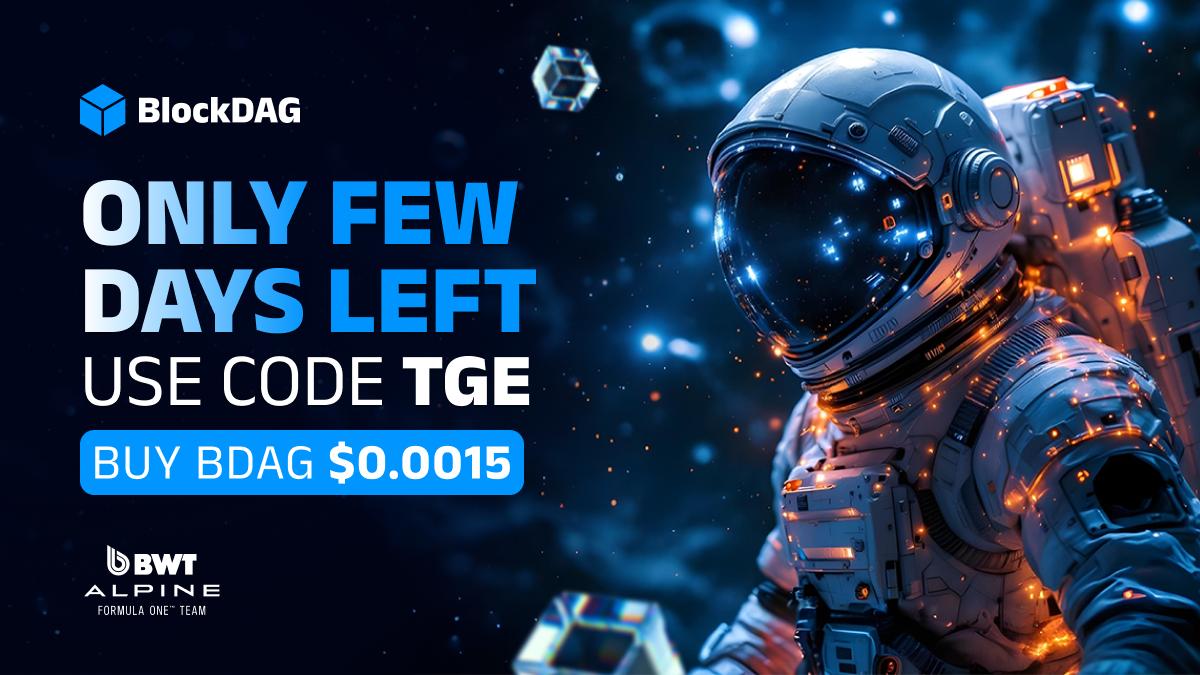
After its mainnet launch, the decentralization discussion will become more prominent. As usage expands, BlockDAG could adopt governance tools such as staking, voting, or proposal systems. The project is now in Batch 31, offering BDAG at just $0.0015 with the TGE code for a limited-time, while its listed batch price is $0.0304. This limited offer gives early supporters a chance to secure long-term involvement in the network.
Given Turner’s focus on sustainability and transparency, decentralization will likely occur once the platform’s base is strong and secure. This gradual approach matches strategies used by major Layer-1 networks like Ethereum and Cardano, which only decentralized after achieving structural stability.

Final Thoughts

So, is BlockDAG decentralized right now? Not entirely, but decentralization remains its long-term aim. It currently follows a founder-led structure under Antony Turner, whose leadership has ensured visible progress and accountability. The project’s growing presale community, ranking systems, audits, and transparent communication demonstrate readiness for broader governance ahead.

In a crypto space often filled with mystery and unreliable leadership, BlockDAG stands out for its clear structure and trustworthy direction, proving that responsible centralization today can set the foundation for genuine decentralization tomorrow.

Presale: https://purchase.blockdag.network

Website: https://blockdag.network

Telegram: https://t.me/blockDAGnetworkOfficial

Discord: https://discord.gg/Q7BxghMVyu 


This publication is sponsored. Coindoo does not endorse or assume responsibility for the content, accuracy, quality, advertising, products, or any other materials on this page. Readers are encouraged to conduct their own research before engaging in any cryptocurrency-related actions. Coindoo will not be liable, directly or indirectly, for any damages or losses resulting from the use of or reliance on any content, goods, or services mentioned. Always do your own research.

The post Is BlockDAG Truly Decentralized or Founder-Governed? Here’s What the Data & Roadmap Show! appeared first on Coindoo.

Disclaimer: The articles reposted on this site are sourced from public platforms and are provided for informational purposes only. They do not necessarily reflect the views of MEXC. All rights remain with the original authors. If you believe any content infringes on third-party rights, please contact crypto.news@mexc.com for removal. MEXC makes no guarantees regarding the accuracy, completeness, or timeliness of the content and is not responsible for any actions taken based on the information provided. The content does not constitute financial, legal, or other professional advice, nor should it be considered a recommendation or endorsement by MEXC.

You May Also Like

Is Doge Losing Steam As Traders Choose Pepeto For The Best Crypto Investment?

Is Doge Losing Steam As Traders Choose Pepeto For The Best Crypto Investment?

The post Is Doge Losing Steam As Traders Choose Pepeto For The Best Crypto Investment? appeared on BitcoinEthereumNews.com. Crypto News 17 September 2025 | 17:39 Is dogecoin really fading? As traders hunt the best crypto to buy now and weigh 2025 picks, Dogecoin (DOGE) still owns the meme coin spotlight, yet upside looks capped, today’s Dogecoin price prediction says as much. Attention is shifting to projects that blend culture with real on-chain tools. Buyers searching “best crypto to buy now” want shipped products, audits, and transparent tokenomics. That frames the true matchup: dogecoin vs. Pepeto. Enter Pepeto (PEPETO), an Ethereum-based memecoin with working rails: PepetoSwap, a zero-fee DEX, plus Pepeto Bridge for smooth cross-chain moves. By fusing story with tools people can use now, and speaking directly to crypto presale 2025 demand, Pepeto puts utility, clarity, and distribution in front. In a market where legacy meme coin leaders risk drifting on sentiment, Pepeto’s execution gives it a real seat in the “best crypto to buy now” debate. First, a quick look at why dogecoin may be losing altitude. Dogecoin Price Prediction: Is Doge Really Fading? Remember when dogecoin made crypto feel simple? In 2013, DOGE turned a meme into money and a loose forum into a movement. A decade on, the nonstop momentum has cooled; the backdrop is different, and the market is far more selective. With DOGE circling ~$0.268, the tape reads bearish-to-neutral for the next few weeks: hold the $0.26 shelf on daily closes and expect choppy range-trading toward $0.29–$0.30 where rallies keep stalling; lose $0.26 decisively and momentum often bleeds into $0.245 with risk of a deeper probe toward $0.22–$0.21; reclaim $0.30 on a clean daily close and the downside bias is likely neutralized, opening room for a squeeze into the low-$0.30s. Source: CoinMarketcap / TradingView Beyond the dogecoin price prediction, DOGE still centers on payments and lacks native smart contracts; ZK-proof verification is proposed,…
Share
BitcoinEthereumNews2025/09/18 00:14
Wormhole launches reserve tying protocol revenue to token

Wormhole launches reserve tying protocol revenue to token

The post Wormhole launches reserve tying protocol revenue to token appeared on BitcoinEthereumNews.com. Wormhole is changing how its W token works by creating a new reserve designed to hold value for the long term. Announced on Wednesday, the Wormhole Reserve will collect onchain and offchain revenues and other value generated across the protocol and its applications (including Portal) and accumulate them into W, locking the tokens within the reserve. The reserve is part of a broader update called W 2.0. Other changes include a 4% targeted base yield for tokenholders who stake and take part in governance. While staking rewards will vary, Wormhole said active users of ecosystem apps can earn boosted yields through features like Portal Earn. The team stressed that no new tokens are being minted; rewards come from existing supply and protocol revenues, keeping the cap fixed at 10 billion. Wormhole is also overhauling its token release schedule. Instead of releasing large amounts of W at once under the old “cliff” model, the network will shift to steady, bi-weekly unlocks starting October 3, 2025. The aim is to avoid sharp periods of selling pressure and create a more predictable environment for investors. Lockups for some groups, including validators and investors, will extend an additional six months, until October 2028. Core contributor tokens remain under longer contractual time locks. Wormhole launched in 2020 as a cross-chain bridge and now connects more than 40 blockchains. The W token powers governance and staking, with a capped supply of 10 billion. By redirecting fees and revenues into the new reserve, Wormhole is betting that its token can maintain value as demand for moving assets and data between chains grows. This is a developing story. This article was generated with the assistance of AI and reviewed by editor Jeffrey Albus before publication. Get the news in your inbox. Explore Blockworks newsletters: Source: https://blockworks.co/news/wormhole-launches-reserve
Share
BitcoinEthereumNews2025/09/18 01:55
Cryptos Signal Divergence Ahead of Fed Rate Decision

Cryptos Signal Divergence Ahead of Fed Rate Decision

The post Cryptos Signal Divergence Ahead of Fed Rate Decision appeared on BitcoinEthereumNews.com. Crypto assets send conflicting signals ahead of the Federal Reserve’s September rate decision. On-chain data reveals a clear decrease in Bitcoin and Ethereum flowing into centralized exchanges, but a sharp increase in altcoin inflows. The findings come from a Tuesday report by CryptoQuant, an on-chain data platform. The firm’s data shows a stark divergence in coin volume, which has been observed in movements onto centralized exchanges over the past few weeks. Bitcoin and Ethereum Inflows Drop to Multi-Month Lows Sponsored Sponsored Bitcoin has seen a dramatic drop in exchange inflows, with the 7-day moving average plummeting to 25,000 BTC, its lowest level in over a year. The average deposit per transaction has fallen to 0.57 BTC as of September. This suggests that smaller retail investors, rather than large-scale whales, are responsible for the recent cash-outs. Ethereum is showing a similar trend, with its daily exchange inflows decreasing to a two-month low. CryptoQuant reported that the 7-day moving average for ETH deposits on exchanges is around 783,000 ETH, the lowest in two months. Other Altcoins See Renewed Selling Pressure In contrast, other altcoin deposit activity on exchanges has surged. The number of altcoin deposit transactions on centralized exchanges was quite steady in May and June of this year, maintaining a 7-day moving average of about 20,000 to 30,000. Recently, however, that figure has jumped to 55,000 transactions. Altcoins: Exchange Inflow Transaction Count. Source: CryptoQuant CryptoQuant projects that altcoins, given their increased inflow activity, could face relatively higher selling pressure compared to BTC and ETH. Meanwhile, the balance of stablecoins on exchanges—a key indicator of potential buying pressure—has increased significantly. The report notes that the exchange USDT balance, around $273 million in April, grew to $379 million by August 31, marking a new yearly high. CryptoQuant interprets this surge as a reflection of…
Share
BitcoinEthereumNews2025/09/18 01:01