October has been the month of volatility for bitcoin, with the digital currency falling 5.33%, its first negative October in six years. In general, BTC is strongest in Q4, and this year has been no exception to the rule; results have fallen short of expectations. Traders are scrambling again as the price of Bitcoin whipsaws. Between Oct. 12 and 19, Bitcoin traded between $104,778 to $115,934, and people are left scratching their heads on where it goes next. Here is what’s driving Bitcoin’s recent wild price ride as the month comes to a close. Bitcoin October Volatility Bitcoin’s performance in October is far from normal. On the week, it fell 3.8%, setting traders’ nerves on edge. As of Oct. 19, the price of Bitcoin was around $108,000, far below its recent highs. $104,000 to $115,000 is a big range and quite volatile. Throughout history, Bitcoin has been known to see a strong showing in October, but the red month this year is even more apparent. Bitcoin remains at the whim of an uncertain market, and traders hunt for signs of stability or further drops. Trump’s Influence on Bitcoin October Volatility The U.S. President Donald Trump is one of the major factors in Bitcoin’s large movements this October. His social media missives, especially on Truth Social, have sent the price of Bitcoin wildly spinning in all directions. Also Read: Bitcoin Price Prediction Q4 2025: Experts Signal a Potential $130K Breakout Before Year End His comments such as the suggested U.S. SBR, has only added to the market’s instability. Getty Images His pro-crypto leaning has buoyed Bitcoin for some time, but his inconsistent views on tariffs and economic policy have left the coin even more volatile. Technical Price Levels to Watch With the volatility of Bitcoin in the recent weeks, traders are closely watching some crucial levels. The $103,000 to $106,000 area has been important for Bitcoin as it has failed to keep a rally going after hitting nearly $126,000 earlier this year. A move below $103,000 could indicate a deeper drop, toward the $100,000 level. Conversely, a strong move higher above $123,000 could potentially lead to an extensive rally. Month Minimum Price Average Price Maximum Price Potential ROI October $108,194.61 $116,084.95 $123,975.29 14.6% November $111,250.55 $115,870.38 $120,490.20 11.4% December $111,412.68 $113,369.75 $115,326.82 6.6% Other analysts see it going up to $148,000 or even above $200,000 before the end of the year — but that’s if Bitcoin blows past some key resistance levels. But Bitcoin’s repeated failure to overcome $123,000 gives rise to concerns about further volatility. The Role of Macroeconomic Policies Macroeconomic concerns are also a driving force of Bitcoin October volatility. Time will tell – as liquidity flows, interest rate reductions and fiscal policy might finally be the tailwind that bitcoin needs to recover. Analysts are closely monitoring the Federal Reserve’s actions, particularly its expected interest rate cuts. The CME Fedwatch tool currently shows a 98.9% probability of a quarter-point rate cut by the end of October.  Source: CME Group That would potentially give Bitcoin the tailwind it needs to push through resistance levels. But there could also de potential inflation fears and banking instability that could scupper the emergence, which makes the market capricious. ETF Developments and Institutional Interest The surge in Bitcoin October Volatility is also driven by the increasing presence of Exchange-Traded Funds (ETFs) and institutional investors. This trend should persist in 2025 with institutions ruling the Bitcoin ETFs roost. Any new approvals of ETFs or inflows could drive up Bitcoin’s price; access to the cryptocurrency is widening. Corporate treasuries are also hoarding Bitcoin, which has reduced supply and assuaged investor sentiment. Mining Metrics and Network Strength Part of the reason that Bitcoin has been so volatile this October is because of its mining network. The hash rate, or amount of computational power that has been used to mine the virtual currency Bitcoin, is at an all-time high. This illustrates that miners continue to believe in the future of Bitcoin. But as mining difficulties rise and their yield in hash prices drops, smaller scale miners might not be able to compete. Hashrate falling off a cliff could indicate that miner capitulation is on the way, and this has been traditionally followed by price corrections. Conclusion October, Bitcoin is far from done being volatile. Traders are focused on political and macroeconomic developments as well as technical levels to infer a direction. Regardless of whether Bitcoin moves through resistance or collapses into further uncertainty, one thing is undeniable: Bitcoin’s October volatility has demonstrated that volatility is a kinetic force due to political and monetary reforms, and technical difficulties. Also Read: Bitcoin Volatility Surges Will BTC Hold Above $105K or Break Lower? Summary  Bitcoin drops 5.33% in October, marking its first negative October in six years amid volatility. Trump’s statements and fiscal policies fuel Bitcoin’s volatility, adding uncertainty to the market. Bitcoin faces key resistance at $123,000; strong mining network signals long-term growth potential Appendix: Glossary of Key Terms Bitcoin Price Volatility: The ups and downs in bitcoin price, caused by political, economic or technical factors. Resistance: A level that Bitcoin finds difficulty to break through above a certain price point. Bitcoin ETFs: Funds available to institutional investors that help them get access to Bitcoin, impacting the price. Hashrate: The amount of computing power involved in Bitcoin mining to determine network health and price movements. Correction: Drop in the price of Bitcoin from a recent investment mania or mining network change. Institutional Investors: Corporations, funds and so on that influence Bitcoin’s price by making big investments. Frequently Asked Questions Bitcoin October Volatility 1: What’s causing Bitcoin’s volatility in October? Bitcoin’s volatility this October is driven by a combination of political factors, including President Trump’s erratic statements, as well as macroeconomic policies and technical price resistance levels. 2: Will Bitcoin recover before the end of 2025? Bitcoin could recover if it breaks through resistance at $123,000. However, its volatility remains high, and market conditions will need to stabilize for a sustained rally. 3: How do Bitcoin ETFs impact its volatility? Bitcoin ETFs have attracted institutional investors, which can push Bitcoin’s price up. However, ETF outflows or regulatory changes could add to the volatility. 4: How does Bitcoin’s hashrate affect its price? The hashrate reflects the strength of Bitcoin’s mining network. A drop in hashrate could signal a price correction, while continued strength suggests confidence in future price growth. Read More: Bitcoin October Volatility: Is There Hope for Recovery as Year-End Approaches?">Bitcoin October Volatility: Is There Hope for Recovery as Year-End Approaches?October has been the month of volatility for bitcoin, with the digital currency falling 5.33%, its first negative October in six years. In general, BTC is strongest in Q4, and this year has been no exception to the rule; results have fallen short of expectations. Traders are scrambling again as the price of Bitcoin whipsaws. Between Oct. 12 and 19, Bitcoin traded between $104,778 to $115,934, and people are left scratching their heads on where it goes next. Here is what’s driving Bitcoin’s recent wild price ride as the month comes to a close. Bitcoin October Volatility Bitcoin’s performance in October is far from normal. On the week, it fell 3.8%, setting traders’ nerves on edge. As of Oct. 19, the price of Bitcoin was around $108,000, far below its recent highs. $104,000 to $115,000 is a big range and quite volatile. Throughout history, Bitcoin has been known to see a strong showing in October, but the red month this year is even more apparent. Bitcoin remains at the whim of an uncertain market, and traders hunt for signs of stability or further drops. Trump’s Influence on Bitcoin October Volatility The U.S. President Donald Trump is one of the major factors in Bitcoin’s large movements this October. His social media missives, especially on Truth Social, have sent the price of Bitcoin wildly spinning in all directions. Also Read: Bitcoin Price Prediction Q4 2025: Experts Signal a Potential $130K Breakout Before Year End His comments such as the suggested U.S. SBR, has only added to the market’s instability. Getty Images His pro-crypto leaning has buoyed Bitcoin for some time, but his inconsistent views on tariffs and economic policy have left the coin even more volatile. Technical Price Levels to Watch With the volatility of Bitcoin in the recent weeks, traders are closely watching some crucial levels. The $103,000 to $106,000 area has been important for Bitcoin as it has failed to keep a rally going after hitting nearly $126,000 earlier this year. A move below $103,000 could indicate a deeper drop, toward the $100,000 level. Conversely, a strong move higher above $123,000 could potentially lead to an extensive rally. Month Minimum Price Average Price Maximum Price Potential ROI October $108,194.61 $116,084.95 $123,975.29 14.6% November $111,250.55 $115,870.38 $120,490.20 11.4% December $111,412.68 $113,369.75 $115,326.82 6.6% Other analysts see it going up to $148,000 or even above $200,000 before the end of the year — but that’s if Bitcoin blows past some key resistance levels. But Bitcoin’s repeated failure to overcome $123,000 gives rise to concerns about further volatility. The Role of Macroeconomic Policies Macroeconomic concerns are also a driving force of Bitcoin October volatility. Time will tell – as liquidity flows, interest rate reductions and fiscal policy might finally be the tailwind that bitcoin needs to recover. Analysts are closely monitoring the Federal Reserve’s actions, particularly its expected interest rate cuts. The CME Fedwatch tool currently shows a 98.9% probability of a quarter-point rate cut by the end of October.  Source: CME Group That would potentially give Bitcoin the tailwind it needs to push through resistance levels. But there could also de potential inflation fears and banking instability that could scupper the emergence, which makes the market capricious. ETF Developments and Institutional Interest The surge in Bitcoin October Volatility is also driven by the increasing presence of Exchange-Traded Funds (ETFs) and institutional investors. This trend should persist in 2025 with institutions ruling the Bitcoin ETFs roost. Any new approvals of ETFs or inflows could drive up Bitcoin’s price; access to the cryptocurrency is widening. Corporate treasuries are also hoarding Bitcoin, which has reduced supply and assuaged investor sentiment. Mining Metrics and Network Strength Part of the reason that Bitcoin has been so volatile this October is because of its mining network. The hash rate, or amount of computational power that has been used to mine the virtual currency Bitcoin, is at an all-time high. This illustrates that miners continue to believe in the future of Bitcoin. But as mining difficulties rise and their yield in hash prices drops, smaller scale miners might not be able to compete. Hashrate falling off a cliff could indicate that miner capitulation is on the way, and this has been traditionally followed by price corrections. Conclusion October, Bitcoin is far from done being volatile. Traders are focused on political and macroeconomic developments as well as technical levels to infer a direction. Regardless of whether Bitcoin moves through resistance or collapses into further uncertainty, one thing is undeniable: Bitcoin’s October volatility has demonstrated that volatility is a kinetic force due to political and monetary reforms, and technical difficulties. Also Read: Bitcoin Volatility Surges Will BTC Hold Above $105K or Break Lower? Summary  Bitcoin drops 5.33% in October, marking its first negative October in six years amid volatility. Trump’s statements and fiscal policies fuel Bitcoin’s volatility, adding uncertainty to the market. Bitcoin faces key resistance at $123,000; strong mining network signals long-term growth potential Appendix: Glossary of Key Terms Bitcoin Price Volatility: The ups and downs in bitcoin price, caused by political, economic or technical factors. Resistance: A level that Bitcoin finds difficulty to break through above a certain price point. Bitcoin ETFs: Funds available to institutional investors that help them get access to Bitcoin, impacting the price. Hashrate: The amount of computing power involved in Bitcoin mining to determine network health and price movements. Correction: Drop in the price of Bitcoin from a recent investment mania or mining network change. Institutional Investors: Corporations, funds and so on that influence Bitcoin’s price by making big investments. Frequently Asked Questions Bitcoin October Volatility 1: What’s causing Bitcoin’s volatility in October? Bitcoin’s volatility this October is driven by a combination of political factors, including President Trump’s erratic statements, as well as macroeconomic policies and technical price resistance levels. 2: Will Bitcoin recover before the end of 2025? Bitcoin could recover if it breaks through resistance at $123,000. However, its volatility remains high, and market conditions will need to stabilize for a sustained rally. 3: How do Bitcoin ETFs impact its volatility? Bitcoin ETFs have attracted institutional investors, which can push Bitcoin’s price up. However, ETF outflows or regulatory changes could add to the volatility. 4: How does Bitcoin’s hashrate affect its price? The hashrate reflects the strength of Bitcoin’s mining network. A drop in hashrate could signal a price correction, while continued strength suggests confidence in future price growth. Read More: Bitcoin October Volatility: Is There Hope for Recovery as Year-End Approaches?">Bitcoin October Volatility: Is There Hope for Recovery as Year-End Approaches?


Bitcoin October Volatility: Is There Hope for Recovery as Year-End Approaches?

October has been the month of volatility for bitcoin, with the digital currency falling 5.33%, its first negative October in six years. In general, BTC is strongest in Q4, and this year has been no exception to the rule; results have fallen short of expectations.

Traders are scrambling again as the price of Bitcoin whipsaws. Between Oct. 12 and 19, Bitcoin traded between $104,778 to $115,934, and people are left scratching their heads on where it goes next. Here is what’s driving Bitcoin’s recent wild price ride as the month comes to a close.

Bitcoin October Volatility

Bitcoin’s performance in October is far from normal. On the week, it fell 3.8%, setting traders’ nerves on edge. As of Oct. 19, the price of

Bitcoin was around $108,000, far below its recent highs. $104,000 to $115,000 is a big range and quite volatile.

Throughout history, Bitcoin has been known to see a strong showing in October, but the red month this year is even more apparent. Bitcoin remains at the whim of an uncertain market, and traders hunt for signs of stability or further drops.

Trump’s Influence on Bitcoin October Volatility

The U.S. President Donald Trump is one of the major factors in Bitcoin’s large movements this October. His social media missives, especially on Truth Social, have sent the price of Bitcoin wildly spinning in all directions.

Also Read: Bitcoin Price Prediction Q4 2025: Experts Signal a Potential $130K Breakout Before Year End

His comments such as the suggested U.S. SBR, has only added to the market’s instability. Getty Images His pro-crypto leaning has buoyed Bitcoin for some time, but his inconsistent views on tariffs and economic policy have left the coin even more volatile.

Technical Price Levels to Watch

With the volatility of Bitcoin in the recent weeks, traders are closely watching some crucial levels. The $103,000 to $106,000 area has been important for Bitcoin as it has failed to keep a rally going after hitting nearly $126,000 earlier this year.

A move below $103,000 could indicate a deeper drop, toward the $100,000 level. Conversely, a strong move higher above $123,000 could potentially lead to an extensive rally.

MonthMinimum PriceAverage PriceMaximum PricePotential ROI
October$108,194.61$116,084.95$123,975.29
14.6%
November$111,250.55$115,870.38$120,490.20
11.4%
December$111,412.68$113,369.75$115,326.82
6.6%

Other analysts see it going up to $148,000 or even above $200,000 before the end of the year — but that’s if Bitcoin blows past some key resistance levels. But Bitcoin’s repeated failure to overcome $123,000 gives rise to concerns about further volatility.

The Role of Macroeconomic Policies

Macroeconomic concerns are also a driving force of Bitcoin October volatility. Time will tell – as liquidity flows, interest rate reductions and fiscal policy might finally be the tailwind that bitcoin needs to recover.

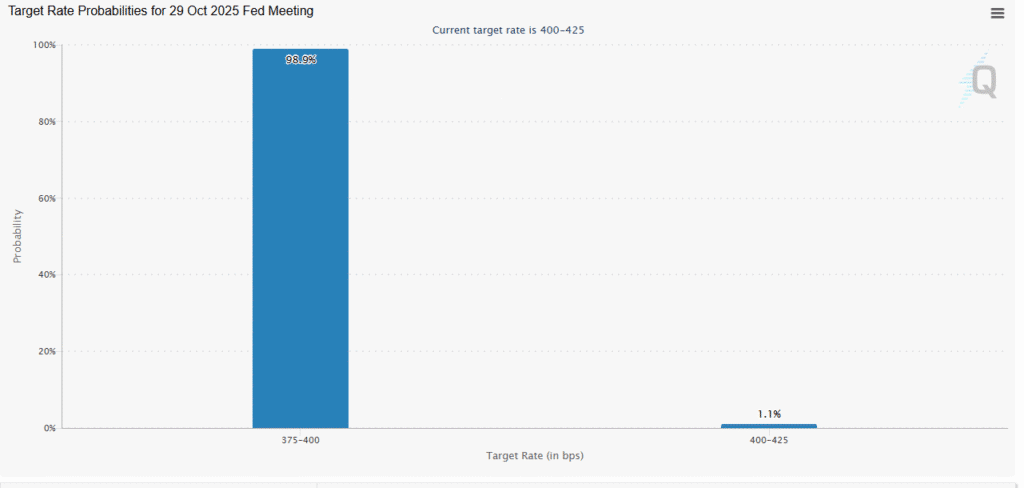
Analysts are closely monitoring the Federal Reserve’s actions, particularly its expected interest rate cuts. The CME Fedwatch tool currently shows a 98.9% probability of a quarter-point rate cut by the end of October. 

Bitcoin October VolatilitySource: CME Group

That would potentially give Bitcoin the tailwind it needs to push through resistance levels. But there could also de potential inflation fears and banking instability that could scupper the emergence, which makes the market capricious.

ETF Developments and Institutional Interest

The surge in Bitcoin October Volatility is also driven by the increasing presence of Exchange-Traded Funds (ETFs) and institutional investors. This trend should persist in 2025 with institutions ruling the Bitcoin ETFs roost.

Any new approvals of ETFs or inflows could drive up Bitcoin’s price; access to the cryptocurrency is widening. Corporate treasuries are also hoarding Bitcoin, which has reduced supply and assuaged investor sentiment.

Mining Metrics and Network Strength

Part of the reason that Bitcoin has been so volatile this October is because of its mining network. The hash rate, or amount of computational power that has been used to mine the virtual currency Bitcoin, is at an all-time high. This illustrates that miners continue to believe in the future of Bitcoin.

But as mining difficulties rise and their yield in hash prices drops, smaller scale miners might not be able to compete. Hashrate falling off a cliff could indicate that miner capitulation is on the way, and this has been traditionally followed by price corrections.

Conclusion

October, Bitcoin is far from done being volatile. Traders are focused on political and macroeconomic developments as well as technical levels to infer a direction.

Regardless of whether Bitcoin moves through resistance or collapses into further uncertainty, one thing is undeniable: Bitcoin’s October volatility has demonstrated that volatility is a kinetic force due to political and monetary reforms, and technical difficulties.

Also Read: Bitcoin Volatility Surges Will BTC Hold Above $105K or Break Lower?

Summary 

  • Bitcoin drops 5.33% in October, marking its first negative October in six years amid volatility.
  • Trump’s statements and fiscal policies fuel Bitcoin’s volatility, adding uncertainty to the market.
  • Bitcoin faces key resistance at $123,000; strong mining network signals long-term growth potential

Appendix: Glossary of Key Terms

Bitcoin Price Volatility: The ups and downs in bitcoin price, caused by political, economic or technical factors.

Resistance: A level that Bitcoin finds difficulty to break through above a certain price point.

Bitcoin ETFs: Funds available to institutional investors that help them get access to Bitcoin, impacting the price.

Hashrate: The amount of computing power involved in Bitcoin mining to determine network health and price movements.

Correction: Drop in the price of Bitcoin from a recent investment mania or mining network change.

Institutional Investors: Corporations, funds and so on that influence Bitcoin’s price by making big investments.

Frequently Asked Questions Bitcoin October Volatility

1: What’s causing Bitcoin’s volatility in October?

Bitcoin’s volatility this October is driven by a combination of political factors, including President Trump’s erratic statements, as well as macroeconomic policies and technical price resistance levels.

2: Will Bitcoin recover before the end of 2025?

Bitcoin could recover if it breaks through resistance at $123,000. However, its volatility remains high, and market conditions will need to stabilize for a sustained rally.

3: How do Bitcoin ETFs impact its volatility?

Bitcoin ETFs have attracted institutional investors, which can push Bitcoin’s price up. However, ETF outflows or regulatory changes could add to the volatility.

4: How does Bitcoin’s hashrate affect its price?

The hashrate reflects the strength of Bitcoin’s mining network. A drop in hashrate could signal a price correction, while continued strength suggests confidence in future price growth.

Read More: Bitcoin October Volatility: Is There Hope for Recovery as Year-End Approaches?">Bitcoin October Volatility: Is There Hope for Recovery as Year-End Approaches?

Market Opportunity
SIX Logo
SIX Price(SIX)
$0.01193
$0.01193$0.01193
+4.74%
USD
SIX (SIX) Live Price Chart
Disclaimer: The articles reposted on this site are sourced from public platforms and are provided for informational purposes only. They do not necessarily reflect the views of MEXC. All rights remain with the original authors. If you believe any content infringes on third-party rights, please contact service@support.mexc.com for removal. MEXC makes no guarantees regarding the accuracy, completeness, or timeliness of the content and is not responsible for any actions taken based on the information provided. The content does not constitute financial, legal, or other professional advice, nor should it be considered a recommendation or endorsement by MEXC.

You May Also Like

The US dollar's share of global foreign exchange reserves has fallen below 60%.

The US dollar's share of global foreign exchange reserves has fallen below 60%.

PANews reported on January 24th that, according to Jinshi, international gold prices are projected to rise by over 64% in 2025, marking the largest annual increase
Share
PANews2026/01/24 14:30
Younger Americans Back Crypto Survey: Why Digitap ($TAP) is the Best Crypto Presale for the Next Generation

Younger Americans Back Crypto Survey: Why Digitap ($TAP) is the Best Crypto Presale for the Next Generation

The post Younger Americans Back Crypto Survey: Why Digitap ($TAP) is the Best Crypto Presale for the Next Generation appeared first on Coinpedia Fintech News A
Share
CoinPedia2026/01/24 14:42
MetaMask Token: Exciting Launch Could Be Sooner Than Expected

MetaMask Token: Exciting Launch Could Be Sooner Than Expected

BitcoinWorld MetaMask Token: Exciting Launch Could Be Sooner Than Expected The cryptocurrency community is buzzing with exciting news: a native MetaMask token might arrive sooner than many anticipated. This development could reshape how users interact with the popular Web3 wallet and the broader decentralized ecosystem. It signals a significant step forward for one of the most widely used tools in the blockchain space. What’s Fueling the MetaMask Token Buzz? Joseph Lubin, the CEO of ConsenSys, the company behind MetaMask, recently shared insights that ignited this excitement. According to reports from The Block, Lubin indicated that a MetaMask token could launch ahead of previous expectations. This isn’t the first time the idea has surfaced; Dan Finlay, one of MetaMask’s founders, had previously mentioned the possibility of issuing such a token. ConsenSys has been a pivotal player in the Ethereum ecosystem, developing essential infrastructure and applications. MetaMask, their flagship wallet, serves millions of users, providing a gateway to decentralized applications (dApps), NFTs, and various blockchain networks. Therefore, any move to introduce a native token is a major event for the entire Web3 community. Why is a MetaMask Token So Anticipated? The prospect of a MetaMask token generates immense interest because it could introduce new layers of utility and community governance. Users often speculate about the benefits such a token could offer. Here are some key reasons for the high anticipation: Governance Rights: A token could empower users to participate in the future direction and development of MetaMask. This means voting on new features, upgrades, or even changes to the platform’s policies. Ecosystem Rewards: Tokens might be distributed as rewards for active participation, using certain features, or contributing to the MetaMask community. This incentivizes engagement and loyalty. Enhanced Utility: The token could unlock premium features, reduce transaction fees, or provide exclusive access to services within the MetaMask ecosystem or partnered dApps. Decentralization: Introducing a token often aligns with the broader Web3 ethos of decentralization, distributing control and ownership among its users rather than centralizing it within ConsenSys. Consequently, a token launch is seen as a way to deepen user involvement and foster a more robust, community-driven ecosystem around the wallet. Exploring the Potential Impact of a MetaMask Token The introduction of a MetaMask token could have far-reaching implications for the decentralized finance (DeFi) and Web3 landscape. Firstly, it could set a new standard for how popular infrastructure tools engage with their user base. By providing a tangible stake, MetaMask might strengthen its position as a community-governed platform. Moreover, a token could significantly boost the wallet’s visibility and adoption, attracting new users eager to participate in its governance or benefit from its utility. This could also lead to innovative integrations with other blockchain projects, creating a more interconnected and efficient Web3 experience. Ultimately, the success of such a token will depend on its design, utility, and how effectively it engages the global MetaMask community. What Challenges Could a MetaMask Token Face? While the excitement is palpable, launching a MetaMask token also presents several challenges that ConsenSys must navigate carefully. One primary concern is regulatory scrutiny. The classification of cryptocurrency tokens varies across jurisdictions, and ensuring compliance is crucial for long-term success. Furthermore, designing a fair and equitable distribution model is paramount. Ensuring that the token provides genuine utility beyond mere speculation will be another hurdle. A token must integrate seamlessly into the MetaMask experience and offer clear value to its holders. Additionally, managing community expectations and preventing market manipulation will require robust strategies. Addressing these challenges effectively will be key to the token’s sustainable growth and positive reception. What’s Next for the MetaMask Ecosystem? The prospect of a MetaMask token signals an evolving strategy for ConsenSys and the future of Web3 wallets. It reflects a growing trend where foundational tools seek to empower their communities through tokenization. Users are keenly watching for official announcements regarding the token’s mechanics, distribution, and launch timeline. This development could solidify MetaMask’s role not just as a wallet, but as a central pillar of decentralized identity and interaction. The potential for a sooner-than-expected launch adds an element of urgency and excitement, encouraging users to stay informed about every new detail. It represents a significant milestone for a platform that has become synonymous with accessing the decentralized web. Conclusion The hints from ConsenSys CEO Joseph Lubin regarding an earlier launch for the MetaMask token have undoubtedly captured the attention of the entire crypto world. This potential development promises to bring enhanced governance, utility, and community engagement to millions of MetaMask users. While challenges exist, the underlying potential for a more decentralized and user-driven ecosystem is immense. The coming months will likely reveal more about this highly anticipated token, marking a new chapter for one of Web3’s most vital tools. Frequently Asked Questions (FAQs) Q1: What is a MetaMask token? A MetaMask token would be a native cryptocurrency issued by ConsenSys, the company behind the MetaMask wallet. It is expected to offer various utilities, including governance rights, rewards, and access to special features within the MetaMask ecosystem. Q2: Why is ConsenSys considering launching a MetaMask token? ConsenSys is likely exploring a token launch to further decentralize the MetaMask platform, empower its user community with governance rights, incentivize active participation, and potentially unlock new forms of utility and growth for the ecosystem. Q3: What benefits could users gain from a MetaMask token? Users could gain several benefits, such as the ability to vote on MetaMask’s future developments, earn rewards for using the wallet, access exclusive features, or potentially reduce transaction fees. It also provides a direct stake in the platform’s success. Q4: When is the MetaMask token expected to launch? While no official launch date has been confirmed, ConsenSys CEO Joseph Lubin has indicated that the launch could happen sooner than previously expected. The exact timeline remains subject to official announcements from ConsenSys. Q5: How would a MetaMask token impact the broader Web3 ecosystem? A MetaMask token could significantly impact Web3 by setting a precedent for user-owned and governed infrastructure tools. It could drive further decentralization, foster innovation, and strengthen the connection between users and the platforms they rely on, ultimately contributing to a more robust and participatory decentralized internet. To learn more about the latest crypto market trends, explore our article on key developments shaping Ethereum institutional adoption. This post MetaMask Token: Exciting Launch Could Be Sooner Than Expected first appeared on BitcoinWorld.
Share
Coinstats2025/09/19 15:40