Circle Internet Group (NYSE: CRCL) has launched the public testnet for Arc, its open Layer-1 blockchain designed to bring more economic activity onchain. In a press release, Circle explains Arc is positioned as a new “Economic Operating System” for the internet, it combines predictable dollar-based fees, sub-second transaction finality, configurable privacy, and direct integration with Circle’s full-stack platform. The network has already attracted collaboration from more than 100 institutions across global finance and technology — including BlackRock, Visa, and Amazon Web Services (AWS) — along with major capital markets, banks, and fintech players. Developers and enterprises can now deploy, test, and build applications on Arc as Circle aims to create a unified, programmable financial infrastructure for the global economy. Circle CEO Jeremy Allaire described Arc as “purpose-built to connect every local market to the global economy,”highlighting its mission to enable faster, more inclusive, and internet-native financial systems. Institutions and Capital Markets Join the Testnet Arc’s early partners include some of the world’s largest financial institutions and asset managers — among them Goldman Sachs, BNY Mellon, Société Générale, Standard Chartered, State Street, and Apollo Global Management. These participants will experiment with tokenized assets, lending, and programmable FX settlement on the network. According to Robert Mitchnick, Global Head of Digital Assets at BlackRock, the project offers “insight into how stablecoin-denominated settlement and onchain FX could enable more efficient capital markets.” Expanding the Onchain Payments Beyond capital markets, Arc’s testnet features integration with global payments and fintech leaders such as Mastercard, Nuvei, Brex, Cloudflare, FIS, and dLocal. The network aims to power cross-border payments, merchant settlements, and programmable finance — including use by AI-driven autonomous agents to send, exchange, and settle value in real time. Visa’s Head of Crypto, Cuy Sheffield, said the company is exploring how Arc’s design — integrating stablecoin-based gas fees and deterministic finality — could “help scale emerging onchain infrastructure.” The Road to Decentralized Governance While Circle is currently stewarding Arc’s early development, the company plans to transition toward distributed, community-driven governance. The network’s roadmap includes expanding validator participation and establishing transparent frameworks to ensure open, verifiable operations. Ultimately, Circle envisions Arc as a shared, neutral layer of economic infrastructure — a blockchain backbone for global finance that bridges regulated institutions, fintech innovators, and decentralized networks. With major players like BlackRock, Visa, and AWS already onboard, Arc’s testnet marks a decisive step toward making onchain finance mainstream. Price Action Shares of Circle Internet Group Inc. (NYSE: CRCL) climbed 7.2% over the past month, closing at $143.29 on Monday amid renewed investor optimism surrounding the company’s blockchain expansion efforts. The stock opened at $146.93, trading between a monthly low of $138.10 and a high of $147.44, with a current market capitalization of $32.95 billion. While the pre-market price shows a slight dip to $141.57 (-1.20%), Circle’s recent momentum reflects growing confidence in the company’s long-term strategy to become a core infrastructure provider for the digital asset economy. Arc’s launch marks a strategic evolution for Circle, best known as the issuer of USDC, one of the world’s leading stablecoins. The new blockchain aims to serve as a foundation for tokenized assets, onchain payments, and programmable finance, integrating directly with Circle’s existing products and services. Investors have interpreted the Arc testnet launch — and its backing by major financial institutions — as a signal that Circle is deepening its role in bridging traditional finance and blockchain technology. Analysts suggest that the company’s partnerships with BNY Mellon, Goldman Sachs, and Société Générale through Arc could attract institutional liquidity and strengthen Circle’s positioning in the onchain settlement market. The broader crypto sector has also shown signs of renewed activity, with sentiment improving after the approval of multiple digital asset ETFs and growing institutional participation in blockchain infrastructureCircle Internet Group (NYSE: CRCL) has launched the public testnet for Arc, its open Layer-1 blockchain designed to bring more economic activity onchain. In a press release, Circle explains Arc is positioned as a new “Economic Operating System” for the internet, it combines predictable dollar-based fees, sub-second transaction finality, configurable privacy, and direct integration with Circle’s full-stack platform. The network has already attracted collaboration from more than 100 institutions across global finance and technology — including BlackRock, Visa, and Amazon Web Services (AWS) — along with major capital markets, banks, and fintech players. Developers and enterprises can now deploy, test, and build applications on Arc as Circle aims to create a unified, programmable financial infrastructure for the global economy. Circle CEO Jeremy Allaire described Arc as “purpose-built to connect every local market to the global economy,”highlighting its mission to enable faster, more inclusive, and internet-native financial systems. Institutions and Capital Markets Join the Testnet Arc’s early partners include some of the world’s largest financial institutions and asset managers — among them Goldman Sachs, BNY Mellon, Société Générale, Standard Chartered, State Street, and Apollo Global Management. These participants will experiment with tokenized assets, lending, and programmable FX settlement on the network. According to Robert Mitchnick, Global Head of Digital Assets at BlackRock, the project offers “insight into how stablecoin-denominated settlement and onchain FX could enable more efficient capital markets.” Expanding the Onchain Payments Beyond capital markets, Arc’s testnet features integration with global payments and fintech leaders such as Mastercard, Nuvei, Brex, Cloudflare, FIS, and dLocal. The network aims to power cross-border payments, merchant settlements, and programmable finance — including use by AI-driven autonomous agents to send, exchange, and settle value in real time. Visa’s Head of Crypto, Cuy Sheffield, said the company is exploring how Arc’s design — integrating stablecoin-based gas fees and deterministic finality — could “help scale emerging onchain infrastructure.” The Road to Decentralized Governance While Circle is currently stewarding Arc’s early development, the company plans to transition toward distributed, community-driven governance. The network’s roadmap includes expanding validator participation and establishing transparent frameworks to ensure open, verifiable operations. Ultimately, Circle envisions Arc as a shared, neutral layer of economic infrastructure — a blockchain backbone for global finance that bridges regulated institutions, fintech innovators, and decentralized networks. With major players like BlackRock, Visa, and AWS already onboard, Arc’s testnet marks a decisive step toward making onchain finance mainstream. Price Action Shares of Circle Internet Group Inc. (NYSE: CRCL) climbed 7.2% over the past month, closing at $143.29 on Monday amid renewed investor optimism surrounding the company’s blockchain expansion efforts. The stock opened at $146.93, trading between a monthly low of $138.10 and a high of $147.44, with a current market capitalization of $32.95 billion. While the pre-market price shows a slight dip to $141.57 (-1.20%), Circle’s recent momentum reflects growing confidence in the company’s long-term strategy to become a core infrastructure provider for the digital asset economy. Arc’s launch marks a strategic evolution for Circle, best known as the issuer of USDC, one of the world’s leading stablecoins. The new blockchain aims to serve as a foundation for tokenized assets, onchain payments, and programmable finance, integrating directly with Circle’s existing products and services. Investors have interpreted the Arc testnet launch — and its backing by major financial institutions — as a signal that Circle is deepening its role in bridging traditional finance and blockchain technology. Analysts suggest that the company’s partnerships with BNY Mellon, Goldman Sachs, and Société Générale through Arc could attract institutional liquidity and strengthen Circle’s positioning in the onchain settlement market. The broader crypto sector has also shown signs of renewed activity, with sentiment improving after the approval of multiple digital asset ETFs and growing institutional participation in blockchain infrastructure

Circle Launches Arc Testnet With BlackRock, Visa, and AWS — A New Era for Onchain Finance?

Circle Internet Group (NYSE: CRCL) has launched the public testnet for Arc, its open Layer-1 blockchain designed to bring more economic activity onchain.

In a press release, Circle explains Arc is positioned as a new “Economic Operating System” for the internet, it combines predictable dollar-based fees, sub-second transaction finality, configurable privacy, and direct integration with Circle’s full-stack platform.

The network has already attracted collaboration from more than 100 institutions across global finance and technology — including BlackRock, Visa, and Amazon Web Services (AWS) — along with major capital markets, banks, and fintech players.

Developers and enterprises can now deploy, test, and build applications on Arc as Circle aims to create a unified, programmable financial infrastructure for the global economy.

Circle CEO Jeremy Allaire described Arc as “purpose-built to connect every local market to the global economy,”highlighting its mission to enable faster, more inclusive, and internet-native financial systems.

Institutions and Capital Markets Join the Testnet

Arc’s early partners include some of the world’s largest financial institutions and asset managers — among them Goldman Sachs, BNY Mellon, Société Générale, Standard Chartered, State Street, and Apollo Global Management. These participants will experiment with tokenized assets, lending, and programmable FX settlement on the network.

According to Robert Mitchnick, Global Head of Digital Assets at BlackRock, the project offers “insight into how stablecoin-denominated settlement and onchain FX could enable more efficient capital markets.”

Expanding the Onchain Payments

Beyond capital markets, Arc’s testnet features integration with global payments and fintech leaders such as Mastercard, Nuvei, Brex, Cloudflare, FIS, and dLocal. The network aims to power cross-border payments, merchant settlements, and programmable finance — including use by AI-driven autonomous agents to send, exchange, and settle value in real time.

Visa’s Head of Crypto, Cuy Sheffield, said the company is exploring how Arc’s design — integrating stablecoin-based gas fees and deterministic finality — could “help scale emerging onchain infrastructure.”

The Road to Decentralized Governance

While Circle is currently stewarding Arc’s early development, the company plans to transition toward distributed, community-driven governance. The network’s roadmap includes expanding validator participation and establishing transparent frameworks to ensure open, verifiable operations.

Ultimately, Circle envisions Arc as a shared, neutral layer of economic infrastructure — a blockchain backbone for global finance that bridges regulated institutions, fintech innovators, and decentralized networks. With major players like BlackRock, Visa, and AWS already onboard, Arc’s testnet marks a decisive step toward making onchain finance mainstream.

Price Action

Shares of Circle Internet Group Inc. (NYSE: CRCL) climbed 7.2% over the past month, closing at $143.29 on Monday amid renewed investor optimism surrounding the company’s blockchain expansion efforts.
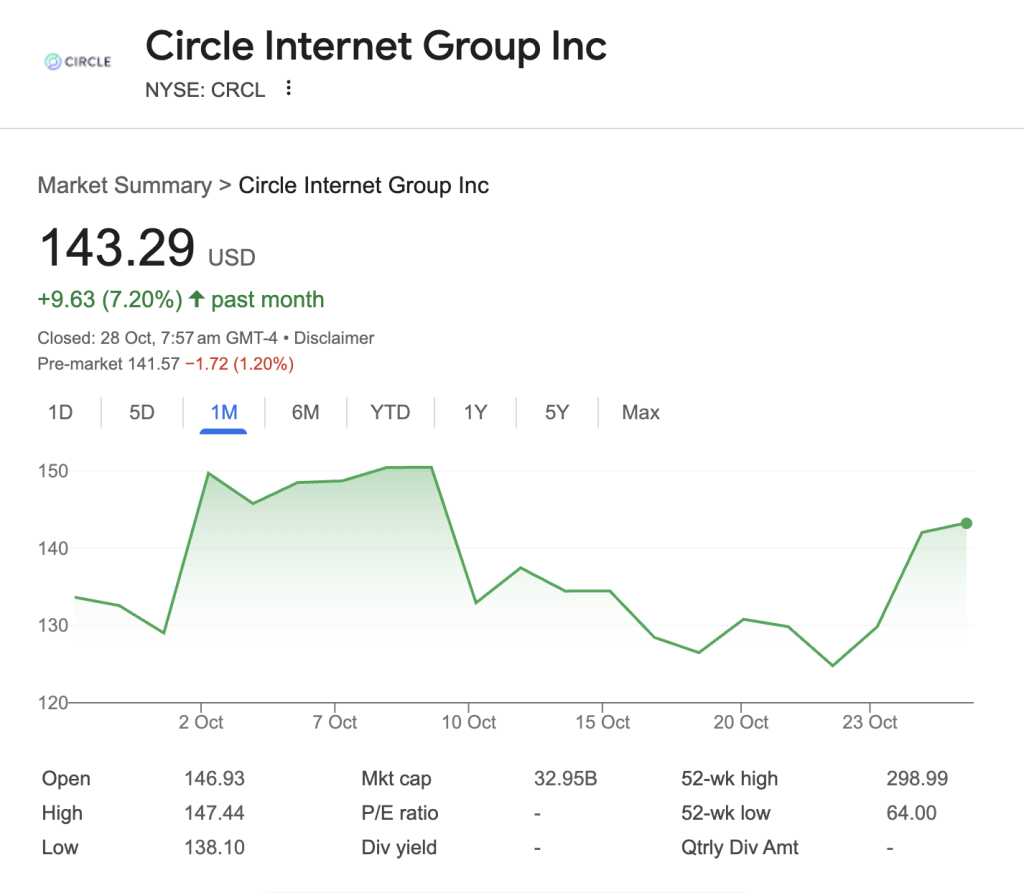
The stock opened at $146.93, trading between a monthly low of $138.10 and a high of $147.44, with a current market capitalization of $32.95 billion. While the pre-market price shows a slight dip to $141.57 (-1.20%), Circle’s recent momentum reflects growing confidence in the company’s long-term strategy to become a core infrastructure provider for the digital asset economy.

Arc’s launch marks a strategic evolution for Circle, best known as the issuer of USDC, one of the world’s leading stablecoins. The new blockchain aims to serve as a foundation for tokenized assets, onchain payments, and programmable finance, integrating directly with Circle’s existing products and services.

Investors have interpreted the Arc testnet launch — and its backing by major financial institutions — as a signal that Circle is deepening its role in bridging traditional finance and blockchain technology.

Analysts suggest that the company’s partnerships with BNY Mellon, Goldman Sachs, and Société Générale through Arc could attract institutional liquidity and strengthen Circle’s positioning in the onchain settlement market.

The broader crypto sector has also shown signs of renewed activity, with sentiment improving after the approval of multiple digital asset ETFs and growing institutional participation in blockchain infrastructure.


Disclaimer: The articles reposted on this site are sourced from public platforms and are provided for informational purposes only. They do not necessarily reflect the views of MEXC. All rights remain with the original authors. If you believe any content infringes on third-party rights, please contact service@support.mexc.com for removal. MEXC makes no guarantees regarding the accuracy, completeness, or timeliness of the content and is not responsible for any actions taken based on the information provided. The content does not constitute financial, legal, or other professional advice, nor should it be considered a recommendation or endorsement by MEXC.

You May Also Like

The Channel Factories We’ve Been Waiting For

The Channel Factories We’ve Been Waiting For

The post The Channel Factories We’ve Been Waiting For appeared on BitcoinEthereumNews.com. Visions of future technology are often prescient about the broad strokes while flubbing the details. The tablets in “2001: A Space Odyssey” do indeed look like iPads, but you never see the astronauts paying for subscriptions or wasting hours on Candy Crush.  Channel factories are one vision that arose early in the history of the Lightning Network to address some challenges that Lightning has faced from the beginning. Despite having grown to become Bitcoin’s most successful layer-2 scaling solution, with instant and low-fee payments, Lightning’s scale is limited by its reliance on payment channels. Although Lightning shifts most transactions off-chain, each payment channel still requires an on-chain transaction to open and (usually) another to close. As adoption grows, pressure on the blockchain grows with it. The need for a more scalable approach to managing channels is clear. Channel factories were supposed to meet this need, but where are they? In 2025, subnetworks are emerging that revive the impetus of channel factories with some new details that vastly increase their potential. They are natively interoperable with Lightning and achieve greater scale by allowing a group of participants to open a shared multisig UTXO and create multiple bilateral channels, which reduces the number of on-chain transactions and improves capital efficiency. Achieving greater scale by reducing complexity, Ark and Spark perform the same function as traditional channel factories with new designs and additional capabilities based on shared UTXOs.  Channel Factories 101 Channel factories have been around since the inception of Lightning. A factory is a multiparty contract where multiple users (not just two, as in a Dryja-Poon channel) cooperatively lock funds in a single multisig UTXO. They can open, close and update channels off-chain without updating the blockchain for each operation. Only when participants leave or the factory dissolves is an on-chain transaction…
Share
BitcoinEthereumNews2025/09/18 00:09
OpenVPP accused of falsely claiming partnership with ComEd

OpenVPP accused of falsely claiming partnership with ComEd

According to PANews on September 18th, on-chain sleuth ZachXBT reported that OpenVPP allegedly falsely claimed a partnership with US electric utility Commonwealth Edison ( ComEd ). ComEd responded, stating, "We have not partnered with them and have no intention of doing so."
Share
PANews2025/09/19 00:00
Haier Shines at Australian Open 2026: Official Partner Elevates the Game with Smart Innovation and Purpose

Haier Shines at Australian Open 2026: Official Partner Elevates the Game with Smart Innovation and Purpose

MELBOURNE, Australia, Jan. 25, 2026 /PRNewswire/ — Haier, the world’s No.1 major home appliance brand, continues its strategic partnership with the Australian Open
Share
AI Journal2026/01/26 11:30