Fidelity Investments has filed a pre-effective amendment for its Solana ETF with the Securities and Exchange Commission, moving the registration toward automatic effectiveness. The filing reveals the fund will stake all its SOL holdings to generate returns exceeding the Fidelity Solana Reference Rate while charging a 0.25% annual fee, fully waived for the first six months after launch. This update pushes Fidelity into a rapidly expanding Solana ETF market, which has already seen three products debut on U.S. exchanges, capturing combined first-day inflows exceeding $81 million. Fidelity Structures Aggressive Staking Strategy The Fidelity Solana Fund will stake up to 100% of its SOL tokens through custodians Anchorage Digital, BitGo, and Coinbase Custody, with node operators including Coinbase Crypto Services and Figment. Staking rewards will be subject to a 15% fee split among the sponsor, custodians, and operators, with the Trust expected to unstake SOL within two days when needed for redemptions. The fund will trade under ticker FSOL on an undisclosed exchange, offering creation and redemption baskets of 25,000 shares settled in either SOL or cash. To support this dual-settlement approach, Fidelity has secured trading agreements with counterparties, including Cumberland DRW, Jane Street Capital affiliates, and Virtu Americas, to facilitate cash creations. Despite the ambitious structure, the filing acknowledges substantial regulatory risk, noting the SEC has previously classified SOL as a security in enforcement actions. However, some cases have been dismissed or settled. The registration warns that a definitive security classification could trigger immediate material impact on SOL’s trading value and potentially force the fund’s liquidation. Bitwise Dominates Early Market While Fidelity prepares to enter, early movers have already claimed significant market share. Bitwise’s Solana ETF captured $69.5 million on its October 28 debut, nearly six times the $12 million raised by Rex-Osprey’s competing product. The Bitwise Solana Fund stakes 100% of holdings in-house to deliver the network’s full yield while charging a 0.20% management fee, waived for three months. Just one day later, Grayscale launched its Solana Trust ETF on NYSE Arca, converting a 2021-vintage private trust holding 525,387 SOL tokens. The fund carries a 0.35% expense ratio and stakes 74.89% of assets, passing 77% of staking rewards to investors on a net basis. Meanwhile, Rex-Osprey’s SSK employs a hybrid structure holding 54% in direct Solana, 43.5% in a Swiss-listed CoinShares ETP, with the remainder in JitoSOL and cash. The fund distributes monthly staking rewards, which are treated as a return of capital for tax purposes, while charging a 0.75% expense ratio. Institutional Appetite Tests Layer 1 Power Balance Speaking with Cryptonews, Maria Carola, CEO of StealthEX, views the Solana ETF wave as a defining moment in blockchain competition. “The launch of a spot ETF on Solana is a signal that has broken out in the protracted battle for dominance in the Layer 1 blockchain space,” she said. “For the first time, institutional investors are being invited to consider Solana as a standalone macro asset.“ Carola notes projections of $3 billion in ETF inflows over 12-18 months depend on Solana maintaining its 2024 momentum in DeFi expansion and network stability. “Solana’s story is one of speed, scalability, and engineering precision, but for many market participants, it remains a symbol of short-term liquidity cycles and the fleeting hype of meme tokens,” she said. “An ETF alone won’t change this perception overnight.“ She acknowledges Ethereum’s commanding position, with over $60 billion locked in DeFi and a mature staking ecosystem that continues to attract institutional capital seeking predictability. “In the long term, it’s Ethereum’s fundamentals, such as stability, institutional reputation, and integration into the global financial system, that maintain its leadership,” Carola said. However, she proposes a coexistence model in which “Ethereum serves as the underlying trust and settlement layer in the on-chain economy, while Solana becomes its high-performance execution engine.“ Despite positive sentiment around ETF launches, SOL’s near-term price action remains unclear. Polymarket gives Solana just a 25% chance (down 2% from yesterday) of reaching a new all-time high before 2026, with SOL trading at $196, up nearly 1% over 24 hours.Source: Polymarket Beyond U.S. markets, the Solana ETF momentum follows Hong Kong’s October approval of China Asset Management’s spot fund, which began trading on October 27 with a $100 minimum investmentFidelity Investments has filed a pre-effective amendment for its Solana ETF with the Securities and Exchange Commission, moving the registration toward automatic effectiveness. The filing reveals the fund will stake all its SOL holdings to generate returns exceeding the Fidelity Solana Reference Rate while charging a 0.25% annual fee, fully waived for the first six months after launch. This update pushes Fidelity into a rapidly expanding Solana ETF market, which has already seen three products debut on U.S. exchanges, capturing combined first-day inflows exceeding $81 million. Fidelity Structures Aggressive Staking Strategy The Fidelity Solana Fund will stake up to 100% of its SOL tokens through custodians Anchorage Digital, BitGo, and Coinbase Custody, with node operators including Coinbase Crypto Services and Figment. Staking rewards will be subject to a 15% fee split among the sponsor, custodians, and operators, with the Trust expected to unstake SOL within two days when needed for redemptions. The fund will trade under ticker FSOL on an undisclosed exchange, offering creation and redemption baskets of 25,000 shares settled in either SOL or cash. To support this dual-settlement approach, Fidelity has secured trading agreements with counterparties, including Cumberland DRW, Jane Street Capital affiliates, and Virtu Americas, to facilitate cash creations. Despite the ambitious structure, the filing acknowledges substantial regulatory risk, noting the SEC has previously classified SOL as a security in enforcement actions. However, some cases have been dismissed or settled. The registration warns that a definitive security classification could trigger immediate material impact on SOL’s trading value and potentially force the fund’s liquidation. Bitwise Dominates Early Market While Fidelity prepares to enter, early movers have already claimed significant market share. Bitwise’s Solana ETF captured $69.5 million on its October 28 debut, nearly six times the $12 million raised by Rex-Osprey’s competing product. The Bitwise Solana Fund stakes 100% of holdings in-house to deliver the network’s full yield while charging a 0.20% management fee, waived for three months. Just one day later, Grayscale launched its Solana Trust ETF on NYSE Arca, converting a 2021-vintage private trust holding 525,387 SOL tokens. The fund carries a 0.35% expense ratio and stakes 74.89% of assets, passing 77% of staking rewards to investors on a net basis. Meanwhile, Rex-Osprey’s SSK employs a hybrid structure holding 54% in direct Solana, 43.5% in a Swiss-listed CoinShares ETP, with the remainder in JitoSOL and cash. The fund distributes monthly staking rewards, which are treated as a return of capital for tax purposes, while charging a 0.75% expense ratio. Institutional Appetite Tests Layer 1 Power Balance Speaking with Cryptonews, Maria Carola, CEO of StealthEX, views the Solana ETF wave as a defining moment in blockchain competition. “The launch of a spot ETF on Solana is a signal that has broken out in the protracted battle for dominance in the Layer 1 blockchain space,” she said. “For the first time, institutional investors are being invited to consider Solana as a standalone macro asset.“ Carola notes projections of $3 billion in ETF inflows over 12-18 months depend on Solana maintaining its 2024 momentum in DeFi expansion and network stability. “Solana’s story is one of speed, scalability, and engineering precision, but for many market participants, it remains a symbol of short-term liquidity cycles and the fleeting hype of meme tokens,” she said. “An ETF alone won’t change this perception overnight.“ She acknowledges Ethereum’s commanding position, with over $60 billion locked in DeFi and a mature staking ecosystem that continues to attract institutional capital seeking predictability. “In the long term, it’s Ethereum’s fundamentals, such as stability, institutional reputation, and integration into the global financial system, that maintain its leadership,” Carola said. However, she proposes a coexistence model in which “Ethereum serves as the underlying trust and settlement layer in the on-chain economy, while Solana becomes its high-performance execution engine.“ Despite positive sentiment around ETF launches, SOL’s near-term price action remains unclear. Polymarket gives Solana just a 25% chance (down 2% from yesterday) of reaching a new all-time high before 2026, with SOL trading at $196, up nearly 1% over 24 hours.Source: Polymarket Beyond U.S. markets, the Solana ETF momentum follows Hong Kong’s October approval of China Asset Management’s spot fund, which began trading on October 27 with a $100 minimum investment

Wall Street’s Solana Bet Advances as Fidelity Updates ETF Filing

Fidelity Investments has filed a pre-effective amendment for its Solana ETF with the Securities and Exchange Commission, moving the registration toward automatic effectiveness.

The filing reveals the fund will stake all its SOL holdings to generate returns exceeding the Fidelity Solana Reference Rate while charging a 0.25% annual fee, fully waived for the first six months after launch.

This update pushes Fidelity into a rapidly expanding Solana ETF market, which has already seen three products debut on U.S. exchanges, capturing combined first-day inflows exceeding $81 million.

Fidelity Structures Aggressive Staking Strategy

The Fidelity Solana Fund will stake up to 100% of its SOL tokens through custodians Anchorage Digital, BitGo, and Coinbase Custody, with node operators including Coinbase Crypto Services and Figment.

Staking rewards will be subject to a 15% fee split among the sponsor, custodians, and operators, with the Trust expected to unstake SOL within two days when needed for redemptions.

The fund will trade under ticker FSOL on an undisclosed exchange, offering creation and redemption baskets of 25,000 shares settled in either SOL or cash.

To support this dual-settlement approach, Fidelity has secured trading agreements with counterparties, including Cumberland DRW, Jane Street Capital affiliates, and Virtu Americas, to facilitate cash creations.

Despite the ambitious structure, the filing acknowledges substantial regulatory risk, noting the SEC has previously classified SOL as a security in enforcement actions. However, some cases have been dismissed or settled.

The registration warns that a definitive security classification could trigger immediate material impact on SOL’s trading value and potentially force the fund’s liquidation.

Bitwise Dominates Early Market

While Fidelity prepares to enter, early movers have already claimed significant market share.

Bitwise’s Solana ETF captured $69.5 million on its October 28 debut, nearly six times the $12 million raised by Rex-Osprey’s competing product.

The Bitwise Solana Fund stakes 100% of holdings in-house to deliver the network’s full yield while charging a 0.20% management fee, waived for three months.

Just one day later, Grayscale launched its Solana Trust ETF on NYSE Arca, converting a 2021-vintage private trust holding 525,387 SOL tokens.

The fund carries a 0.35% expense ratio and stakes 74.89% of assets, passing 77% of staking rewards to investors on a net basis.

Meanwhile, Rex-Osprey’s SSK employs a hybrid structure holding 54% in direct Solana, 43.5% in a Swiss-listed CoinShares ETP, with the remainder in JitoSOL and cash.

The fund distributes monthly staking rewards, which are treated as a return of capital for tax purposes, while charging a 0.75% expense ratio.

Institutional Appetite Tests Layer 1 Power Balance

Speaking with Cryptonews, Maria Carola, CEO of StealthEX, views the Solana ETF wave as a defining moment in blockchain competition.

The launch of a spot ETF on Solana is a signal that has broken out in the protracted battle for dominance in the Layer 1 blockchain space,” she said.

For the first time, institutional investors are being invited to consider Solana as a standalone macro asset.

Carola notes projections of $3 billion in ETF inflows over 12-18 months depend on Solana maintaining its 2024 momentum in DeFi expansion and network stability.

Solana’s story is one of speed, scalability, and engineering precision, but for many market participants, it remains a symbol of short-term liquidity cycles and the fleeting hype of meme tokens,” she said. “An ETF alone won’t change this perception overnight.

She acknowledges Ethereum’s commanding position, with over $60 billion locked in DeFi and a mature staking ecosystem that continues to attract institutional capital seeking predictability.

In the long term, it’s Ethereum’s fundamentals, such as stability, institutional reputation, and integration into the global financial system, that maintain its leadership,” Carola said.

However, she proposes a coexistence model in which “Ethereum serves as the underlying trust and settlement layer in the on-chain economy, while Solana becomes its high-performance execution engine.

Despite positive sentiment around ETF launches, SOL’s near-term price action remains unclear.

Polymarket gives Solana just a 25% chance (down 2% from yesterday) of reaching a new all-time high before 2026, with SOL trading at $196, up nearly 1% over 24 hours.
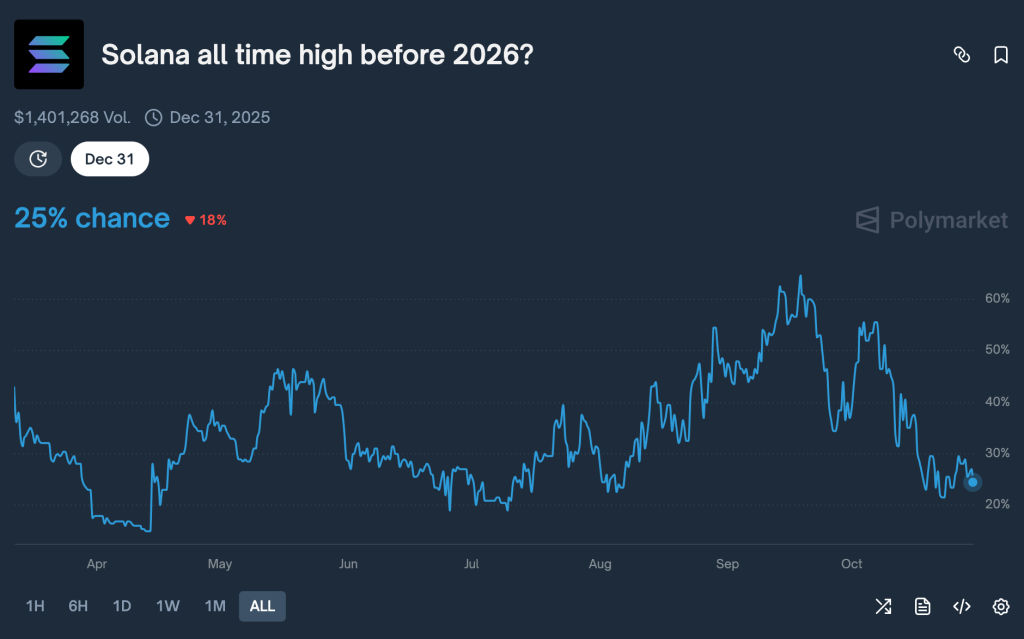
Wall Street's Solana Bet Advances as Fidelity Updates ETF FilingSource: Polymarket

Beyond U.S. markets, the Solana ETF momentum follows Hong Kong’s October approval of China Asset Management’s spot fund, which began trading on October 27 with a $100 minimum investment.


Disclaimer: The articles reposted on this site are sourced from public platforms and are provided for informational purposes only. They do not necessarily reflect the views of MEXC. All rights remain with the original authors. If you believe any content infringes on third-party rights, please contact service@support.mexc.com for removal. MEXC makes no guarantees regarding the accuracy, completeness, or timeliness of the content and is not responsible for any actions taken based on the information provided. The content does not constitute financial, legal, or other professional advice, nor should it be considered a recommendation or endorsement by MEXC.

You May Also Like

Microsoft Corp. $MSFT blue box area offers a buying opportunity

Microsoft Corp. $MSFT blue box area offers a buying opportunity

The post Microsoft Corp. $MSFT blue box area offers a buying opportunity appeared on BitcoinEthereumNews.com. In today’s article, we’ll examine the recent performance of Microsoft Corp. ($MSFT) through the lens of Elliott Wave Theory. We’ll review how the rally from the April 07, 2025 low unfolded as a 5-wave impulse followed by a 3-swing correction (ABC) and discuss our forecast for the next move. Let’s dive into the structure and expectations for this stock. Five wave impulse structure + ABC + WXY correction $MSFT 8H Elliott Wave chart 9.04.2025 In the 8-hour Elliott Wave count from Sep 04, 2025, we saw that $MSFT completed a 5-wave impulsive cycle at red III. As expected, this initial wave prompted a pullback. We anticipated this pullback to unfold in 3 swings and find buyers in the equal legs area between $497.02 and $471.06 This setup aligns with a typical Elliott Wave correction pattern (ABC), in which the market pauses briefly before resuming its primary trend. $MSFT 8H Elliott Wave chart 7.14.2025 The update, 10 days later, shows the stock finding support from the equal legs area as predicted allowing traders to get risk free. The stock is expected to bounce towards 525 – 532 before deciding if the bounce is a connector or the next leg higher. A break into new ATHs will confirm the latter and can see it trade higher towards 570 – 593 area. Until then, traders should get risk free and protect their capital in case of a WXY double correction. Conclusion In conclusion, our Elliott Wave analysis of Microsoft Corp. ($MSFT) suggested that it remains supported against April 07, 2025 lows and bounce from the blue box area. In the meantime, keep an eye out for any corrective pullbacks that may offer entry opportunities. By applying Elliott Wave Theory, traders can better anticipate the structure of upcoming moves and enhance risk management in volatile markets. Source: https://www.fxstreet.com/news/microsoft-corp-msft-blue-box-area-offers-a-buying-opportunity-202509171323
Share
BitcoinEthereumNews2025/09/18 03:50
WTI drifts higher above $59.50 on Kazakh supply disruptions

WTI drifts higher above $59.50 on Kazakh supply disruptions

The post WTI drifts higher above $59.50 on Kazakh supply disruptions appeared on BitcoinEthereumNews.com. West Texas Intermediate (WTI), the US crude oil benchmark
Share
BitcoinEthereumNews2026/01/21 11:24
Fed forecasts only one rate cut in 2026, a more conservative outlook than expected

Fed forecasts only one rate cut in 2026, a more conservative outlook than expected

The post Fed forecasts only one rate cut in 2026, a more conservative outlook than expected appeared on BitcoinEthereumNews.com. Federal Reserve Chairman Jerome Powell talks to reporters following the regular Federal Open Market Committee meetings at the Fed on July 30, 2025 in Washington, DC. Chip Somodevilla | Getty Images The Federal Reserve is projecting only one rate cut in 2026, fewer than expected, according to its median projection. The central bank’s so-called dot plot, which shows 19 individual members’ expectations anonymously, indicated a median estimate of 3.4% for the federal funds rate at the end of 2026. That compares to a median estimate of 3.6% for the end of this year following two expected cuts on top of Wednesday’s reduction. A single quarter-point reduction next year is significantly more conservative than current market pricing. Traders are currently pricing in at two to three more rate cuts next year, according to the CME Group’s FedWatch tool, updated shortly after the decision. The gauge uses prices on 30-day fed funds futures contracts to determine market-implied odds for rate moves. Here are the Fed’s latest targets from 19 FOMC members, both voters and nonvoters: Zoom In IconArrows pointing outwards The forecasts, however, showed a large difference of opinion with two voting members seeing as many as four cuts. Three officials penciled in three rate reductions next year. “Next year’s dot plot is a mosaic of different perspectives and is an accurate reflection of a confusing economic outlook, muddied by labor supply shifts, data measurement concerns, and government policy upheaval and uncertainty,” said Seema Shah, chief global strategist at Principal Asset Management. The central bank has two policy meetings left for the year, one in October and one in December. Economic projections from the Fed saw slightly faster economic growth in 2026 than was projected in June, while the outlook for inflation was updated modestly higher for next year. There’s a lot of uncertainty…
Share
BitcoinEthereumNews2025/09/18 02:59