A debate on X this week exposed a core question for on-chain privacy: when quantum computers are able to break elliptic-curve cryptography (ECC), will they be able to retroactively deanonymize every transaction ever made of privacy coins like Zcash? Nic Carter, co-founder of Coin Metrics and partner at Castle Island Ventures, argued that the answer […]A debate on X this week exposed a core question for on-chain privacy: when quantum computers are able to break elliptic-curve cryptography (ECC), will they be able to retroactively deanonymize every transaction ever made of privacy coins like Zcash? Nic Carter, co-founder of Coin Metrics and partner at Castle Island Ventures, argued that the answer […]

Is Zcash Quantum-Resistant Yet? Experts Weigh In

2025/11/01 07:00
4 min read

A debate on X this week exposed a core question for on-chain privacy: when quantum computers are able to break elliptic-curve cryptography (ECC), will they be able to retroactively deanonymize every transaction ever made of privacy coins like Zcash?

Nic Carter, co-founder of Coin Metrics and partner at Castle Island Ventures, argued that the answer is effectively yes for most privacy coins. “For privacy coins, even if they migrate to post-quantum cryptographic schemes, all historical transactions prior to that migration can be decrypted,” he said on October 30, 2025. “So all historical txns will be stripped of privacy in >~5y. Everything is built on ECC.”

Carter’s point is based on “harvest now, decrypt later.” Attackers don’t need to break you today. They just copy the data now and crack it once quantum is strong enough. On blockchains, that problem is worse because the data is already public and permanent. “Blockchains are uniquely bad for quantum because normally the quantum thing is ‘harvest now decrypt later’ so adversaries have to be preemptively harvesting traffic but blockchains just.. publish.. everything.. forever.”

He warned specifically that even if a privacy coin upgrades to quantum-resistant signatures in the future, old activity is still exposed once ECC falls. “While privacy coins can adopt post quantum sigs, understand that all previously hidden addresses, relationships between addresses, etc, will be revealed once ECC is broken,” Carter said. “And obviously everything is on chain so you don’t even need to harvest traffic today.”

Is Zcash Already Quantum-Resistant?

That claim triggered pushback from Zcash supporters, who argue Zcash is structurally different from something like Monero.

Mert Mumtaz (Helius) agreed that Carter’s warning applies to “many privacy coins like Monero,” but said it’s “not necessarily true for zcash’s privacy, given advanced opsec.” He acknowledged that “advanced opsec is not the norm,” but said that if it is followed, Zcash users “get you certain guarantees w.r.t information leakage.” He also said “some things are in the works to make this even stronger,” pointing to research by Zcash engineer Sean Bowe.

Bowe’s position is that Zcash’s fully shielded pool simply does not put critical sender/receiver information on the ledger in the first place. “There is no quantum computer or powerful AI that will be able to look back at the Zcash blockchain 1000 years from now and figure out who made every fully shielded transaction,” Bowe said in July this year. “That information, among other things, never even touches the ledger. It’s already gone.” His condition is clear: “To be certain about your privacy you must start by using shielded Zcash. You almost cannot even begin otherwise.”

Carter partially credits that. “Zec is definitely ahead of anyone when it comes to quantum preparedness, not denying that,” he said. But he called the “already quantum-proof” framing unrealistic in practice.

He argued that Zcash’s long-term privacy story depends on very strong assumptions that often break in the real world: “assumes pubkey never being known. assumes: no metadata collection, no exchange key leaks, perfect metadata privacy.”

He added that Zcash’s shielded pools — Sprout, Sapling, Orchard — still “rely on ECC for key exchange, viewkeys, proof verification, which are all broken” under a powerful quantum adversary. His conclusion: “unrealistic to say zec privacy is perfectly q resistant. linkages between addrs are forever encoded on the blockchain, you and Sean know that. store now decrypt later still applies.”

In other words: Zcash builders say that if you stay fully shielded, the chain itself won’t hand quantum attackers a clean map of who paid whom. Carter says that in the real world, users leak, exchanges leak, metadata leaks — and once ECC breaks, those leaks plus the permanent ledger are enough to unwind the privacy anyway.

One final note: when asked directly, Carter denied holding ZEC. “Nope.”

At press time, ZEC traded at $366.
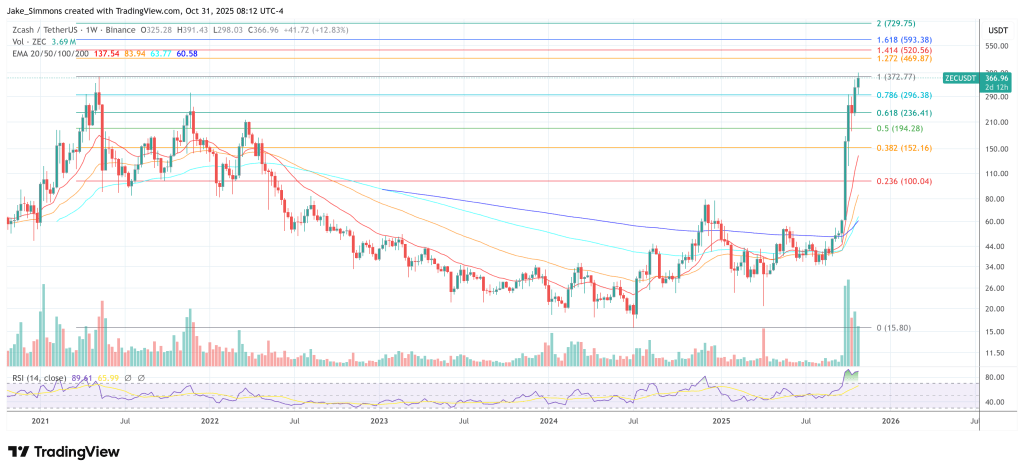
Zcash price
Market Opportunity
QUANTUM Logo
QUANTUM Price(QUANTUM)
$0.002814
$0.002814$0.002814
+0.21%
USD
QUANTUM (QUANTUM) Live Price Chart
Disclaimer: The articles reposted on this site are sourced from public platforms and are provided for informational purposes only. They do not necessarily reflect the views of MEXC. All rights remain with the original authors. If you believe any content infringes on third-party rights, please contact crypto.news@mexc.com for removal. MEXC makes no guarantees regarding the accuracy, completeness, or timeliness of the content and is not responsible for any actions taken based on the information provided. The content does not constitute financial, legal, or other professional advice, nor should it be considered a recommendation or endorsement by MEXC.

You May Also Like

Siren Token Sheds 16.4% After 54% Retreat From All-Time High

Siren Token Sheds 16.4% After 54% Retreat From All-Time High

Siren token experienced a sharp 16.4% decline in the past 24 hours, trading at $0.247 as the market cap contracted by $34.4 million. Our analysis of on-chain metrics
Share
Blockchainmagazine2026/03/02 05:03
Privacy is ‘Constant Battle’ Between Blockchain Stakeholders and State

Privacy is ‘Constant Battle’ Between Blockchain Stakeholders and State

The post Privacy is ‘Constant Battle’ Between Blockchain Stakeholders and State appeared on BitcoinEthereumNews.com. Blockchain industry participants and regulators continue wrangling over privacy rights as the European Union’s sweeping Anti-Money Laundering (AML) rules look set to ban privacy-preserving tokens and anonymous crypto accounts starting in 2027. Credit institutions, financial institutions and crypto asset service providers (CASPs) will be prohibited from maintaining anonymous accounts or handling privacy-preserving cryptocurrencies under the EU’s new Anti-Money Laundering Regulation (AMLR) that will go into effect in 2027, Cointelegraph reported in May. Maintaining the right to access privacy-preserving coins like Monero (XMR) has been a “constant battle” between blockchain industry stakeholders and regulators, according to Anja Blaj, an independent legal consultant and policy expert at the European Crypto Initiative. “Once you think of how the states want to play out their policies, they want to establish control. They want to understand who the parties are that transact among themselves,” said Blaj, speaking during Cointelegraph’s daily live X spaces show on Sept. 3. “[The state] wants to understand that to be able to prevent whatever crime and scamming is happening, and we want to enforce the policies that we create as a society.” Her comments came as the EU ramped up its regulatory oversight of the crypto industry, building on the bloc’s Markets in Crypto-Assets Regulation (MiCA). Related: Swiss banks complete first blockchain-based legally binding payment Room for negotiation remains While the AML framework is final, regulatory experts still see potential for negotiation until it rolls out in 2027. Policymaking is a “continuous conversation,” meaning that “nothing is set in stone, even if the regulation is already out,” said Blaj. “There are still ways to either talk to the regulators, see how it’s going to play out, how it’s going to be enforced.” While there’s always room for negotiations with policymakers, the regulation concerning privacy-preserving cryptocurrencies and accounts is becoming “more…
Share
BitcoinEthereumNews2025/09/18 12:45
Santander’s Openbank Enables Bitcoin, Litecoin, POL, Ethereum, and Altcoin Trading for German Customers

Santander’s Openbank Enables Bitcoin, Litecoin, POL, Ethereum, and Altcoin Trading for German Customers

Santander’s digital bank has launched crypto trading in Germany, letting customers buy, sell, and hold these assets. At launch, Openbank customers in Germany can get their hands on Bitcoin, Ethereum, Cardano, Litecoin, and Polygon. Openbank, the digital arm of Banco Santander, has just rolled out a new crypto trading service for its retail customers in [...]]]>
Share
Crypto News Flash2025/09/18 04:00





