In this section, we introduce Theorem 2, an important theoretical extension showing that merely giving a Transformer additional unguided computing space does not overcome the "local reasoning barrier." In the context of a "agnostic scratchpad," the model is permitted to produce a polynomial-length sequence of intermediate tokens (a scratchpad) with no oversight over their content. This theorem generalizes the earlier finding (Theorem 1). The high-locality "cycle task," which requires the model to identify if three particular nodes in a graph belong to the same cycle, is still the task at hand.In this section, we introduce Theorem 2, an important theoretical extension showing that merely giving a Transformer additional unguided computing space does not overcome the "local reasoning barrier." In the context of a "agnostic scratchpad," the model is permitted to produce a polynomial-length sequence of intermediate tokens (a scratchpad) with no oversight over their content. This theorem generalizes the earlier finding (Theorem 1). The high-locality "cycle task," which requires the model to identify if three particular nodes in a graph belong to the same cycle, is still the task at hand.

Research from Apple and EPFL Explains Why AI Models Can’t Truly “Reason” Yet

Abstract and 1. Introduction

1.1 Syllogisms composition

1.2 Hardness of long compositions

1.3 Hardness of global reasoning

1.4 Our contributions

  1. Results on the local reasoning barrier

    2.1 Defining locality and auto-regressive locality

    2.2 Transformers require low locality: formal results

    2.3 Agnostic scratchpads cannot break the locality

  2. Scratchpads to break the locality

    3.1 Educated scratchpad

    3.2 Inductive Scratchpads

  3. Conclusion, Acknowledgments, and References

A. Further related literature

B. Additional experiments

C. Experiment and implementation details

D. Proof of Theorem 1

E. Comment on Lemma 1

F. Discussion on circuit complexity connections

G. More experiments with ChatGPT

D Proof of Theorem 1

\
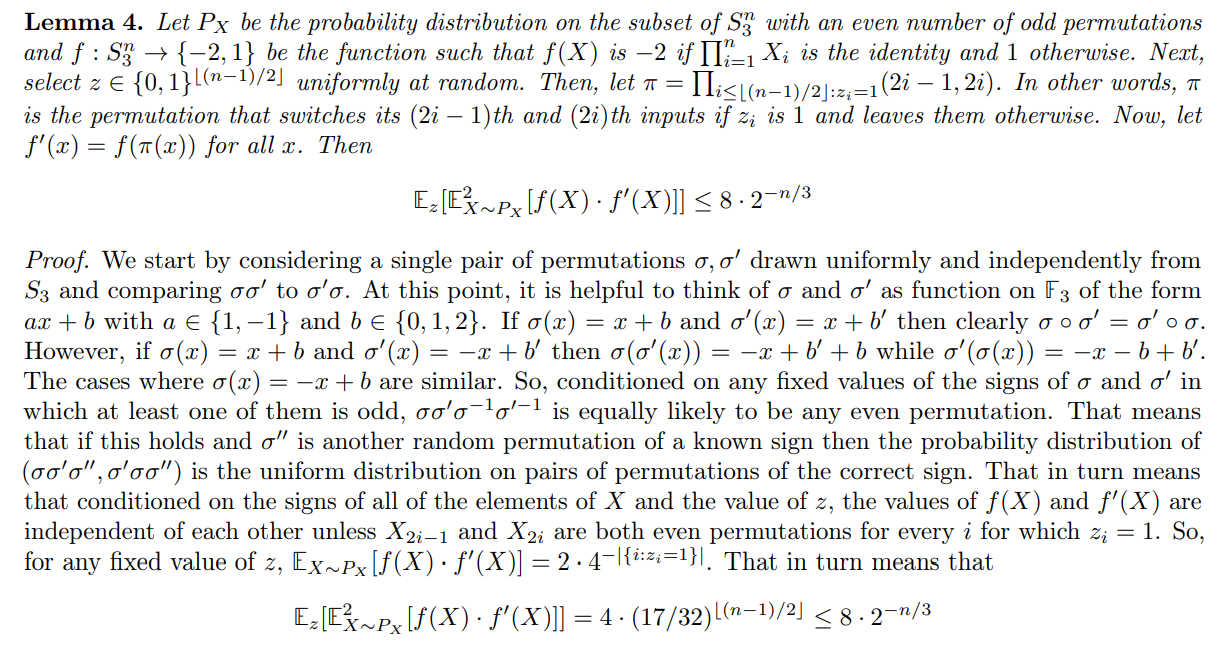
\
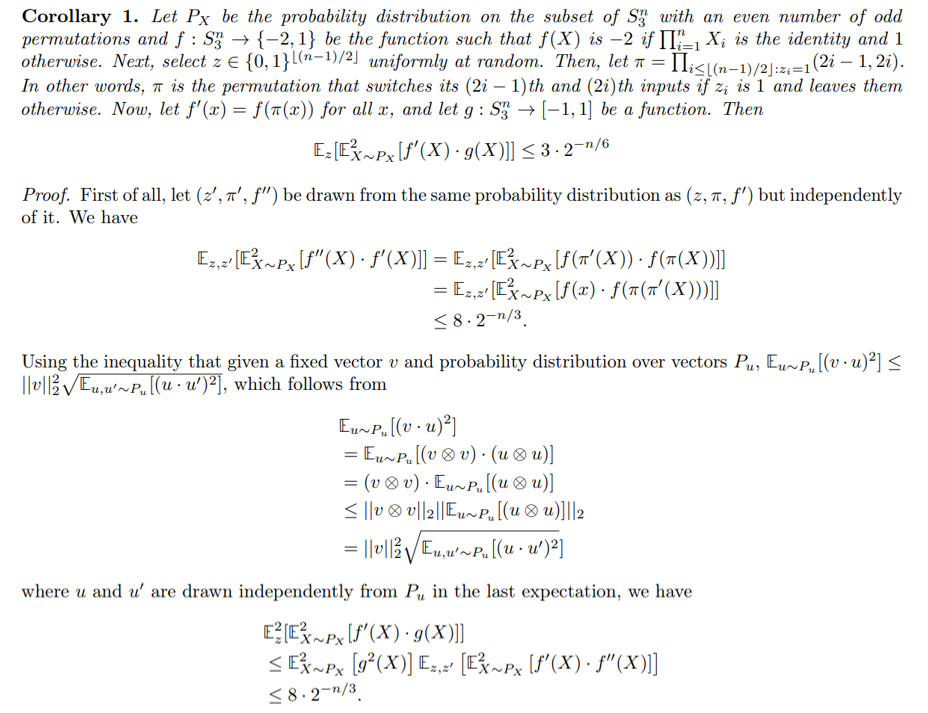
\ At this point, we are finally ready to prove Theorem 1 as follows.

\
\
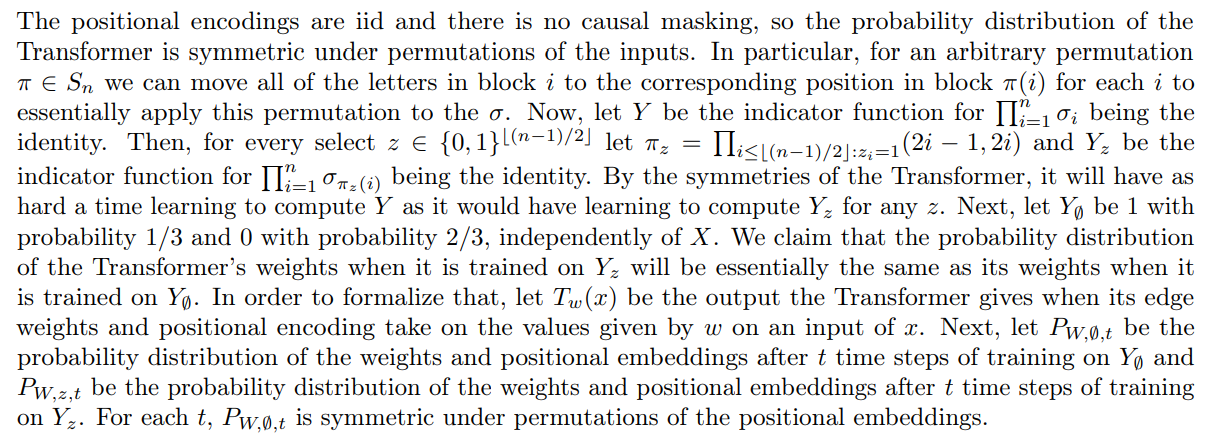
\
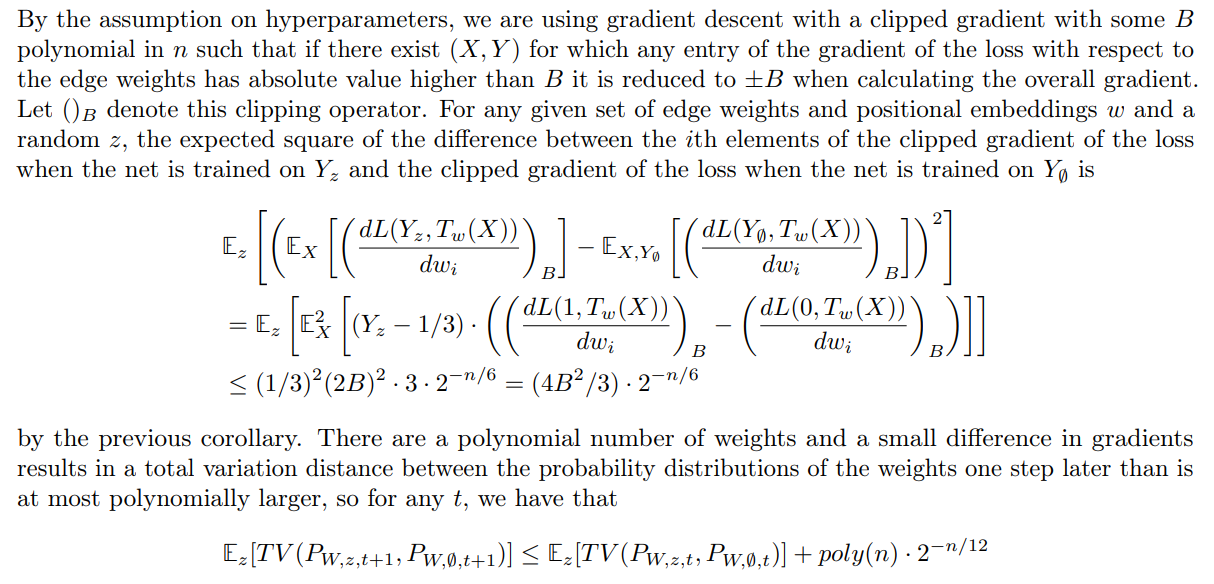
\
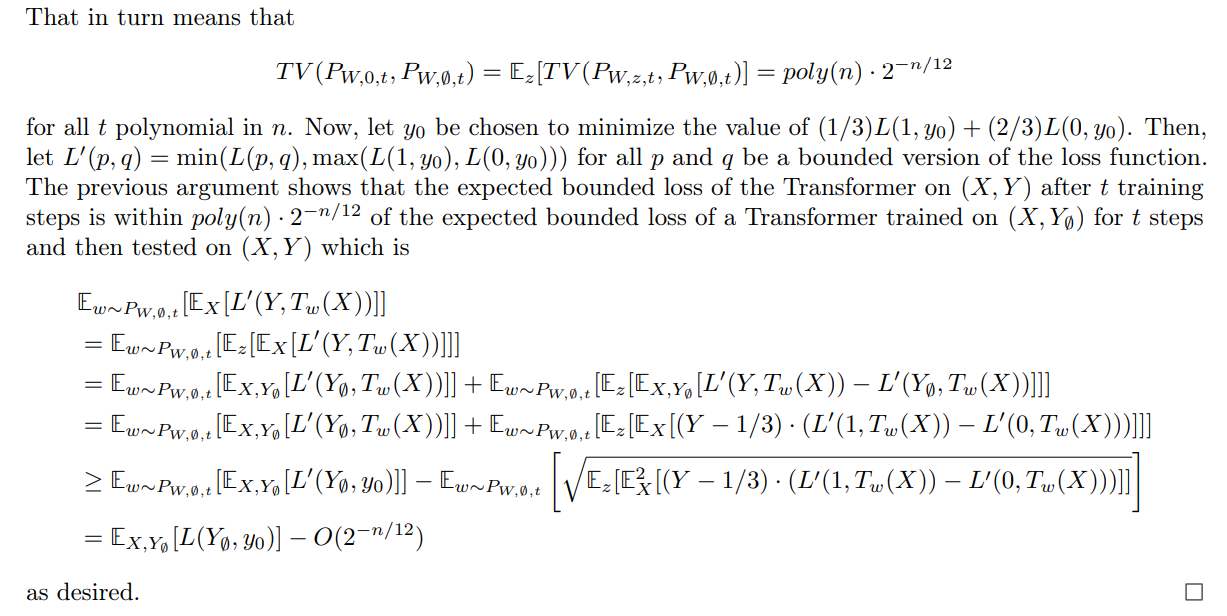
\
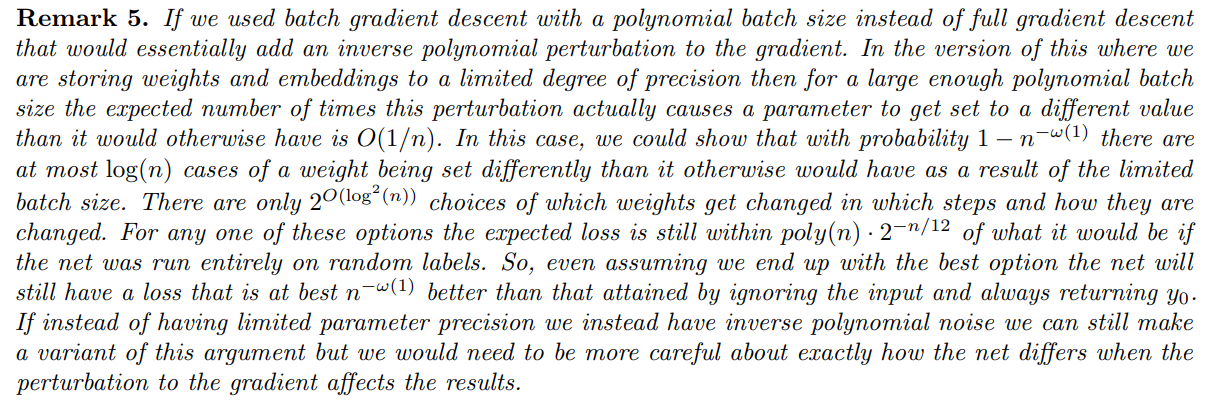
D.1 Extension to agnostic scratchpads

Theorem 1 can also be generalised to Transformers trained with agnostic scratchpads in order to get the following.

\ Theorem 2. Let G be a directed graph which consists of a cycle of length 3n with probability 2/3 and 3 cycles of length n otherwise. Next, if there are 3 cycles pick one vertex from each and if there is one cycle pick three vertices that are each n edges apart. Then, label uniformly at random these vertices with a0, b0, c0. Next, number every other vertex by the distance from one of these three to it, and for each i, label uniformly at random the vertices at distance i by ai, bi, and ci and store in X the edges between ai − 1, bi − 1, ci − 1 and ai, bi, ci; i.e.

\

\ where e(v) represents the vertex that v’s edge points to, all of the instances of i or i + 1 should have the appropriate value substituted in and the symbols in black should be used exactly as stated. See Figure 2 for an example. Finally, let Y report whether a0, b0, c_0 are in the same cycle or not. Now, consider training a T-regular neural network with a scratchpad of polynomial length on (X, Y ) generated in this manner. For any given (X, Y ), we will regard the net’s loss on (X, Y ) as the expectation over all possible scratchpads that it might generate on X of the loss of its eventual output. If we train it on (X, Y ) using population[14] gradient descent with polynomial hyperparameters[15] and a differentiable loss function then the network fails to weakly learn to compute Y.

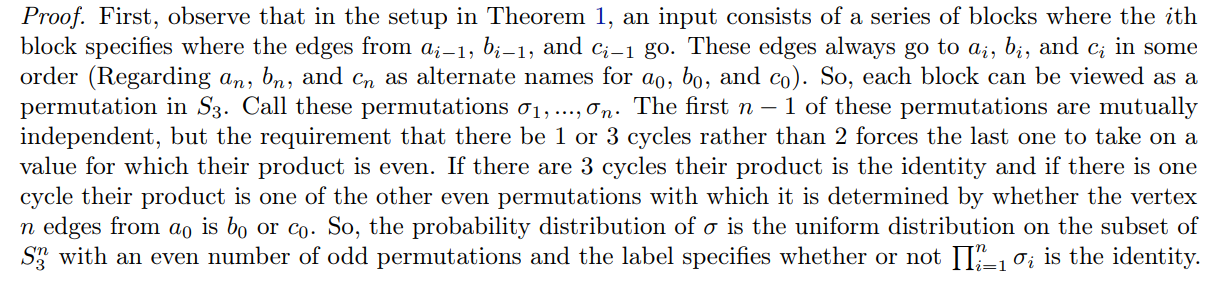
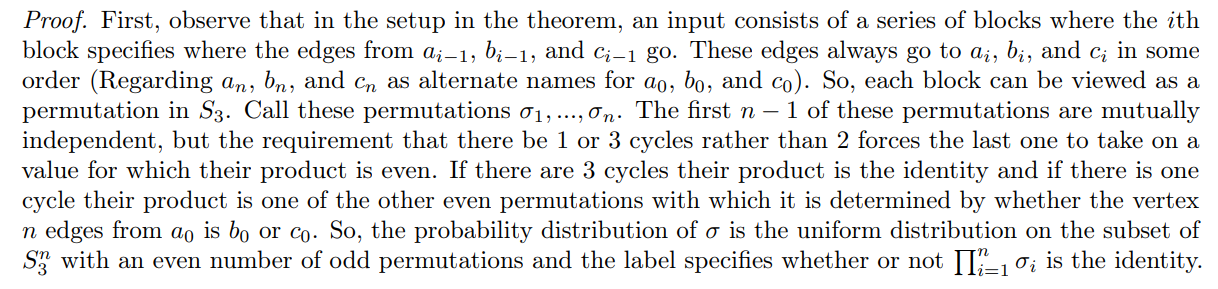
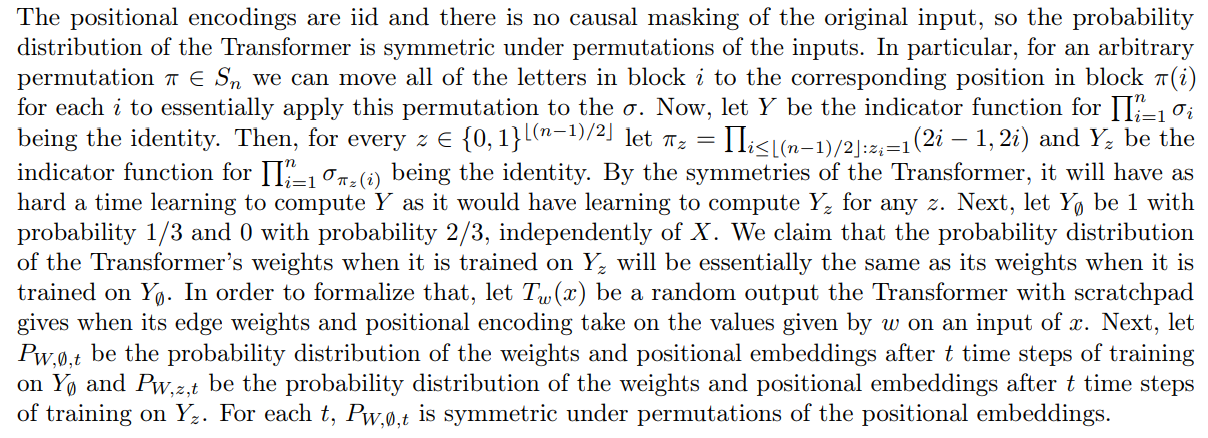
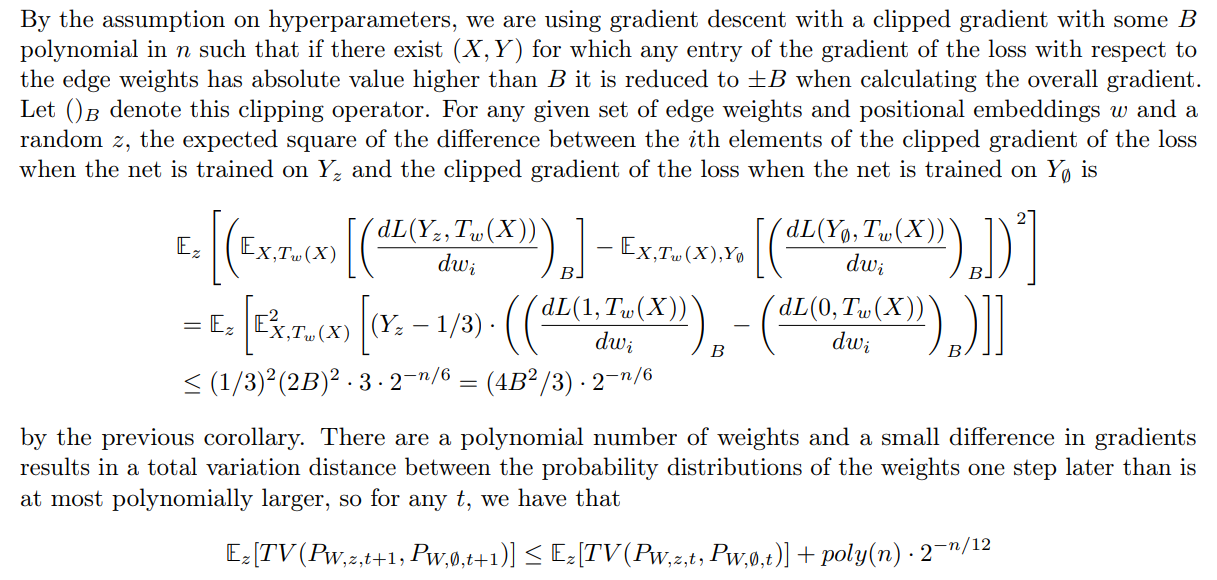
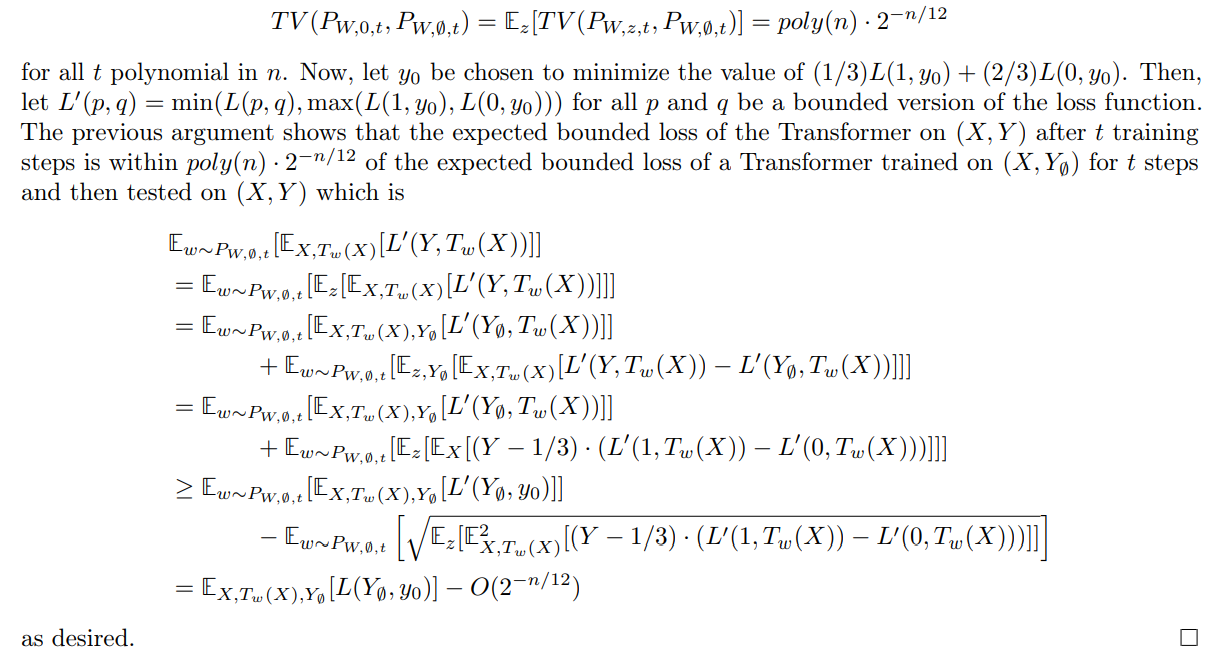
\ The proof of this theorem is not meaningfully different from the proof of the previous version, but for completeness we include it below.

\
\
\
\ That in turn means that

\
\

E Comment on Lemma 1

For S such that |S| < n, X[S] is independent of Y , since the distribution of such subsets of edges is the same for both classes.

\ Let S be such that |S| = n. Let ZS be the ternary random variable that records whether there is a cycle or an open path on S. Then,

\ Thus

\

\ Therefore, even for sets of size n, the mutual information is exponentially low, implying that loc(D) is greater than n + 1

\

:::info Authors:

(1) Emmanuel Abbe, Apple and EPFL;

(2) Samy Bengio, Apple;

(3) Aryo Lotf, EPFL;

(4) Colin Sandon, EPFL;

(5) Omid Saremi, Apple.

:::


:::info This paper is available on arxiv under CC BY 4.0 license.

:::

[14] This would also be true for batch GD with batches of size n c with c chosen as a function of the other hyperparameters.

\ [15] I.e., either polynomial learning rate, polynomial clipping [12, 31], and weights stored using a logarithmic number of bits of precision and random rounding: for a < b < c if b needs to be rounded to a or c then it rounds to c with probability (b − a)/(c − a), or with polynomial learning rate, polynomial clipping and polynomial noise added to the gradients.


Market Opportunity
null Logo
null Price(null)
--
----
USD
null (null) Live Price Chart
Disclaimer: The articles reposted on this site are sourced from public platforms and are provided for informational purposes only. They do not necessarily reflect the views of MEXC. All rights remain with the original authors. If you believe any content infringes on third-party rights, please contact service@support.mexc.com for removal. MEXC makes no guarantees regarding the accuracy, completeness, or timeliness of the content and is not responsible for any actions taken based on the information provided. The content does not constitute financial, legal, or other professional advice, nor should it be considered a recommendation or endorsement by MEXC.

You May Also Like

The Channel Factories We’ve Been Waiting For

The Channel Factories We’ve Been Waiting For

The post The Channel Factories We’ve Been Waiting For appeared on BitcoinEthereumNews.com. Visions of future technology are often prescient about the broad strokes while flubbing the details. The tablets in “2001: A Space Odyssey” do indeed look like iPads, but you never see the astronauts paying for subscriptions or wasting hours on Candy Crush.  Channel factories are one vision that arose early in the history of the Lightning Network to address some challenges that Lightning has faced from the beginning. Despite having grown to become Bitcoin’s most successful layer-2 scaling solution, with instant and low-fee payments, Lightning’s scale is limited by its reliance on payment channels. Although Lightning shifts most transactions off-chain, each payment channel still requires an on-chain transaction to open and (usually) another to close. As adoption grows, pressure on the blockchain grows with it. The need for a more scalable approach to managing channels is clear. Channel factories were supposed to meet this need, but where are they? In 2025, subnetworks are emerging that revive the impetus of channel factories with some new details that vastly increase their potential. They are natively interoperable with Lightning and achieve greater scale by allowing a group of participants to open a shared multisig UTXO and create multiple bilateral channels, which reduces the number of on-chain transactions and improves capital efficiency. Achieving greater scale by reducing complexity, Ark and Spark perform the same function as traditional channel factories with new designs and additional capabilities based on shared UTXOs.  Channel Factories 101 Channel factories have been around since the inception of Lightning. A factory is a multiparty contract where multiple users (not just two, as in a Dryja-Poon channel) cooperatively lock funds in a single multisig UTXO. They can open, close and update channels off-chain without updating the blockchain for each operation. Only when participants leave or the factory dissolves is an on-chain transaction…
Share
BitcoinEthereumNews2025/09/18 00:09
Market data: ICP rose 4.54% intraday, while GLM fell 5.44% intraday.

Market data: ICP rose 4.54% intraday, while GLM fell 5.44% intraday.

PANews reported on January 16th that, according to OKX market data, the top gainers of the day are: ICP at $4.494, up 4.54%; CHZ at $0.0579, up 4.19%; CRV at $0
Share
PANews2026/01/16 10:00
Iran Crypto Volume Hits $7.78B as IRGC Controls Half of Market

Iran Crypto Volume Hits $7.78B as IRGC Controls Half of Market

The post Iran Crypto Volume Hits $7.78B as IRGC Controls Half of Market appeared on BitcoinEthereumNews.com. Darius Baruo Jan 15, 2026 15:54 Chainalysis data
Share
BitcoinEthereumNews2026/01/16 10:16