

Bitcoin price eyes possible retest of $91K–$97K range as MVRV hints at buyer fatigue
Bitcoin price is cooling after its October peak, and the market is now watching whether buyers will defend the key $91,000–$97,000 support zone.
- Bitcoin is easing lower after a strong October peak, now trading near key support levels.
- On-chain metrics show a potential test of the $91K–$97K “profit floor,” where buyers have repeatedly stepped in this cycle.
- Trend remains intact, but momentum has softened.
Bitcoin is trading near $102,292, down 1.3% over the past day. The market has softened over the week, now down about 7% in seven days and roughly 16% over the past month. The price currently sits about 18% below the record high of $126,080 reached in early October.
With a spot volume of about $69.5 billion over the last 24 hours, up 14.8% from the day before, trading activity has somewhat increased. In futures, total trading volume rose 8% to $107.5 billion, and open interest increased 1.4% to $69.6 billion.
When open interest rises while price slips, it usually means traders are adding positions rather than stepping away, which can extend the current trend.
MVRV shows cooling momentum, not a full reversal
A Nov. 6 analysis from CryptoQuant contributor Sunny Mom highlights a developing divergence in the Bitcoin’s (BTC) MVRV ratio, which tracks unrealized profit across the network.
The MVRV ratio has continuously found support in the range of 1.7 to 1.8 during this cycle. Since early 2024, that area has served as the market’s “profit floor.” Usually, the market stabilizes after selling pressure subsides. If price and sentiment were to retest that region, it would align closely with the $91,800–$97,200 price area.
Technical weight is added by the fact that the range also overlaps with a sizable, unfilled CME gap close to $92,000. Although prices increased earlier in the cycle, unrealized profit margins have been compressing, as indicated by the current bearish MVRV divergence.
This suggests buyers are becoming more cautious, but it does not signal a confirmed cycle top. A similar divergence appeared in 2017 before Bitcoin’s final parabolic move.
Meanwhile, recent data shows corporate Bitcoin accumulation slowed in October. Firms purchased around 14,400 BTC, down sharply from September’s 38,035 BTC. The market capitalization of Bitcoin-holding companies has also decreased in relation to their holdings, indicating that investors have grown more cautious during the recent decline.
Bitcoin price technical analysis
A cautious short-term outlook is reinforced by the fact that Bitcoin is still trading below all significant short- and long-term moving averages. Instead of oversold exhaustion, the cooling market is reflected by the relative strength index, which is close to 37.
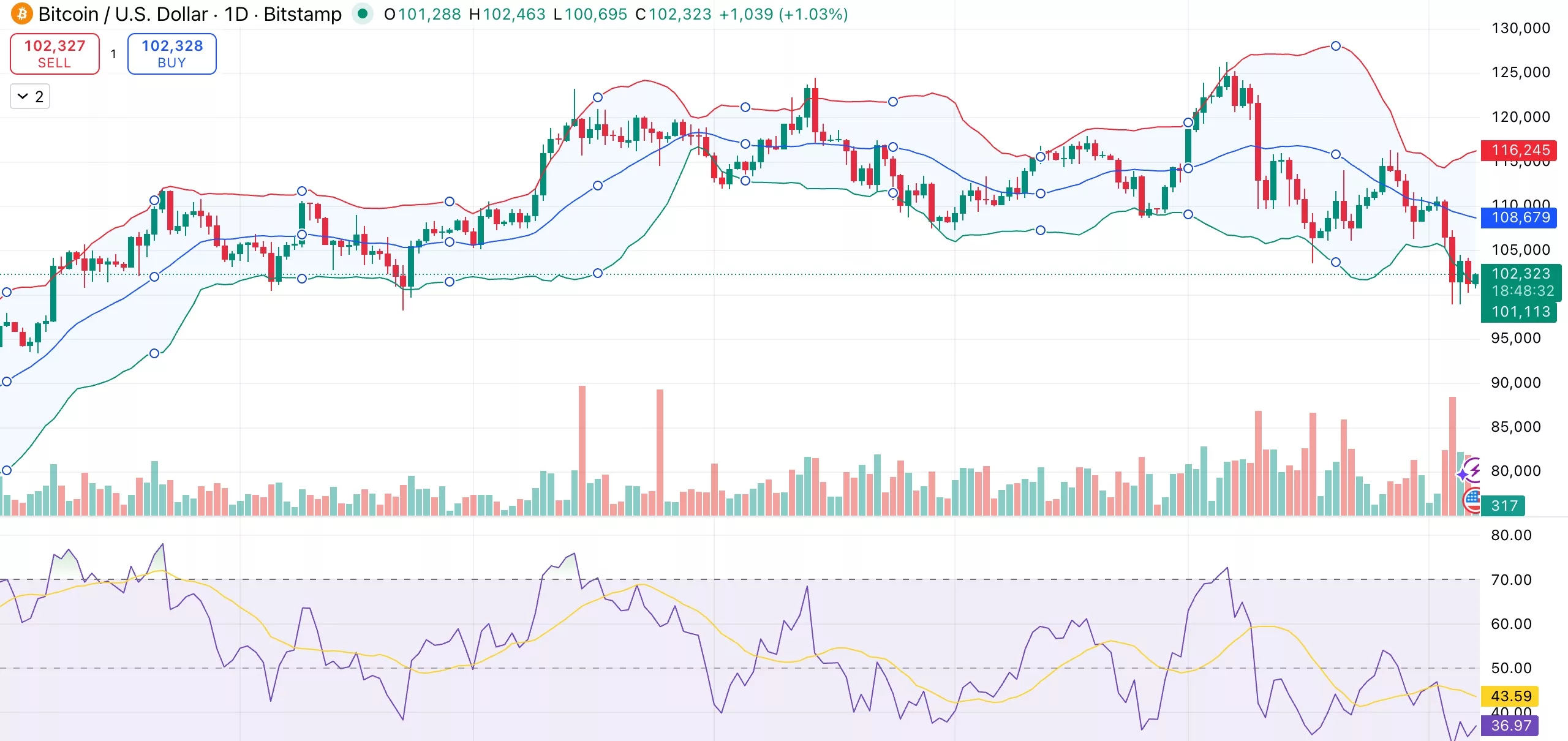
The commodity channel index and momentum readings suggest some early signs of stabilizing or value-based buying at current levels. At the same time, MACD remains negative and most short- and long-term moving averages still sit above price, which shows that trend pressure is still guiding downward in the near term.
A break above $105,800 could restore upside momentum, while failure to hold above $97,000 would open the path toward the CME gap region around $92,000.


You May Also Like

Justice Department has 'gone off the rails' for Trump's 'pretzel logic': analysis

EUR/GBP Exchange Rate Surges as Bank of England Rate Hike Expectations Intensify – Market Analysis




