New Bank of England (BoE) stablecoin regulation proposal sets £20K holding limit
The Bank of England (BoE) has published a consultation paper (CP) that proposes new regulations for sterling-denominated stablecoins. The proposal builds on feedback received on the November 2023 Discussion Paper.
The proposal marks a step toward a future where new forms of digital currency can be widely used for payments, with existing ones offering more choices for the public. The Bank revealed that the new rules outline a regime that’s robust, future-proof, and aligned with the broader National Payments Vision and the Payments Vision Delivery Committee’s strategy to modernize UK retail payments.
BoE proposes holding limits of up to £20,000 for individuals
The scope of the Bank’s regime will not cover stablecoins used as assets for non-systemic purposes, such as buying and selling of cryptoassets, which is the most common use of stablecoins today. The Financial Conduct Authority (FCA) will be tasked with supervising those use cases.
The BoE has proposed that systemic stablecoin issuers be permitted to hold up to 60% of backing assets in the near-term UK government debt. The Bank will also provide issuers with unremunerated accounts at the BoE, the remaining 40% to ensure a robust redemption and public confidence even during a crisis.
Additionally, issuers considered systemic at launch or transitioning from FCA supervision will be allowed to initially hold up to 95% of backing assets in short-term UK government debt. The rule is designed to support the issuer’s viability as it grows.
The BoE is also considering central bank liquidity arrangements to support systemic stablecoin issuers in times of crisis. The arrangements are expected to boost financial stability through the provision of a backstop in case systemic issuers fail.
According to the BoE proposal, to safeguard access to credit as the financial system gradually adapts to new forms of digital money, the Bank has proposed a temporary holding limit of £20,000 per individual and £10 million for businesses. The clause has an additional exemption to allow large entities to hold more if required.
The new proposal has been met with criticism across the industry, with some arguing that the limits are only intended to protect banks, not users. Stani Kulechov, founder and CEO of Aave, noted that proposed limits are absurd, saying that stablecoins issued on-chain are less risky than those issued on traditional electronic databases.
BOE says it will lift the limits only when it is confident of no risk
The Bank noted that the limits are temporary and will be removed when the transition no longer poses risks to the provision of finance to the real economy. The limits would not apply to stablecoins used for settling wholesale financial market transactions in the Bank and FCA’s Digital Securities Sandbox.
As part of the new regulations, the Bank is also publishing a way to quantify the risk to the provision of finance to the economy from potentially rushed withdrawals of bank deposits into new forms of digital money.
For joint regulations with the FCA, non-systemic stablecoin issuers will be subject to FCA regulation. However, if recognized as systemic by HM Treasury (HMT), they will be moved under the Bank’s supervision and jointly controlled by the Bank, with oversight of prudential and financial stability risks. Furthermore, the FCA will continue to supervise conduct and consumer protection.
The BoE has also confirmed that it will publish a joint approach in 2026 to clarify the rules’ applications in practice and support a smooth transition between regimes. The Bank has published the consultation paper with the expectation of receiving feedback on ways to manage risks by February 10, 2026. The Bank will finalize the Codes of Practice in 2026, after considering feedback and consulting on the requirements for systemic stablecoins.
Want your project in front of crypto’s top minds? Feature it in our next industry report, where data meets impact.


You May Also Like
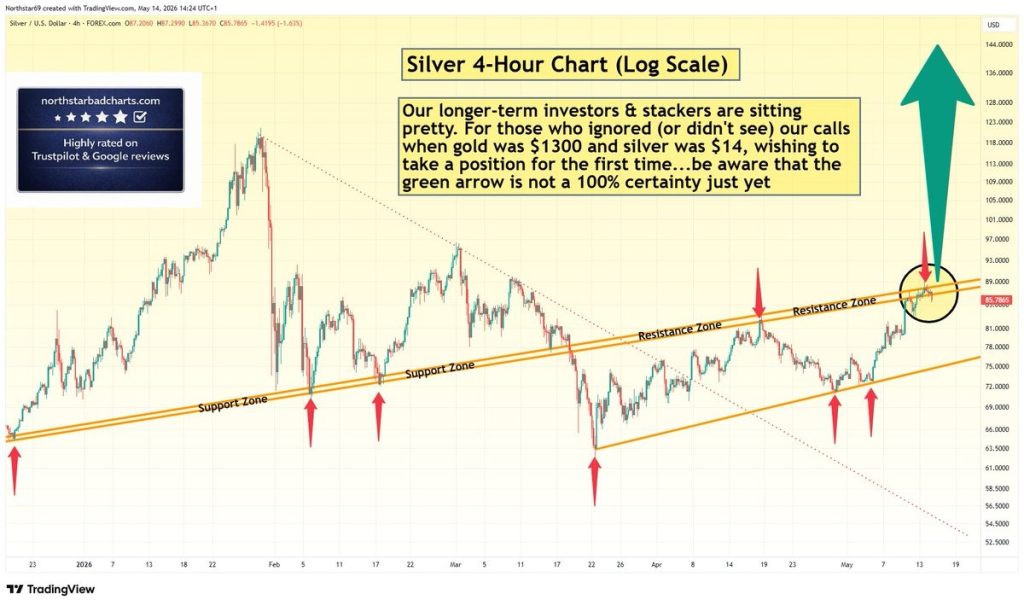
Silver Price Warning: Green Arrow Setup Is Not Confirmed – Wait for Clear Signal

Facebook spotlights African cinema in 6th ‘Made by Africa, loved by the world’ campaign