Spot Bitcoin exchange-traded funds in the United States have recently experienced a sharp drop in inflows as investor sentiment continues to take a hit amid escalating geopolitical concerns. According to data from SoSoValue, the 12 spot Bitcoin ETFs pulled in…Spot Bitcoin exchange-traded funds in the United States have recently experienced a sharp drop in inflows as investor sentiment continues to take a hit amid escalating geopolitical concerns. According to data from SoSoValue, the 12 spot Bitcoin ETFs pulled in…

Bitcoin ETF demand drops sharply as geopolitical jitters rattle investor sentiment

Spot Bitcoin exchange-traded funds in the United States have recently experienced a sharp drop in inflows as investor sentiment continues to take a hit amid escalating geopolitical concerns.

According to data from SoSoValue, the 12 spot Bitcoin ETFs pulled in $1.02 billion over the past week, a significant drop of over 26% compared to the $1.39 billion these funds attracted the week before.

The week of June 16–20 started off strong. Bitcoin ETFs saw $412.2 million in inflows on Monday, followed by $216.48 million on Tuesday and $389.57 million on Wednesday. Thursday was a holiday in the U.S. due to Juneteenth, so markets were closed. But on Friday, inflows fell off a cliff, coming in at just $6.37 million, down about 98% from the average of the previous three trading days.

Most of Friday’s activity was concentrated in two major funds. BlackRock’s IBIT saw $46.91 million in inflows, but that was almost entirely offset by a massive $440.55 million outflow from Fidelity’s FBTC. The rest of the spot Bitcoin ETFs had no activity at all.

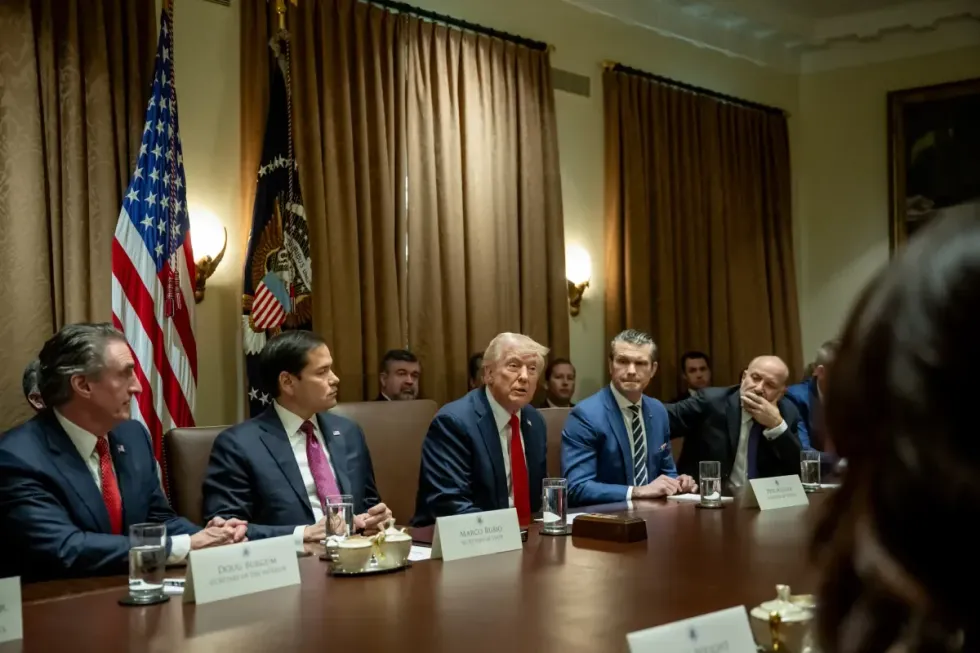
The significant drop in investor demand came as President Donald Trump set a two-week deadline to decide whether the U.S. would officially join Israel’s military campaign against Iran, an ally it’s long backed in the region. That uncertainty spooked markets and drove a broader pullback in risk-on assets like crypto.

While last week’s ETF flows reflected early caution, developments over the weekend added to the geopolitical strain and could further weigh on demand this week.

On June 22, American forces launched a coordinated airstrike on Iran, targeting three key nuclear sites. This marked a turning point in the crisis and intensified fears of a broader conflict.

In response, Iran vowed retaliation, warning of “everlasting” consequences and has even threatened to shut down the Strait of Hormuz, a critical passage for nearly 20% of the world’s oil supply. 

Oil traders are on high alert, with some analysts now projecting prices could spike to $120–$130 per barrel and potentially push U.S. inflation back toward 5%, a level not seen since March 2023, when the Fed was still actively raising rates.

Oil prices are often viewed as a barometer for global economic stability and can influence central bank policy decisions, which can impact investor demand for risk-on assets such as  Bitcoin.

As markets digested the news, investors started moving out of crypto and into traditional safe-haven assets like gold and defense-sector equities. 

Bitcoin felt the pressure, dropping over 2.8% to dip below $99,000 on June 22. Ethereum (ETH) took a bigger hit, tumbling around 9%, while other major altcoins, including Virtuals Protocol, Celestia, Aptos, and AB, were all down over 9% as well.

Despite the sell-off, Bitcoin (BTC) managed to rebound above $100,000 by press time. That recovery was fueled by a 75.8% spike in daily trading volume, which rose to $48.4 billion.

Meanwhile, derivatives activity surged as well, volume jumped 67% to $136 billion, according to data from Coinglass. This suggests some traders may have closed positions due to the uncertainty but are now testing the waters again.

Going forward, the trajectory of Bitcoin will likely be shaped by the pace of diplomatic resolution and the resilience of exchange-traded fund inflows against ongoing sell-side pressure, factors that have historically influenced its performance during periods of geopolitical crisis.


Disclaimer: The articles reposted on this site are sourced from public platforms and are provided for informational purposes only. They do not necessarily reflect the views of MEXC. All rights remain with the original authors. If you believe any content infringes on third-party rights, please contact service@support.mexc.com for removal. MEXC makes no guarantees regarding the accuracy, completeness, or timeliness of the content and is not responsible for any actions taken based on the information provided. The content does not constitute financial, legal, or other professional advice, nor should it be considered a recommendation or endorsement by MEXC.

You May Also Like

Shocking OpenVPP Partnership Claim Draws Urgent Scrutiny

Shocking OpenVPP Partnership Claim Draws Urgent Scrutiny

The post Shocking OpenVPP Partnership Claim Draws Urgent Scrutiny appeared on BitcoinEthereumNews.com. The cryptocurrency world is buzzing with a recent controversy surrounding a bold OpenVPP partnership claim. This week, OpenVPP (OVPP) announced what it presented as a significant collaboration with the U.S. government in the innovative field of energy tokenization. However, this claim quickly drew the sharp eye of on-chain analyst ZachXBT, who highlighted a swift and official rebuttal that has sent ripples through the digital asset community. What Sparked the OpenVPP Partnership Claim Controversy? The core of the issue revolves around OpenVPP’s assertion of a U.S. government partnership. This kind of collaboration would typically be a monumental endorsement for any private cryptocurrency project, especially given the current regulatory climate. Such a partnership could signify a new era of mainstream adoption and legitimacy for energy tokenization initiatives. OpenVPP initially claimed cooperation with the U.S. government. This alleged partnership was said to be in the domain of energy tokenization. The announcement generated considerable interest and discussion online. ZachXBT, known for his diligent on-chain investigations, was quick to flag the development. He brought attention to the fact that U.S. Securities and Exchange Commission (SEC) Commissioner Hester Peirce had directly addressed the OpenVPP partnership claim. Her response, delivered within hours, was unequivocal and starkly contradicted OpenVPP’s narrative. How Did Regulatory Authorities Respond to the OpenVPP Partnership Claim? Commissioner Hester Peirce’s statement was a crucial turning point in this unfolding story. She clearly stated that the SEC, as an agency, does not engage in partnerships with private cryptocurrency projects. This response effectively dismantled the credibility of OpenVPP’s initial announcement regarding their supposed government collaboration. Peirce’s swift clarification underscores a fundamental principle of regulatory bodies: maintaining impartiality and avoiding endorsements of private entities. Her statement serves as a vital reminder to the crypto community about the official stance of government agencies concerning private ventures. Moreover, ZachXBT’s analysis…
Share
BitcoinEthereumNews2025/09/18 02:13
Forward Industries Bets Big on Solana With $4B Capital Plan

Forward Industries Bets Big on Solana With $4B Capital Plan

The firm has filed with the U.S. Securities and Exchange Commission to launch a $4 billion at-the-market (ATM) equity program, […] The post Forward Industries Bets Big on Solana With $4B Capital Plan appeared first on Coindoo.
Share
Coindoo2025/09/18 04:15
Coinbase Joins Ethereum Foundation to Back Open Intents Framework

Coinbase Joins Ethereum Foundation to Back Open Intents Framework

Coinbase Payments has joined the Open Intents Framework as a core contributor, working alongside Ethereum Foundation and other major players. The initiative aims to simplify complex multi-chain interactions through automated solver technology. The post Coinbase Joins Ethereum Foundation to Back Open Intents Framework appeared first on Coinspeaker.
Share
Coinspeaker2025/09/18 02:43