Ryan Rasmussen, Head of Research at Bitwise, used a Yahoo Finance appearance to restate Bitwise’s view that Bitcoin is headed to $200,000 in 2026, while simultaneously characterizing the current sell-off as a maturing-market shakeout rather than a trend break. Is The Bottom In For Bitcoin? He opened with a near-term assessment that “we’re closer to the bottom here today than we have been for the past few weeks,” linking the drawdown to sharply risk-off conditions and to ETF-era flow dynamics. In his framing, Bitcoin “really was a leader of this risk-off move starting in mid-October,” and he expects it to “be a leader to the upside once things start to turn around,” adding that the market feels nearer to that inflection than it did “a week or two weeks ago.” When asked whether spot Bitcoin ETFs have become a double-edged sword, Rasmussen agreed, describing a market that now has deeper liquidity but more cross-currents. “Bitcoin, in our view, is one of the biggest technological developments of the past 15 years,” he said, before explaining that institutionalization brings “new investors and adds more liquidity to the market,” yet also means “we’re seeing a lot more choppiness in times where risk-off moves happen.” He pointed to hedge funds rotating in and out via basis trades and emphasized that “you just have more market participants.” Over time, he expects that shift to damp volatility, but not in a straight line: “throughout that journey, we’re going to see some choppiness, and certainly over the past month, we’ve seen that.” Related Reading: Will Bitcoin Bottom At $56,000? CryptoQuant CEO Presents The Data Pressed on why volatility still looks elevated, Rasmussen separated short-horizon spikes from long-run trend. “If you look at the trend over the past 10 years, volatility has certainly been falling,” he said, but conceded that “over this short-term period, you do see spikes in volatility.” The composition of buyers is, in his view, changing in a stabilizing direction. “The buyers for Bitcoin that we’re seeing come into the market today are more long-term buyers than we’ve seen in the past,” he said, naming wealth managers and financial advisors who “are adding Bitcoin to model portfolios” and “rebalancing on a standard basis.” That institutional style of demand “should all reduce volatility, add more long-term demand,” though he also noted a counterweight: corporate treasury buying that was strong earlier in the year has faded. “The corporate treasuries that are purchasing Bitcoin were coming in in size earlier this year, and that’s really dried up,” he said, arguing that this demand pause is “in part due to this sell-off that we’ve seen in October.” Bitcoin Still Set for $200,000 By 2026 Rasmussen acknowledged the pain of lower prices for recent buyers, but insisted the medium-term path remains higher. “Lower prices are a gift and a curse, of course,” he said. “A lot of investors are feeling pain right now who bought Bitcoin above $100,000 or closer to the $125,000 mark, but we believe that Bitcoin’s going to end the year higher than it is today.” He reiterated that the short-term bottoming process is likely advanced, and then pivoted to his structural thesis: “Institutions are finally here.” He stressed that adoption is gradual rather than instantaneous: “That doesn’t mean that right away they deploy all of their capital.” Even so, he cited early signals such as endowment participation: “even Harvard, we saw with their recent filing, is buying Bitcoin in their endowment.” Related Reading: Bitcoin Capitulation Deepens Around $90K Level: Classic Late-Stage Fear Structure Emerging On macro, Rasmussen conceded an irony that an asset marketed as sovereign and untethered now reacts to central-bank expectations. Post-COVID, he said, Bitcoin has traded in a “fiscally-dominated environment where rate cuts and other macro elements do play more of a role,” and correlations to equities have “spike[d] or raise[d].” Still, he argued correlations are drifting back toward historical lows, and he emphasized Bitcoin’s tendency to do well in “low rate environments and risk on environments.” Regarding the December Fed meeting, he said “no cut in December is largely priced into the market,” and suggested investors have “already started to turn to 2026.” The price target itself was stated unambiguously. “So this year, we had a price target of $200,000. And I think it’s safe to say that come December, that’s not going to happen. But we do believe that in 2026, Bitcoin will hit $200,000,” Rasmussen said. He attributed that forecast to institutional inflows arriving “in waves,” spanning “wealth managers or endowments or pensions or corporations or governments,” which he believes are creating “a systemic imbalance of demand versus supply.” At press time, BTC traded at $91,205. Featured image created with DALL.E, chart from TradingView.comRyan Rasmussen, Head of Research at Bitwise, used a Yahoo Finance appearance to restate Bitwise’s view that Bitcoin is headed to $200,000 in 2026, while simultaneously characterizing the current sell-off as a maturing-market shakeout rather than a trend break. Is The Bottom In For Bitcoin? He opened with a near-term assessment that “we’re closer to the bottom here today than we have been for the past few weeks,” linking the drawdown to sharply risk-off conditions and to ETF-era flow dynamics. In his framing, Bitcoin “really was a leader of this risk-off move starting in mid-October,” and he expects it to “be a leader to the upside once things start to turn around,” adding that the market feels nearer to that inflection than it did “a week or two weeks ago.” When asked whether spot Bitcoin ETFs have become a double-edged sword, Rasmussen agreed, describing a market that now has deeper liquidity but more cross-currents. “Bitcoin, in our view, is one of the biggest technological developments of the past 15 years,” he said, before explaining that institutionalization brings “new investors and adds more liquidity to the market,” yet also means “we’re seeing a lot more choppiness in times where risk-off moves happen.” He pointed to hedge funds rotating in and out via basis trades and emphasized that “you just have more market participants.” Over time, he expects that shift to damp volatility, but not in a straight line: “throughout that journey, we’re going to see some choppiness, and certainly over the past month, we’ve seen that.” Related Reading: Will Bitcoin Bottom At $56,000? CryptoQuant CEO Presents The Data Pressed on why volatility still looks elevated, Rasmussen separated short-horizon spikes from long-run trend. “If you look at the trend over the past 10 years, volatility has certainly been falling,” he said, but conceded that “over this short-term period, you do see spikes in volatility.” The composition of buyers is, in his view, changing in a stabilizing direction. “The buyers for Bitcoin that we’re seeing come into the market today are more long-term buyers than we’ve seen in the past,” he said, naming wealth managers and financial advisors who “are adding Bitcoin to model portfolios” and “rebalancing on a standard basis.” That institutional style of demand “should all reduce volatility, add more long-term demand,” though he also noted a counterweight: corporate treasury buying that was strong earlier in the year has faded. “The corporate treasuries that are purchasing Bitcoin were coming in in size earlier this year, and that’s really dried up,” he said, arguing that this demand pause is “in part due to this sell-off that we’ve seen in October.” Bitcoin Still Set for $200,000 By 2026 Rasmussen acknowledged the pain of lower prices for recent buyers, but insisted the medium-term path remains higher. “Lower prices are a gift and a curse, of course,” he said. “A lot of investors are feeling pain right now who bought Bitcoin above $100,000 or closer to the $125,000 mark, but we believe that Bitcoin’s going to end the year higher than it is today.” He reiterated that the short-term bottoming process is likely advanced, and then pivoted to his structural thesis: “Institutions are finally here.” He stressed that adoption is gradual rather than instantaneous: “That doesn’t mean that right away they deploy all of their capital.” Even so, he cited early signals such as endowment participation: “even Harvard, we saw with their recent filing, is buying Bitcoin in their endowment.” Related Reading: Bitcoin Capitulation Deepens Around $90K Level: Classic Late-Stage Fear Structure Emerging On macro, Rasmussen conceded an irony that an asset marketed as sovereign and untethered now reacts to central-bank expectations. Post-COVID, he said, Bitcoin has traded in a “fiscally-dominated environment where rate cuts and other macro elements do play more of a role,” and correlations to equities have “spike[d] or raise[d].” Still, he argued correlations are drifting back toward historical lows, and he emphasized Bitcoin’s tendency to do well in “low rate environments and risk on environments.” Regarding the December Fed meeting, he said “no cut in December is largely priced into the market,” and suggested investors have “already started to turn to 2026.” The price target itself was stated unambiguously. “So this year, we had a price target of $200,000. And I think it’s safe to say that come December, that’s not going to happen. But we do believe that in 2026, Bitcoin will hit $200,000,” Rasmussen said. He attributed that forecast to institutional inflows arriving “in waves,” spanning “wealth managers or endowments or pensions or corporations or governments,” which he believes are creating “a systemic imbalance of demand versus supply.” At press time, BTC traded at $91,205. Featured image created with DALL.E, chart from TradingView.com
Why Bitwise Thinks Bitcoin Still Hits $200,000 In 2026

2025/11/21 13:00
4 min read
For feedback or concerns regarding this content, please contact us at crypto.news@mexc.com

Ryan Rasmussen, Head of Research at Bitwise, used a Yahoo Finance appearance to restate Bitwise’s view that Bitcoin is headed to $200,000 in 2026, while simultaneously characterizing the current sell-off as a maturing-market shakeout rather than a trend break.

Is The Bottom In For Bitcoin?

He opened with a near-term assessment that “we’re closer to the bottom here today than we have been for the past few weeks,” linking the drawdown to sharply risk-off conditions and to ETF-era flow dynamics. In his framing, Bitcoin “really was a leader of this risk-off move starting in mid-October,” and he expects it to “be a leader to the upside once things start to turn around,” adding that the market feels nearer to that inflection than it did “a week or two weeks ago.”

When asked whether spot Bitcoin ETFs have become a double-edged sword, Rasmussen agreed, describing a market that now has deeper liquidity but more cross-currents. “Bitcoin, in our view, is one of the biggest technological developments of the past 15 years,” he said, before explaining that institutionalization brings “new investors and adds more liquidity to the market,” yet also means “we’re seeing a lot more choppiness in times where risk-off moves happen.”

He pointed to hedge funds rotating in and out via basis trades and emphasized that “you just have more market participants.” Over time, he expects that shift to damp volatility, but not in a straight line: “throughout that journey, we’re going to see some choppiness, and certainly over the past month, we’ve seen that.”

Pressed on why volatility still looks elevated, Rasmussen separated short-horizon spikes from long-run trend. “If you look at the trend over the past 10 years, volatility has certainly been falling,” he said, but conceded that “over this short-term period, you do see spikes in volatility.” The composition of buyers is, in his view, changing in a stabilizing direction. “The buyers for Bitcoin that we’re seeing come into the market today are more long-term buyers than we’ve seen in the past,” he said, naming wealth managers and financial advisors who “are adding Bitcoin to model portfolios” and “rebalancing on a standard basis.”

That institutional style of demand “should all reduce volatility, add more long-term demand,” though he also noted a counterweight: corporate treasury buying that was strong earlier in the year has faded. “The corporate treasuries that are purchasing Bitcoin were coming in in size earlier this year, and that’s really dried up,” he said, arguing that this demand pause is “in part due to this sell-off that we’ve seen in October.”

Bitcoin Still Set for $200,000 By 2026

Rasmussen acknowledged the pain of lower prices for recent buyers, but insisted the medium-term path remains higher. “Lower prices are a gift and a curse, of course,” he said. “A lot of investors are feeling pain right now who bought Bitcoin above $100,000 or closer to the $125,000 mark, but we believe that Bitcoin’s going to end the year higher than it is today.”

He reiterated that the short-term bottoming process is likely advanced, and then pivoted to his structural thesis: “Institutions are finally here.” He stressed that adoption is gradual rather than instantaneous: “That doesn’t mean that right away they deploy all of their capital.” Even so, he cited early signals such as endowment participation: “even Harvard, we saw with their recent filing, is buying Bitcoin in their endowment.”

On macro, Rasmussen conceded an irony that an asset marketed as sovereign and untethered now reacts to central-bank expectations. Post-COVID, he said, Bitcoin has traded in a “fiscally-dominated environment where rate cuts and other macro elements do play more of a role,” and correlations to equities have “spike[d] or raise[d].”

Still, he argued correlations are drifting back toward historical lows, and he emphasized Bitcoin’s tendency to do well in “low rate environments and risk on environments.” Regarding the December Fed meeting, he said “no cut in December is largely priced into the market,” and suggested investors have “already started to turn to 2026.”

The price target itself was stated unambiguously. “So this year, we had a price target of $200,000. And I think it’s safe to say that come December, that’s not going to happen. But we do believe that in 2026, Bitcoin will hit $200,000,” Rasmussen said. He attributed that forecast to institutional inflows arriving “in waves,” spanning “wealth managers or endowments or pensions or corporations or governments,” which he believes are creating “a systemic imbalance of demand versus supply.”

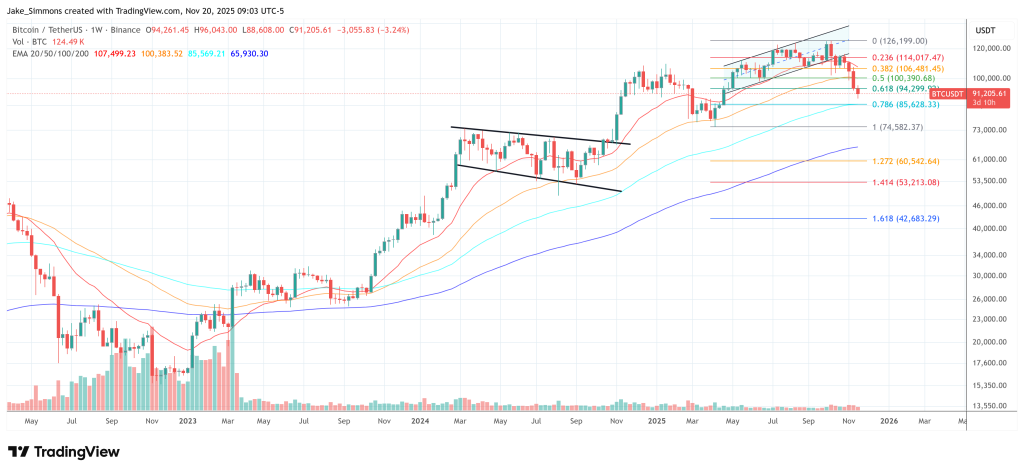
At press time, BTC traded at $91,205.

Bitcoin price
Market Opportunity
NEAR Logo
NEAR Price(NEAR)
$1.3319
$1.3319$1.3319
-0.03%
USD
NEAR (NEAR) Live Price Chart
Disclaimer: The articles reposted on this site are sourced from public platforms and are provided for informational purposes only. They do not necessarily reflect the views of MEXC. All rights remain with the original authors. If you believe any content infringes on third-party rights, please contact crypto.news@mexc.com for removal. MEXC makes no guarantees regarding the accuracy, completeness, or timeliness of the content and is not responsible for any actions taken based on the information provided. The content does not constitute financial, legal, or other professional advice, nor should it be considered a recommendation or endorsement by MEXC.

You May Also Like

The Channel Factories We’ve Been Waiting For

The Channel Factories We’ve Been Waiting For

The post The Channel Factories We’ve Been Waiting For appeared on BitcoinEthereumNews.com. Visions of future technology are often prescient about the broad strokes while flubbing the details. The tablets in “2001: A Space Odyssey” do indeed look like iPads, but you never see the astronauts paying for subscriptions or wasting hours on Candy Crush.  Channel factories are one vision that arose early in the history of the Lightning Network to address some challenges that Lightning has faced from the beginning. Despite having grown to become Bitcoin’s most successful layer-2 scaling solution, with instant and low-fee payments, Lightning’s scale is limited by its reliance on payment channels. Although Lightning shifts most transactions off-chain, each payment channel still requires an on-chain transaction to open and (usually) another to close. As adoption grows, pressure on the blockchain grows with it. The need for a more scalable approach to managing channels is clear. Channel factories were supposed to meet this need, but where are they? In 2025, subnetworks are emerging that revive the impetus of channel factories with some new details that vastly increase their potential. They are natively interoperable with Lightning and achieve greater scale by allowing a group of participants to open a shared multisig UTXO and create multiple bilateral channels, which reduces the number of on-chain transactions and improves capital efficiency. Achieving greater scale by reducing complexity, Ark and Spark perform the same function as traditional channel factories with new designs and additional capabilities based on shared UTXOs.  Channel Factories 101 Channel factories have been around since the inception of Lightning. A factory is a multiparty contract where multiple users (not just two, as in a Dryja-Poon channel) cooperatively lock funds in a single multisig UTXO. They can open, close and update channels off-chain without updating the blockchain for each operation. Only when participants leave or the factory dissolves is an on-chain transaction…
Share
BitcoinEthereumNews2025/09/18 00:09
Top 3 Altcoins for the Next Bull Run Ethereum, Solana and Mutuum Finance

Top 3 Altcoins for the Next Bull Run Ethereum, Solana and Mutuum Finance

Ethereum and Solana already sit near the top of most serious altcoin watchlists, and Mutuum Finance is starting to enter that same conversation from a very different
Share
Techbullion2026/03/20 23:07
Trump: We want to negotiate with Iran, but we have no negotiating partner.

Trump: We want to negotiate with Iran, but we have no negotiating partner.

PANews reported on March 20 that US President Trump stated: "We want to negotiate with Iran, but we have no one to negotiate with. Nobody wants to be Iran's leader
Share
PANews2026/03/20 23:04