

A Guide on How to Make Your AI Fool-Proof
People are asking AI whether to marry someone, what to believe about politics, how to build a business, as though a calculator could teach them courage.
\ You shouldn’t outsource any choices, creative sprints, or emotional decisions to it, as that would be the dumbest thing one can ever do.
\ My goal isn’t to write another “10 AI Tricks” essay.
\ I want to address the anthropomorphic mistake people make in regarding AI as a “wise being.”
What We Created AI to Do
Fire freed our stomachs so our brains could grow. Numerals freed our hands from counting stones. Now, AI is freeing our cognition from statistical drudgery; it is automating memory and probability so we can evolve toward deeper creativity.
\ You couldn’t perform the square root of numbers with tally marks or Roman numerals, so we moved to Arabic numerals and scientific notation. We’ve now created a tool that can run a billion iterations and find statistical patterns 100,000,000x faster than any human.
\ AI is a probability compressor, not a god of wisdom. It’s a statistical prosthetic; outsourcing mental RAM to free the human mind for exploration, creativity, and meaning.
\ And to see what this really means in practice, let’s test it with a glass of wine.
The Glass of Wine Problem
Ask an image model to create “a wine glass filled to the brim.”
\ It can’t. It’s never seen one.
\ It just calculates the statistical average (about 70% full), because that’s how people typically photograph wine.
\ The AI isn’t thinking, “How full should this glass be?”
\ It’s calculating, “Given the tokens ‘wine glass’ and ‘full’, what pixel patterns have the highest probability of appearing together?”
\ This isn’t a bug. This is precisely what AI is.
\ And this is why asking it for personal things is absurd.
The Fundamental Distinction
Where most see AI as “artificial intellect”, it is actually a “probabilistic cognition”: the automation of inductive reasoning so we can focus on creation.
\ Consider this sequence: Red, Blue, Red, Blue, Red… If I ask you the next color, you’ll say Blue. That’s induction: guessing the next piece based on the pattern established by the previous examples. You don’t know why the pattern exists, just that it’s the most probable next step.
\ For centuries, many philosophers thought human learning was primarily this, which is true to an extent. However, induction only gets you the pattern. It doesn’t give you the explanation (“The pattern is red-blue because I used two different paint cans and switched every time”).
\ AI is simply the ultimate master of this “Next Color” game, operating on trillions of data points.
\ Here’s a mental model that captures the gap:
\ 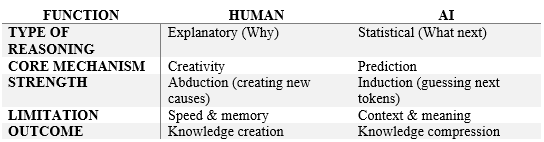
AI predicts. Humans explain. Prediction without explanation is automation; explanation without prediction is art. Combine both, and you get progress.
AI Makes Iteration Easier. Period.
The reason you shouldn’t ask AI for your creative decisions (where truth is subjective) is the same reason you should outsource your statistical tasks (where truth is technical): Humans are fundamentally flawed at probability and inductive reasoning.
\ Psychologists like Kahneman and Tversky showed that our minds don’t naturally work by the rules of probability. Instead, we rely on heuristics (mental shortcuts) that lead to consistent errors.
\ Let AI handle the statistics; the permutations, translations, and patterns, while you handle meaning, causation, and moral choice
Why This Matters
When you ask AI to write your wedding vows, you’re asking it, “Given millions of wedding vow texts in your training data, what sequence of tokens has the highest probability of appearing in this context?”
\ What you get is the statistical average of every wedding vow it’s ever seen. It will give you something that sounds like a wedding vow because it has pattern-matched the structure, tone, and common phrases.
\ What you won’t get is:
- The specific memory of how your partner looks when they laugh
- The private joke that defines your relationship
- The promise that matters uniquely to your shared future
- The vulnerability that comes from genuine commitment
\ AI can’t generate these because they don’t exist as patterns in its training data. They exist only in your explanatory understanding of your relationship, your ability to create meaning from experience.
\ The same applies to career advice, product ideas, essay ideas, creative direction, and any decision requiring you to generate new explanatory knowledge about your own life.
A Note on IQ and What We Should Optimize For
AI has fundamentally changed what cognitive skills we should value. IQ tests largely measure inductive ability, pattern recognition, and statistical reasoning. These are precisely the things AI now does better than humans.
\ What IQ tests don’t measure well is your ability to generate good explanations, to create new knowledge, to understand causation, and to make meaning from experience. Inductivism plays a role in generating good explanations, but it’s just one component used by creativity.
\ If you’ve been obsessed with MENSA or IQ scores, this technology has made that optimization obsolete. The future belongs to explanation generators, not pattern matchers.
The Real Risk
The real risk isn’t that AI will become conscious or replace human intelligence. The real risk is that humans will outsource their thinking to a tool that can’t think, that we’ll mistake its probability calculations for wisdom, and delegate our explanatory reasoning to a pattern matcher.
\ Don’t outsource your thinking and choices to anyone.
\ Your job is to remain the explanation engine. Let AI be your iteration engine.
\ Use it to compress probabilities so you can expand possibilities.
\ Use it to handle statistical drudgery so you can focus on generating knowledge.
\ Use it to amplify patterns so you can create meaning.
\ But never confuse its speed for wisdom or its patterns for understanding.
\ If you want to train your mind to prompt AI statistically, to compress probabilities without losing meaning, the Fool-Proof AI Kit walks you through it, along with 100+ creator-tested examples you can use daily. Grab it here.
Summary
What AI is: A stochastic compressor that performs probability calculations at scale. A pattern-matching engine trained on human-generated data.
\ What AI isn’t: a wise being, a creative entity, or something that understands what it’s saying.
\ What to outsource: statistical calculations, pattern finding, iterations at scale, and information structuring according to defined rules.
\ What never to outsource: meaning-making, causal explanation, creative choices that define you, moral judgements, and life decisions.
\ Reminder: If AI can’t generate a truly full glass of wine because that pattern barely exists in its training data, why would you trust it to generate the unique truth of your life, which exists in no training data at all?
This is not an essay against AI, but a reminder that AI helps us remember and match patterns faster. You still have to do the thinking.
\ If you enjoyed this, click the HackerNoon subscribe button to get more, or visit: https://crive.substack.com

You May Also Like

American Bitcoin’s $5B Nasdaq Debut Puts Trump-Backed Miner in Crypto Spotlight

U.S. Moves Grip on Crypto Regulation Intensifies

