Apeing’s whitelist gains momentum as Pudgy Penguins and Floki pull back. Discover why early access is rewriting today’s altcoin news cycle.Apeing’s whitelist gains momentum as Pudgy Penguins and Floki pull back. Discover why early access is rewriting today’s altcoin news cycle.

Altcoins News Bleeds Across the Market, PENGU and FLOKI Retreat, While Apeing’s Whitelist Breaks Out
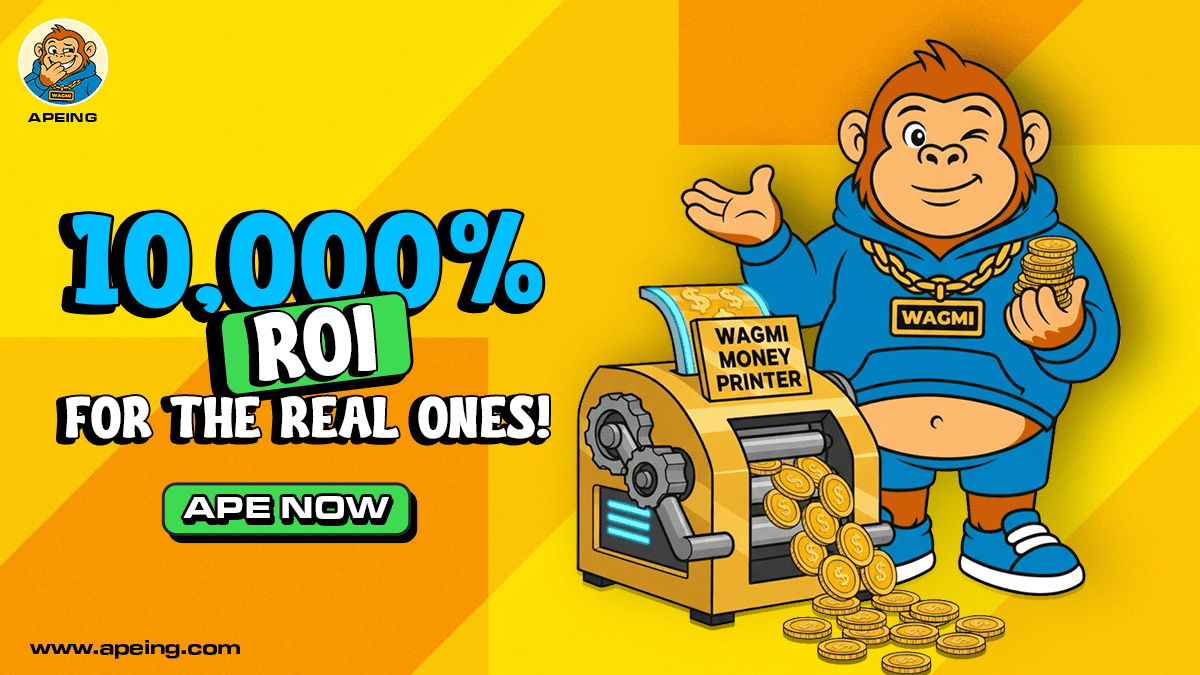
image 243
Sponsored Post Disclaimer: This publication was produced under a paid arrangement with a third-party advertiser. It should not be relied upon as financial or investment counsel.

Ever wonder why some crypto launches feel like a secret rocket ready for liftoff while others fade out like a stalled meme? In today’s altcoin news, nothing gets hearts racing like early-entry access, and right now, the hype around the upcoming whitelist for Apeing is turning heads. The earliest apes could be the ones counting gains while holdouts are left watching charts go sideways.

Investors chase altcoin news like it’s a treasure map, digging for signals “before the crowd catches on and the FOMO-fog thickens.” When in doubt, zoom out: the winners often skip the endless indicators and jump where access is limited. Meanwhile, established meme-coins like Pudgy Penguins and Floki have their own updates rolling, but Apeing’s whitelist momentum is stealing the spotlight.

Apeing Takes the Spotlight in Altcoin News as the Ideal Entry

Apeing is making waves in this altcoin news cycle by offering something rare: a structured stage 1 entry with defined mechanics and upside potential. The project opens with a whitelist priced at just $0.0001 and a projected listing at $0.001, suggesting a theoretical 10,000% ROI if the launch hits target. With limited tokens allocated to Stage 1, it’s clear that the design rewards those who act now rather than watching every candle.

Beyond the price floor, Apeing’s transparency stands out. The structure is laid out plainly, the whitelist process is open, and the early‐entry design creates trust. That kind of clarity in projects builds confidence and invites community commitment, the sort of growth engine smart early investors look for. With the altcoin news buzzing, Apeing isn’t just another token launch: it looks like front-row access to a potential breakout.

How to Join the Whitelist 

Joining the Apeing whitelist is straightforward and designed for speed. 

  1. Go to Apeing’s official site.
  2. Enter your verified email and submit the access request form.
  3. Receive a confirmation message showing that your registration is secure and recorded.

This access format allows early participants to get allocation ahead of the rush. It keeps the process clean, transparent, and fast for traders who do not like delays.

Benefits of Joining a Whitelist Before Public Sale

When the community jumps into the whitelist phase, advantages stack quickly. Entry at $0.0001 gives the best possible starting point; listing at $0.001 offers a theoretically massive upside. The guarantee of allocation avoids many of the pitfalls of public sale chaos. Limited supply and early access mean fewer competitors and less dilution. In short: owning one of the early spots means skipping the stampede and landing where opportunity is freshest.

Pudgy Penguins ($PENGU) Faces a Pullback Amid Broader Altcoin News

Pudgy Penguins trades at approximately $0.01071 after a recent 13.87% drop in the last 24 hours. While that figure is a snapshot, the key takeaway is this: the project remains in the limelight, but momentum is cooling. The news around PENGU still matters, but its correction highlights how even popular meme tokens can lose steam.

That context supports the broader altcoin news narrative: when established players pull back, new launches like Apeing gain relative attention. Investors tracking every shift in meme-coin value should note that the early-entry mechanics matter perhaps even more than brand familiarity.

Floki ($FLOKI) Sees a Dip While Utility Plans Remain in Focus

Floki recently lost about 11.64% of its value, trading around $0.00004635 in the latest 24-hour window. Although the number is just a short-term snapshot, this decrease underscores how volatile the meme-coin space remains, even for names with large followings and utility focus.

Despite the dip, Floki’s ecosystem remains active: gaming, NFTs, and community initiatives continue to drive narrative even when the price backs off. That aligns with broader altcoin news where utility meets hype, but also reminds investors that early access mechanics (like a strong whitelist) can tilt the breakout potential.

Conclusion

Pulling it all together: the altcoin news ecosystem currently features strong players like Pudgy Penguins and Floki, both of which carry heavy market presence and stories. But when it comes to structured early entry, defined upside mechanics, and a clear path to potentially big gains, Apeing’s whitelist sets it apart.

The Apeing Stage 1 entry at $0.0001, listing target at $0.001, and limited token allocation add up to an opportunity that stands apart in this cycle. The mechanics are laid out, the timing is now, and the window is narrowing. If the goal is to lock in access ahead of the crowd, now’s the moment. Apeing’s whitelist is open right now and filling fast. Secure your priority access today, step into the front row of the next major altcoin presale, and act before this entry window closes.

For More Information:

Website: Visit the Official Apeing Website

Telegram: Join the Apeing Telegram Channel

Twitter: Follow Apeing ON X (Formerly Twitter)

Frequently Asked Questions About Altcoin News

What is Apeing’s whitelist process?

Apeing’s whitelist lets early participants reserve tokens at $0.0001 before Stage 1 ends. Register, verify, commit funds, then sit back and await listing. Limited spots mean this process matters.

What upside could early Apeing investors see?

If Apeing lists at $0.001 and early participants entered at $0.0001, the theoretical gain is 10,000%. That’s potential, not a guarantee; always assess risk.

Why join the whitelist instead of waiting for the public sale?

Whitelist ensures the lowest entry price, fewer competitors, and early allocation. Public sale often means a higher price and more buyers clawing at the same tokens.

Does the article mean Pudgy Penguins or Floki are bad investments?

No. Both tokens maintain value and ecosystem activity. The article highlights Apeing’s mechanics as a more compelling entry at this moment.

Is accessing the whitelist risk-free?

No. Crypto investing carries risks, including loss of capital. Whitelist access helps but doesn’t guarantee outcomes. Conduct due diligence and manage risk.

Summary

This article examines current altcoin news with a focus on Apeing’s whitelist mechanics and growth potential. It highlights how Apeing’s structured Stage 1 entry at $0.0001 and projected listing at $0.001 offer early access and clear upside. While established tokens like Pudgy Penguins and Floki remain relevant, their short-term dips signal opportunity for newer launches. The article explains how to join the whitelist, the advantages inherent in early access, and why this mechanics-based presale may outperform typical meme-coin plays. Investors are encouraged to act swiftly for priority access, though risks remain. Ultimately, the piece positions Apeing as the presale worth attention in the altcoin news cycle.

Disclaimer: The text above is an advertorial article that is not part of CoinLineup editorial content.
Market Opportunity
Pudgy Penguins Logo
Pudgy Penguins Price(PENGU)
$0.008713
$0.008713$0.008713
-4.53%
USD
Pudgy Penguins (PENGU) Live Price Chart
Disclaimer: The articles reposted on this site are sourced from public platforms and are provided for informational purposes only. They do not necessarily reflect the views of MEXC. All rights remain with the original authors. If you believe any content infringes on third-party rights, please contact service@support.mexc.com for removal. MEXC makes no guarantees regarding the accuracy, completeness, or timeliness of the content and is not responsible for any actions taken based on the information provided. The content does not constitute financial, legal, or other professional advice, nor should it be considered a recommendation or endorsement by MEXC.

You May Also Like

21Shares Launches JitoSOL Staking ETP on Euronext for European Investors

21Shares Launches JitoSOL Staking ETP on Euronext for European Investors

21Shares launches JitoSOL staking ETP on Euronext, offering European investors regulated access to Solana staking rewards with additional yield opportunities.Read
Share
Coinstats2026/01/30 12:53
Digital Asset Infrastructure Firm Talos Raises $45M, Valuation Hits $1.5 Billion

Digital Asset Infrastructure Firm Talos Raises $45M, Valuation Hits $1.5 Billion

Robinhood, Sony and trading firms back Series B extension as institutional crypto trading platform expands into traditional asset tokenization
Share
Blockhead2026/01/30 13:30
Summarize Any Stock’s Earnings Call in Seconds Using FMP API

Summarize Any Stock’s Earnings Call in Seconds Using FMP API

Turn lengthy earnings call transcripts into one-page insights using the Financial Modeling Prep APIPhoto by Bich Tran Earnings calls are packed with insights. They tell you how a company performed, what management expects in the future, and what analysts are worried about. The challenge is that these transcripts often stretch across dozens of pages, making it tough to separate the key takeaways from the noise. With the right tools, you don’t need to spend hours reading every line. By combining the Financial Modeling Prep (FMP) API with Groq’s lightning-fast LLMs, you can transform any earnings call into a concise summary in seconds. The FMP API provides reliable access to complete transcripts, while Groq handles the heavy lifting of distilling them into clear, actionable highlights. In this article, we’ll build a Python workflow that brings these two together. You’ll see how to fetch transcripts for any stock, prepare the text, and instantly generate a one-page summary. Whether you’re tracking Apple, NVIDIA, or your favorite growth stock, the process works the same — fast, accurate, and ready whenever you are. Fetching Earnings Transcripts with FMP API The first step is to pull the raw transcript data. FMP makes this simple with dedicated endpoints for earnings calls. If you want the latest transcripts across the market, you can use the stable endpoint /stable/earning-call-transcript-latest. For a specific stock, the v3 endpoint lets you request transcripts by symbol, quarter, and year using the pattern: https://financialmodelingprep.com/api/v3/earning_call_transcript/{symbol}?quarter={q}&year={y}&apikey=YOUR_API_KEY here’s how you can fetch NVIDIA’s transcript for a given quarter: import requestsAPI_KEY = "your_api_key"symbol = "NVDA"quarter = 2year = 2024url = f"https://financialmodelingprep.com/api/v3/earning_call_transcript/{symbol}?quarter={quarter}&year={year}&apikey={API_KEY}"response = requests.get(url)data = response.json()# Inspect the keysprint(data.keys())# Access transcript contentif "content" in data[0]: transcript_text = data[0]["content"] print(transcript_text[:500]) # preview first 500 characters The response typically includes details like the company symbol, quarter, year, and the full transcript text. If you aren’t sure which quarter to query, the “latest transcripts” endpoint is the quickest way to always stay up to date. Cleaning and Preparing Transcript Data Raw transcripts from the API often include long paragraphs, speaker tags, and formatting artifacts. Before sending them to an LLM, it helps to organize the text into a cleaner structure. Most transcripts follow a pattern: prepared remarks from executives first, followed by a Q&A session with analysts. Separating these sections gives better control when prompting the model. In Python, you can parse the transcript and strip out unnecessary characters. A simple way is to split by markers such as “Operator” or “Question-and-Answer.” Once separated, you can create two blocks — Prepared Remarks and Q&A — that will later be summarized independently. This ensures the model handles each section within context and avoids missing important details. Here’s a small example of how you might start preparing the data: import re# Example: using the transcript_text we fetched earliertext = transcript_text# Remove extra spaces and line breaksclean_text = re.sub(r'\s+', ' ', text).strip()# Split sections (this is a heuristic; real-world transcripts vary slightly)if "Question-and-Answer" in clean_text: prepared, qna = clean_text.split("Question-and-Answer", 1)else: prepared, qna = clean_text, ""print("Prepared Remarks Preview:\n", prepared[:500])print("\nQ&A Preview:\n", qna[:500]) With the transcript cleaned and divided, you’re ready to feed it into Groq’s LLM. Chunking may be necessary if the text is very long. A good approach is to break it into segments of a few thousand tokens, summarize each part, and then merge the summaries in a final pass. Summarizing with Groq LLM Now that the transcript is clean and split into Prepared Remarks and Q&A, we’ll use Groq to generate a crisp one-pager. The idea is simple: summarize each section separately (for focus and accuracy), then synthesize a final brief. Prompt design (concise and factual) Use a short, repeatable template that pushes for neutral, investor-ready language: You are an equity research analyst. Summarize the following earnings call sectionfor {symbol} ({quarter} {year}). Be factual and concise.Return:1) TL;DR (3–5 bullets)2) Results vs. guidance (what improved/worsened)3) Forward outlook (specific statements)4) Risks / watch-outs5) Q&A takeaways (if present)Text:<<<{section_text}>>> Python: calling Groq and getting a clean summary Groq provides an OpenAI-compatible API. Set your GROQ_API_KEY and pick a fast, high-quality model (e.g., a Llama-3.1 70B variant). We’ll write a helper to summarize any text block, then run it for both sections and merge. import osimport textwrapimport requestsGROQ_API_KEY = os.environ.get("GROQ_API_KEY") or "your_groq_api_key"GROQ_BASE_URL = "https://api.groq.com/openai/v1" # OpenAI-compatibleMODEL = "llama-3.1-70b" # choose your preferred Groq modeldef call_groq(prompt, temperature=0.2, max_tokens=1200): url = f"{GROQ_BASE_URL}/chat/completions" headers = { "Authorization": f"Bearer {GROQ_API_KEY}", "Content-Type": "application/json", } payload = { "model": MODEL, "messages": [ {"role": "system", "content": "You are a precise, neutral equity research analyst."}, {"role": "user", "content": prompt}, ], "temperature": temperature, "max_tokens": max_tokens, } r = requests.post(url, headers=headers, json=payload, timeout=60) r.raise_for_status() return r.json()["choices"][0]["message"]["content"].strip()def build_prompt(section_text, symbol, quarter, year): template = """ You are an equity research analyst. Summarize the following earnings call section for {symbol} ({quarter} {year}). Be factual and concise. Return: 1) TL;DR (3–5 bullets) 2) Results vs. guidance (what improved/worsened) 3) Forward outlook (specific statements) 4) Risks / watch-outs 5) Q&A takeaways (if present) Text: <<< {section_text} >>> """ return textwrap.dedent(template).format( symbol=symbol, quarter=quarter, year=year, section_text=section_text )def summarize_section(section_text, symbol="NVDA", quarter="Q2", year="2024"): if not section_text or section_text.strip() == "": return "(No content found for this section.)" prompt = build_prompt(section_text, symbol, quarter, year) return call_groq(prompt)# Example usage with the cleaned splits from Section 3prepared_summary = summarize_section(prepared, symbol="NVDA", quarter="Q2", year="2024")qna_summary = summarize_section(qna, symbol="NVDA", quarter="Q2", year="2024")final_one_pager = f"""# {symbol} Earnings One-Pager — {quarter} {year}## Prepared Remarks — Key Points{prepared_summary}## Q&A Highlights{qna_summary}""".strip()print(final_one_pager[:1200]) # preview Tips that keep quality high: Keep temperature low (≈0.2) for factual tone. If a section is extremely long, chunk at ~5–8k tokens, summarize each chunk with the same prompt, then ask the model to merge chunk summaries into one section summary before producing the final one-pager. If you also fetched headline numbers (EPS/revenue, guidance) earlier, prepend them to the prompt as brief context to help the model anchor on the right outcomes. Building the End-to-End Pipeline At this point, we have all the building blocks: the FMP API to fetch transcripts, a cleaning step to structure the data, and Groq LLM to generate concise summaries. The final step is to connect everything into a single workflow that can take any ticker and return a one-page earnings call summary. The flow looks like this: Input a stock ticker (for example, NVDA). Use FMP to fetch the latest transcript. Clean and split the text into Prepared Remarks and Q&A. Send each section to Groq for summarization. Merge the outputs into a neatly formatted earnings one-pager. Here’s how it comes together in Python: def summarize_earnings_call(symbol, quarter, year, api_key, groq_key): # Step 1: Fetch transcript from FMP url = f"https://financialmodelingprep.com/api/v3/earning_call_transcript/{symbol}?quarter={quarter}&year={year}&apikey={api_key}" resp = requests.get(url) resp.raise_for_status() data = resp.json() if not data or "content" not in data[0]: return f"No transcript found for {symbol} {quarter} {year}" text = data[0]["content"] # Step 2: Clean and split clean_text = re.sub(r'\s+', ' ', text).strip() if "Question-and-Answer" in clean_text: prepared, qna = clean_text.split("Question-and-Answer", 1) else: prepared, qna = clean_text, "" # Step 3: Summarize with Groq prepared_summary = summarize_section(prepared, symbol, quarter, year) qna_summary = summarize_section(qna, symbol, quarter, year) # Step 4: Merge into final one-pager return f"""# {symbol} Earnings One-Pager — {quarter} {year}## Prepared Remarks{prepared_summary}## Q&A Highlights{qna_summary}""".strip()# Example runprint(summarize_earnings_call("NVDA", 2, 2024, API_KEY, GROQ_API_KEY)) With this setup, generating a summary becomes as simple as calling one function with a ticker and date. You can run it inside a notebook, integrate it into a research workflow, or even schedule it to trigger after each new earnings release. Free Stock Market API and Financial Statements API... Conclusion Earnings calls no longer need to feel overwhelming. With the Financial Modeling Prep API, you can instantly access any company’s transcript, and with Groq LLM, you can turn that raw text into a sharp, actionable summary in seconds. This pipeline saves hours of reading and ensures you never miss the key results, guidance, or risks hidden in lengthy remarks. Whether you track tech giants like NVIDIA or smaller growth stocks, the process is the same — fast, reliable, and powered by the flexibility of FMP’s data. Summarize Any Stock’s Earnings Call in Seconds Using FMP API was originally published in Coinmonks on Medium, where people are continuing the conversation by highlighting and responding to this story
Share
Medium2025/09/18 14:40
