Crypto markets are confronting a fast-moving repricing of US monetary policy expectations, and macro trader Alex Krüger argues that even after last week’s sharp dovish turn, futures curves still fail to discount what a Trump-aligned Federal Reserve leadership could look like. Fed Cut Mispricing Sets Up Crypto Repricing Event In a post on X, Krüger shared a CME-derived table of implied policy rates for late-stage 2026 and framed it as the market’s baseline for the post-Powell transition. The table shows an expected fed funds rate of 3.47% for the April 29, 2026 FOMC meeting (347 bps), drifting to 3.29% for June 17, 2026 (329 bps), to 3.10% for September 16, 2026 (310 bps), and to 2.99% for December 9, 2026 (299 bps). In other words, the curve prices roughly 48 basis points of easing between late April and early December 2026 about two quarter-point cuts across that span—implying a relatively gradual descent toward just under 3%. Krüger’s core claim is that this path is inconsistent with the policy preferences he associates with the Trump camp, and therefore inconsistent with an “ultra dovish” chair appointment. He situates the April 2026 meeting as the last one under Jerome Powell’s chairmanship, whose four-year term ends in mid-May 2026, and then treats the June 2026 meeting as the first under a new chair. Related Reading: Crypto Crash Is A Forced Crypto Seller Unwind, Glassnode Co-Founders Claim Against that transition, Krüger points to Fed Governor Stephen Miran—whom he casts as a proxy for Trump-world monetary instincts—as advocating a much faster return to neutral. In Krüger’s telling, Miran has argued that the “appropriate fed funds rate” is “roughly 2% to 2.5%,” has linked this year’s tighter stance to a rise in the neutral rate, and has characterized his divergence from colleagues as centered on “speed of cuts,” not destination. Krüger also highlights Miran’s preference for “50 bps cuts” over 25-bp steps as the way to get policy back to neutral. On Krüger’s arithmetic, a futures curve that delivers only about 50 bps of easing from the first post-Powell meeting in June 2026 through December 2026 is not a curve that has truly priced a Trump-era chair willing to front-load larger moves. Related Reading: Crypto Funds Face Third Consecutive Weekly Losses, Totaling $3 Billion In Outflows Put simply, he sees the market as still anchored to a Powell-style glide path, even while political risk is skewing toward more abrupt easing. “The Trump camp wants faster and bigger cuts, many of them. The Fed only cutting 50bps between the new Fed Chair’s FOMC in June and December 2026 falls short. That’s why I sustain an ultra dovish Fed Chair appointed by Trump is not priced in,” Krüger concludes. December Rate Cut Seems Likely The timing of Krüger’s warning matters because the front end has already undergone a dramatic swing. Last week, traders sharply increased the probability of another cut at the Fed’s December meeting after New York Fed President John Williams said rates could fall “in the near term,” a remark that pushed implied odds of a quarter-point December move into the mid-70% range on CME FedWatch, up from roughly 40% the day before. In parallel, Goldman Sachs chief economist Jan Hatzius reiterated a baseline in which the Fed cuts in December, then again in March and June 2026, taking the policy band down to roughly 3.00%–3.25%.” We expect another Fed cut in December, followed by two more moves in March and June 2026 that take the funds rate to 3-3.25%,” said Hatzius. GOLDMAN SEES DOWNSIDE RISKS FOR ECONOMY NEXT YEAR Goldman Sachs economists expect the Fed to cut rates in December, followed by a few more cuts in 2025, bringing rates just above 3%. Chief economist Jan Hatzius warns the economy could slow more than expected, requiring… — *Walter Bloomberg (@DeItaone) November 24, 2025 His path is modestly more dovish than what the curve had discounted earlier in the month, but it still resembles the gradualism embedded in Krüger’s CME table: sequential 25-bp steps, aiming for an early-2026 rate around the low-3% area rather than a rapid drop toward the low-2s. For the crypto markets, the dispute is less about whether cuts are coming than about the speed and terminal rate. Crypto is structurally levered to shifts in dollar liquidity and real-rate expectations; what Krüger is flagging is a scenario where the curve’s “destination” and, especially, its pacing remain too conservative relative to a potential political reorientation of the Fed. If traders are right that the Williams-sparked repricing is the beginning of a slower, data-dependent easing cycle, then current crypto asset valuations already incorporate the relevant macro impulse. If Krüger is right, the curve is still missing a regime change in reaction function—one in which larger front-loaded cuts compress cash yields faster than expected, steepen risk-on positioning, and force another round of cross-asset duration and liquidity repricing. That gap between a Powell-era slope and a Trump-era shock path is what he means when he says an ultra-dovish chair “is not priced in” for crypto markets. At press time, the total crypto market cap was at $2.92 trillion. Featured image created with DALL.E, chart from TradingView.comCrypto markets are confronting a fast-moving repricing of US monetary policy expectations, and macro trader Alex Krüger argues that even after last week’s sharp dovish turn, futures curves still fail to discount what a Trump-aligned Federal Reserve leadership could look like. Fed Cut Mispricing Sets Up Crypto Repricing Event In a post on X, Krüger shared a CME-derived table of implied policy rates for late-stage 2026 and framed it as the market’s baseline for the post-Powell transition. The table shows an expected fed funds rate of 3.47% for the April 29, 2026 FOMC meeting (347 bps), drifting to 3.29% for June 17, 2026 (329 bps), to 3.10% for September 16, 2026 (310 bps), and to 2.99% for December 9, 2026 (299 bps). In other words, the curve prices roughly 48 basis points of easing between late April and early December 2026 about two quarter-point cuts across that span—implying a relatively gradual descent toward just under 3%. Krüger’s core claim is that this path is inconsistent with the policy preferences he associates with the Trump camp, and therefore inconsistent with an “ultra dovish” chair appointment. He situates the April 2026 meeting as the last one under Jerome Powell’s chairmanship, whose four-year term ends in mid-May 2026, and then treats the June 2026 meeting as the first under a new chair. Related Reading: Crypto Crash Is A Forced Crypto Seller Unwind, Glassnode Co-Founders Claim Against that transition, Krüger points to Fed Governor Stephen Miran—whom he casts as a proxy for Trump-world monetary instincts—as advocating a much faster return to neutral. In Krüger’s telling, Miran has argued that the “appropriate fed funds rate” is “roughly 2% to 2.5%,” has linked this year’s tighter stance to a rise in the neutral rate, and has characterized his divergence from colleagues as centered on “speed of cuts,” not destination. Krüger also highlights Miran’s preference for “50 bps cuts” over 25-bp steps as the way to get policy back to neutral. On Krüger’s arithmetic, a futures curve that delivers only about 50 bps of easing from the first post-Powell meeting in June 2026 through December 2026 is not a curve that has truly priced a Trump-era chair willing to front-load larger moves. Related Reading: Crypto Funds Face Third Consecutive Weekly Losses, Totaling $3 Billion In Outflows Put simply, he sees the market as still anchored to a Powell-style glide path, even while political risk is skewing toward more abrupt easing. “The Trump camp wants faster and bigger cuts, many of them. The Fed only cutting 50bps between the new Fed Chair’s FOMC in June and December 2026 falls short. That’s why I sustain an ultra dovish Fed Chair appointed by Trump is not priced in,” Krüger concludes. December Rate Cut Seems Likely The timing of Krüger’s warning matters because the front end has already undergone a dramatic swing. Last week, traders sharply increased the probability of another cut at the Fed’s December meeting after New York Fed President John Williams said rates could fall “in the near term,” a remark that pushed implied odds of a quarter-point December move into the mid-70% range on CME FedWatch, up from roughly 40% the day before. In parallel, Goldman Sachs chief economist Jan Hatzius reiterated a baseline in which the Fed cuts in December, then again in March and June 2026, taking the policy band down to roughly 3.00%–3.25%.” We expect another Fed cut in December, followed by two more moves in March and June 2026 that take the funds rate to 3-3.25%,” said Hatzius. GOLDMAN SEES DOWNSIDE RISKS FOR ECONOMY NEXT YEAR Goldman Sachs economists expect the Fed to cut rates in December, followed by a few more cuts in 2025, bringing rates just above 3%. Chief economist Jan Hatzius warns the economy could slow more than expected, requiring… — *Walter Bloomberg (@DeItaone) November 24, 2025 His path is modestly more dovish than what the curve had discounted earlier in the month, but it still resembles the gradualism embedded in Krüger’s CME table: sequential 25-bp steps, aiming for an early-2026 rate around the low-3% area rather than a rapid drop toward the low-2s. For the crypto markets, the dispute is less about whether cuts are coming than about the speed and terminal rate. Crypto is structurally levered to shifts in dollar liquidity and real-rate expectations; what Krüger is flagging is a scenario where the curve’s “destination” and, especially, its pacing remain too conservative relative to a potential political reorientation of the Fed. If traders are right that the Williams-sparked repricing is the beginning of a slower, data-dependent easing cycle, then current crypto asset valuations already incorporate the relevant macro impulse. If Krüger is right, the curve is still missing a regime change in reaction function—one in which larger front-loaded cuts compress cash yields faster than expected, steepen risk-on positioning, and force another round of cross-asset duration and liquidity repricing. That gap between a Powell-era slope and a Trump-era shock path is what he means when he says an ultra-dovish chair “is not priced in” for crypto markets. At press time, the total crypto market cap was at $2.92 trillion. Featured image created with DALL.E, chart from TradingView.com

Crypto Markets Underestimate A Trump-Style Flood Of Rate Cuts: Expert

2025/11/25 13:00

Crypto markets are confronting a fast-moving repricing of US monetary policy expectations, and macro trader Alex Krüger argues that even after last week’s sharp dovish turn, futures curves still fail to discount what a Trump-aligned Federal Reserve leadership could look like.

Fed Cut Mispricing Sets Up Crypto Repricing Event

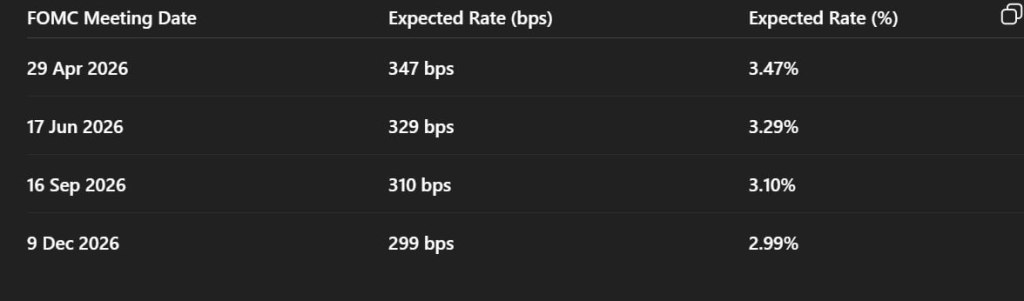
In a post on X, Krüger shared a CME-derived table of implied policy rates for late-stage 2026 and framed it as the market’s baseline for the post-Powell transition. The table shows an expected fed funds rate of 3.47% for the April 29, 2026 FOMC meeting (347 bps), drifting to 3.29% for June 17, 2026 (329 bps), to 3.10% for September 16, 2026 (310 bps), and to 2.99% for December 9, 2026 (299 bps).
Fed rate cut projections

In other words, the curve prices roughly 48 basis points of easing between late April and early December 2026 about two quarter-point cuts across that span—implying a relatively gradual descent toward just under 3%. Krüger’s core claim is that this path is inconsistent with the policy preferences he associates with the Trump camp, and therefore inconsistent with an “ultra dovish” chair appointment. He situates the April 2026 meeting as the last one under Jerome Powell’s chairmanship, whose four-year term ends in mid-May 2026, and then treats the June 2026 meeting as the first under a new chair.

Against that transition, Krüger points to Fed Governor Stephen Miran—whom he casts as a proxy for Trump-world monetary instincts—as advocating a much faster return to neutral. In Krüger’s telling, Miran has argued that the “appropriate fed funds rate” is “roughly 2% to 2.5%,” has linked this year’s tighter stance to a rise in the neutral rate, and has characterized his divergence from colleagues as centered on “speed of cuts,” not destination.

Krüger also highlights Miran’s preference for “50 bps cuts” over 25-bp steps as the way to get policy back to neutral. On Krüger’s arithmetic, a futures curve that delivers only about 50 bps of easing from the first post-Powell meeting in June 2026 through December 2026 is not a curve that has truly priced a Trump-era chair willing to front-load larger moves.

Put simply, he sees the market as still anchored to a Powell-style glide path, even while political risk is skewing toward more abrupt easing. “The Trump camp wants faster and bigger cuts, many of them. The Fed only cutting 50bps between the new Fed Chair’s FOMC in June and December 2026 falls short. That’s why I sustain an ultra dovish Fed Chair appointed by Trump is not priced in,” Krüger concludes.

December Rate Cut Seems Likely

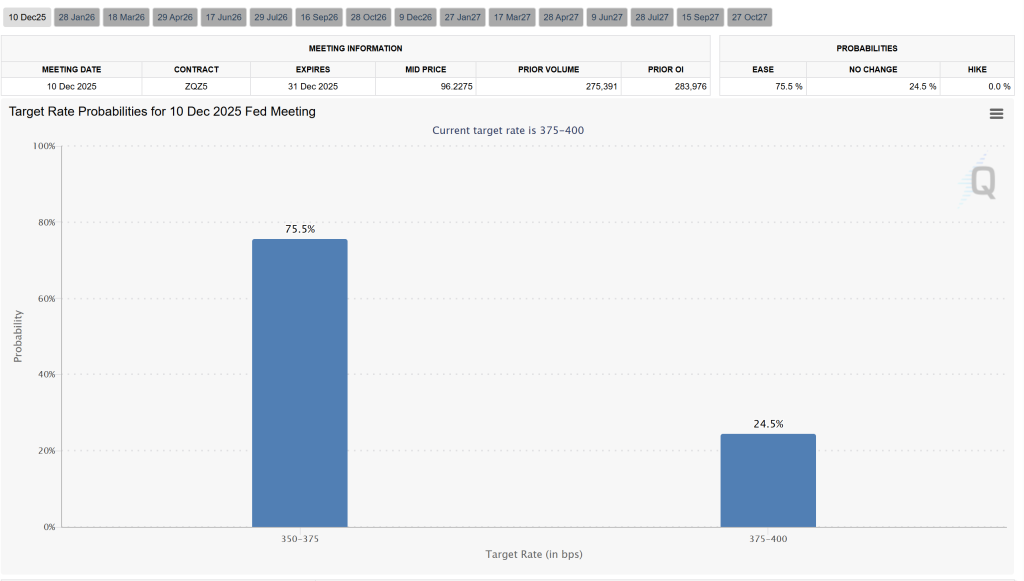
The timing of Krüger’s warning matters because the front end has already undergone a dramatic swing. Last week, traders sharply increased the probability of another cut at the Fed’s December meeting after New York Fed President John Williams said rates could fall “in the near term,” a remark that pushed implied odds of a quarter-point December move into the mid-70% range on CME FedWatch, up from roughly 40% the day before.
CME Fedwatch

In parallel, Goldman Sachs chief economist Jan Hatzius reiterated a baseline in which the Fed cuts in December, then again in March and June 2026, taking the policy band down to roughly 3.00%–3.25%.” We expect another Fed cut in December, followed by two more moves in March and June 2026 that take the funds rate to 3-3.25%,” said Hatzius.

His path is modestly more dovish than what the curve had discounted earlier in the month, but it still resembles the gradualism embedded in Krüger’s CME table: sequential 25-bp steps, aiming for an early-2026 rate around the low-3% area rather than a rapid drop toward the low-2s.

For the crypto markets, the dispute is less about whether cuts are coming than about the speed and terminal rate. Crypto is structurally levered to shifts in dollar liquidity and real-rate expectations; what Krüger is flagging is a scenario where the curve’s “destination” and, especially, its pacing remain too conservative relative to a potential political reorientation of the Fed.

If traders are right that the Williams-sparked repricing is the beginning of a slower, data-dependent easing cycle, then current crypto asset valuations already incorporate the relevant macro impulse.

If Krüger is right, the curve is still missing a regime change in reaction function—one in which larger front-loaded cuts compress cash yields faster than expected, steepen risk-on positioning, and force another round of cross-asset duration and liquidity repricing. That gap between a Powell-era slope and a Trump-era shock path is what he means when he says an ultra-dovish chair “is not priced in” for crypto markets.

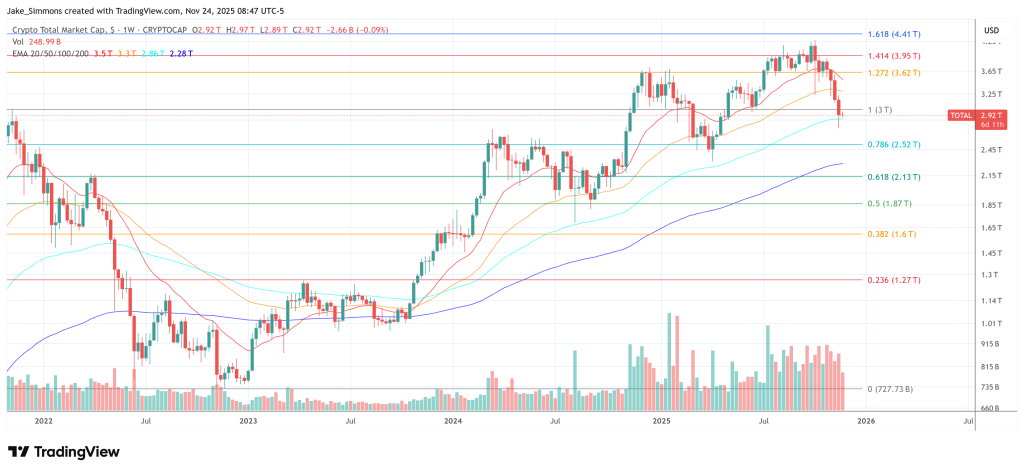
At press time, the total crypto market cap was at $2.92 trillion.
Total crypto market cap
Market Opportunity
OFFICIAL TRUMP Logo
OFFICIAL TRUMP Price(TRUMP)
$4.953
$4.953$4.953
-4.47%
USD
OFFICIAL TRUMP (TRUMP) Live Price Chart
Disclaimer: The articles reposted on this site are sourced from public platforms and are provided for informational purposes only. They do not necessarily reflect the views of MEXC. All rights remain with the original authors. If you believe any content infringes on third-party rights, please contact service@support.mexc.com for removal. MEXC makes no guarantees regarding the accuracy, completeness, or timeliness of the content and is not responsible for any actions taken based on the information provided. The content does not constitute financial, legal, or other professional advice, nor should it be considered a recommendation or endorsement by MEXC.

You May Also Like

China Launches Cross-Border QR Code Payment Trial

China Launches Cross-Border QR Code Payment Trial

The post China Launches Cross-Border QR Code Payment Trial appeared on BitcoinEthereumNews.com. Key Points: Main event involves China initiating a cross-border QR code payment trial. Alipay and Ant International are key participants. Impact on financial security and regulatory focus on illicit finance. China’s central bank, led by Deputy Governor Lu Lei, initiated a trial of a unified cross-border QR code payment gateway with Alipay and Ant International as participants. This pilot addresses cross-border fund risks, aiming to enhance financial security amid rising money laundering through digital channels, despite muted crypto market reactions. China’s Cross-Border Payment Gateway Trial with Alipay The trial operation of a unified cross-border QR code payment gateway marks a milestone in China’s financial landscape. Prominent entities such as Alipay and Ant International are at the forefront, participating as the initial institutions in this venture. Lu Lei, Deputy Governor of the People’s Bank of China, highlighted the systemic risks posed by increased cross-border fund flows. Changes are expected in the dynamics of digital transactions, potentially enhancing transaction efficiency while tightening regulations around illicit finance. The initiative underscores China’s commitment to bolstering financial security amidst growing global fund movements. “The scale of cross-border fund flows is expanding, and the frequency is accelerating, providing opportunities for risks such as cross-border money laundering and terrorist financing. Some overseas illegal platforms transfer funds through channels such as virtual currencies and underground banks, creating a ‘resonance’ of risks at home and abroad, posing a challenge to China’s foreign exchange management and financial security.” — Lu Lei, Deputy Governor, People’s Bank of China Bitcoin and Impact of China’s Financial Initiatives Did you know? China’s latest initiative echoes the Payment Connect project of June 2025, furthering real-time cross-boundary remittances and expanding its influence on global financial systems. As of September 17, 2025, Bitcoin (BTC) stands at $115,748.72 with a market cap of $2.31 trillion, showing a 0.97%…
Share
BitcoinEthereumNews2025/09/18 05:28
Zero Knowledge Proof Auction Limits Large Buyers to $50K: Experts Forecast 200x to 10,000x ROI

Zero Knowledge Proof Auction Limits Large Buyers to $50K: Experts Forecast 200x to 10,000x ROI

In most token sales, the fastest and richest participants win. Large buyers jump in early, take most of the supply, and control the market before regular people
Share
LiveBitcoinNews2026/01/19 08:00
IP Hits $11.75, HYPE Climbs to $55, BlockDAG Surpasses Both with $407M Presale Surge!

IP Hits $11.75, HYPE Climbs to $55, BlockDAG Surpasses Both with $407M Presale Surge!

The post IP Hits $11.75, HYPE Climbs to $55, BlockDAG Surpasses Both with $407M Presale Surge! appeared on BitcoinEthereumNews.com. Crypto News 17 September 2025 | 18:00 Discover why BlockDAG’s upcoming Awakening Testnet launch makes it the best crypto to buy today as Story (IP) price jumps to $11.75 and Hyperliquid hits new highs. Recent crypto market numbers show strength but also some limits. The Story (IP) price jump has been sharp, fueled by big buybacks and speculation, yet critics point out that revenue still lags far behind its valuation. The Hyperliquid (HYPE) price looks solid around the mid-$50s after a new all-time high, but questions remain about sustainability once the hype around USDH proposals cools down. So the obvious question is: why chase coins that are either stretched thin or at risk of retracing when you could back a network that’s already proving itself on the ground? That’s where BlockDAG comes in. While other chains are stuck dealing with validator congestion or outages, BlockDAG’s upcoming Awakening Testnet will be stress-testing its EVM-compatible smart chain with real miners before listing. For anyone looking for the best crypto coin to buy, the choice between waiting on fixes or joining live progress feels like an easy one. BlockDAG: Smart Chain Running Before Launch Ethereum continues to wrestle with gas congestion, and Solana is still known for network freezes, yet BlockDAG is already showing a different picture. Its upcoming Awakening Testnet, set to launch on September 25, isn’t just a demo; it’s a live rollout where the chain’s base protocols are being stress-tested with miners connected globally. EVM compatibility is active, account abstraction is built in, and tools like updated vesting contracts and Stratum integration are already functional. Instead of waiting for fixes like other networks, BlockDAG is proving its infrastructure in real time. What makes this even more important is that the technology is operational before the coin even hits exchanges. That…
Share
BitcoinEthereumNews2025/09/18 00:32