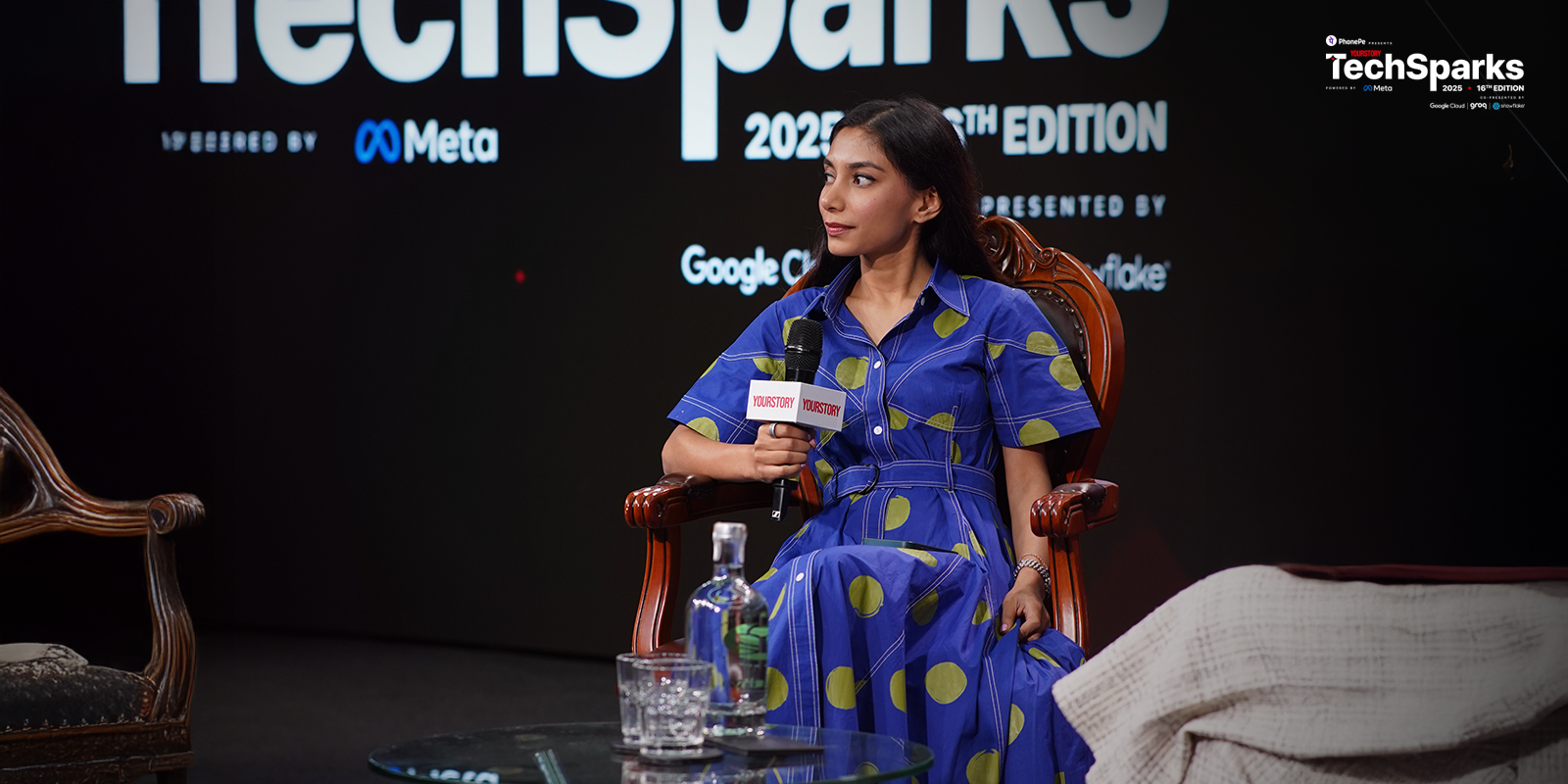
At TechSparks 2025, Devika Mittal, of Ava Labs, explains how open infrastructure and developer support are turning India into a global leader in blockchain-enabled AI systems.At TechSparks 2025, Devika Mittal, of Ava Labs, explains how open infrastructure and developer support are turning India into a global leader in blockchain-enabled AI systems.

Beyond the buzzwords: How blockchain is making AI accountable for India's next builders
2025/11/26 13:48

"Blockchain doesn't fix your AI. What blockchain does is make your AI credible and auditable."

Devika Mittal's declaration at TechSparks 2025 cut through the hype surrounding two of technology's most discussed innovations. Speaking at YourStory's flagship event in Bengaluru, the regional head of Ava Labs made a compelling case for why blockchain matters in an AI-driven future, and how India's 2,100 blockchain startups are positioned to lead this convergence.

In a fireside chat with Shivani Muthanna, Senior Director of Strategic Partnerships at YourStory, Mittal explored the intersection of AI and blockchain under the theme ‘AI x blockchain: Empowering India's Next Builders’. The conversation revealed how open infrastructure and targeted developer support are transforming India's tech ecosystem, from crypto speculation to solving real-world problems.

The trust question in AI systems

Can your data be trusted? Can it be auditable? These questions framed Mittal's central argument. As AI systems increasingly decide whether farmers receive loans or patients get medical diagnoses, the ability to trace and verify every piece of data becomes critical.

"When AI systems are scaling now, when we have these large language models, there's a lot of discussion about these kinds of black boxes of data," Mittal said. "We're talking about data hallucinations, loops. We just don't understand where the data is coming from."

Blockchain provides the answer through immutability. "You can't change data once it's there," she explained. This foundational characteristic means that in critical sectors like healthcare, finance, and agriculture, blockchain can secure AI's data pipeline by preventing tampering and ensuring every decision can be traced from input to inference.

Avalanche's infrastructure play

Ava Labs operates at this intersection, providing what Mittal called an "infrastructure layer" for building scalable blockchains. Think AWS, but for distributed ledgers.

Unlike Ethereum, which can be slow and costly, Avalanche allows developers to launch custom blockchains on demand at low cost. "We just let you build these strong, auditable AI networks," Mittal said. Teams can spin up networks handling millions of transactions per second without prohibitive fees.

This open, cloud-like model is designed to let India's startups innovate at scale. "Avalanche is all open source," she noted. "You can build anything you want."

From ideation to commercialization

Mittal revealed that Ava Labs has fundamentally changed its approach to supporting India's developer community. Instead of distributing a few large grants, the company now nurtures builders across their entire journey.

"We take the builder from day one to commercialization," she explained. The firm organizes university bootcamps, sending developer teams to train students on blockchain development. A mini-grant program distributes small seed funds in quick checks to early projects. Promising teams then enter the CodeBase incubator, receiving marketing support, go-to-market strategy, and venture capital introductions.

"Sometimes engineers might have brilliant engineering skills, but they might not know how to talk to a VC," Mittal acknowledged. The comprehensive support system essentially holds developers' hands from ideation through scale, allowing engineering talent to focus on building rather than fundraising alone.

Real impact on the ground

The session highlighted concrete pilots demonstrating blockchain's practical applications. In Dantewada district of Chhattisgarh, a former Maoist-affected area, 700,000 land titles now sit on Avalanche. Every future land sale or transfer must be recorded on the public chain, making title history tamper-proof.

"If someone buys or sells land, it will be recorded on a public network," Mittal said. "Nobody can change it without detection.”

A large grain-handling firm is building a blockchain-based loan platform where farmers' stored grain automatically moves into escrow for loan issuance and returns upon repayment. Universities are issuing diplomas on blockchain, making degrees instantly verifiable anywhere.

These projects illustrate how distributed ledger technology can enhance trust in land records, agricultural finance, and education credentialing before AI is fully integrated.

Beyond crypto speculation

Indian developers are moving past cryptocurrency trading, Mittal said. Teams are building infrastructure and AI tools, not just decentralized exchanges. Examples include protocols enabling AI agents to pay each other per query, and startups tracking whiskey authenticity on the chain.

"We're moving beyond the crypto hardcore," she said. "That's what shows you that the industry is maturing in India."

This diversification into enterprise software, supply chain systems, and decentralized identity solutions reflects India's deep developer pool and rising startup ecosystem.

The regulatory landscape

On policy, Mittal acknowledged uncertainty but saw opportunity. India is not anti-blockchain, she argued, only wary of cryptocurrency abuse. She discussed the US Genesis Act, which officially recognizes stablecoins as legitimate instruments.

This change could unleash blockchain-based remittances to India. Funds moving between India's diaspora and home country through stablecoins could cut typical 5-10% fees to near 0.5%. "Hundreds of millions, if not billions of dollars," could start flowing on chain through lower-cost corridors, Mittal said.

She warned that India will likely remain cautious on speculative tokens like meme coins, viewing such wariness as prudent for protecting retail investors.

Building for the world

The panel closed on accountability. Blockchain doesn't improve AI algorithms, Mittal reiterated, but it makes AI systems transparent and auditable. By anchoring AI inputs to verifiable records, developers can ensure model decisions are explainable.

In a decentralized data economy, better datasets can be matched to the right models, giving rise to secondary markets for high-quality data. Indian innovators can solve homegrown challenges with trusted AI-blockchain solutions and potentially export them globally.

"India's developers are building for the world," Mittal said, combining local use cases with technology that scales. In keeping with TechSparks' AI and deeptech theme, the session delivered a clear message: an infrastructure of open blockchains could empower the next generation of Indian builders to lead on secure, data-driven innovation.


-
Disclaimer: The articles reposted on this site are sourced from public platforms and are provided for informational purposes only. They do not necessarily reflect the views of MEXC. All rights remain with the original authors. If you believe any content infringes on third-party rights, please contact service@support.mexc.com for removal. MEXC makes no guarantees regarding the accuracy, completeness, or timeliness of the content and is not responsible for any actions taken based on the information provided. The content does not constitute financial, legal, or other professional advice, nor should it be considered a recommendation or endorsement by MEXC.

You May Also Like

Shocking OpenVPP Partnership Claim Draws Urgent Scrutiny

Shocking OpenVPP Partnership Claim Draws Urgent Scrutiny

The post Shocking OpenVPP Partnership Claim Draws Urgent Scrutiny appeared on BitcoinEthereumNews.com. The cryptocurrency world is buzzing with a recent controversy surrounding a bold OpenVPP partnership claim. This week, OpenVPP (OVPP) announced what it presented as a significant collaboration with the U.S. government in the innovative field of energy tokenization. However, this claim quickly drew the sharp eye of on-chain analyst ZachXBT, who highlighted a swift and official rebuttal that has sent ripples through the digital asset community. What Sparked the OpenVPP Partnership Claim Controversy? The core of the issue revolves around OpenVPP’s assertion of a U.S. government partnership. This kind of collaboration would typically be a monumental endorsement for any private cryptocurrency project, especially given the current regulatory climate. Such a partnership could signify a new era of mainstream adoption and legitimacy for energy tokenization initiatives. OpenVPP initially claimed cooperation with the U.S. government. This alleged partnership was said to be in the domain of energy tokenization. The announcement generated considerable interest and discussion online. ZachXBT, known for his diligent on-chain investigations, was quick to flag the development. He brought attention to the fact that U.S. Securities and Exchange Commission (SEC) Commissioner Hester Peirce had directly addressed the OpenVPP partnership claim. Her response, delivered within hours, was unequivocal and starkly contradicted OpenVPP’s narrative. How Did Regulatory Authorities Respond to the OpenVPP Partnership Claim? Commissioner Hester Peirce’s statement was a crucial turning point in this unfolding story. She clearly stated that the SEC, as an agency, does not engage in partnerships with private cryptocurrency projects. This response effectively dismantled the credibility of OpenVPP’s initial announcement regarding their supposed government collaboration. Peirce’s swift clarification underscores a fundamental principle of regulatory bodies: maintaining impartiality and avoiding endorsements of private entities. Her statement serves as a vital reminder to the crypto community about the official stance of government agencies concerning private ventures. Moreover, ZachXBT’s analysis…
Share
BitcoinEthereumNews2025/09/18 02:13
Tom Lee Predicts Major Bitcoin Adoption Surge

Tom Lee Predicts Major Bitcoin Adoption Surge

The post Tom Lee Predicts Major Bitcoin Adoption Surge appeared on BitcoinEthereumNews.com. Key Points: Tom Lee suggests significant future Bitcoin adoption. Potential 200x increase in Bitcoin adoption forecast. Ethereum positioned as key settlement layer for tokenization. Tom Lee, co-founder of Fundstrat Global Advisors, predicted at Binance Blockchain Week that Bitcoin adoption could surge 200-fold amid shifts in institutional and retirement capital allocations. This outlook suggests a potential major restructuring of financial ecosystems, boosting Bitcoin and Ethereum as core assets, with tokenization poised to reshape markets significantly. Tom Lee Projects 200x Bitcoin Adoption Increase Tom Lee, known for his bullish stance on digital assets, suggested that Bitcoin might experience a 200 times adoption growth as more traditional retirement accounts transition to Bitcoin holdings. He predicts a break from Bitcoin’s traditional four-year cycle. Despite a market slowdown, Lee sees tokenization as a key trend with Wall Street eyeing on-chain financial products. The immediate implications suggest significant structural changes in digital finance. Lee highlighted that the adoption of a Bitcoin ETF by BlackRock exemplifies potential shifts in finance. If retirement funds begin reallocating to Bitcoin, it could catalyze substantial growth. Community reactions appear positive, with some experts agreeing that the tokenization of traditional finance is inevitable. Statements from Lee argue that Ethereum’s role in this transformation is crucial, resonating with broader positive sentiment from institutional and retail investors. As Lee explained, “2025 is the year of tokenization,” highlighting U.S. policy shifts and stablecoin volumes as key components of a bullish outlook. source Bitcoin, Ethereum, and the Future of Finance Did you know? Tom Lee suggests Bitcoin might deviate from its historical four-year cycle, driven by massive institutional interest and tokenization trends, potentially marking a new era in cryptocurrency adoption. Bitcoin (BTC) trades at $92,567.31, dominating 58.67% of the market. Its market cap stands at $1.85 trillion with a fully diluted market cap of $1.94 trillion.…
Share
BitcoinEthereumNews2025/12/05 10:42
‘Real product market fit’ – Can Chainlink’s ETF moment finally unlock $20?

‘Real product market fit’ – Can Chainlink’s ETF moment finally unlock $20?

The post ‘Real product market fit’ – Can Chainlink’s ETF moment finally unlock $20? appeared on BitcoinEthereumNews.com. Chainlink has officially joined the U.S. Spot ETF club, following Grayscale’s successful debut on the 3rd of December.  The product achieved $13 million in day-one trading volume, significantly lower than the Solana [SOL] and Ripple [XRP], which saw $56 million and $33 million during their respective launches.  However, the Grayscale spot Chainlink [LINK] ETF saw $42 million in inflows during the launch. Reacting to the performance, Bloomberg ETF analyst Eric Balchunas called it “another insta-hit.” “Also $41m in first day flows. Another insta-hit from the crypto world, only dud so far was Doge, but it’s still early.” Source: Bloomberg For his part, James Seyffart, another Bloomberg ETF analyst, said the debut volume was “strong” and “impressive.” He added,  “Chainlink showing that longer tail assets can find success in the ETF wrapper too.” The performance also meant broader market demand for LINK exposure, noted Peter Mintzberg, Grayscale CEO.  Impact on LINK markets Bitwise has also applied for a Spot LINK ETF and could receive the green light to trade soon. That said, LINK’s Open Interest (OI) surged from $194 million to nearly $240 million after the launch.  The surge indicated a surge in speculative interest for the token on the Futures market.  Source: Velo By extension, it also showed bullish sentiment following the debut. On the price charts, LINK rallied 8.6%, extending its weekly recovery to over 20% from around $12 to $15 before easing to $14.4 as of press time. It was still 47% down from the recent peak of $27.  The immediate overheads for bulls were $15 and $16, and clearing them could raise the odds for tagging $20. Especially if the ETF inflows extend.  Source: LINK/USDT, TradingView Assessing Chainlink’s growth Chainlink has grown over the years and has become the top decentralized oracle provider, offering numerous blockchain projects…
Share
BitcoinEthereumNews2025/12/05 10:26







