

Women’s place in the revolution comes alive in ‘Lakambini: Gregoria de Jesus’
MANILA, Philippines – A revolutionary history that is both feminine and feminized is at the core of Lakambini: Gregoria de Jesus, a full-length feature co-directed by Arjanmar Rebeta and Jeffrey Jeturian, which screened earlier this month in local theaters and recently at the 2025 QCinema International Film Festival.
The story of Ka Oryang, as she’s commonly known, has already been translated on stage this year: first as a period romance drama in Boni Ilagan’s O, Pag-ibig na Makapangyarihan, which ran from February through March; then as a frantic musical in Tanghalang Pilipino’s Gregoria Lakambini: A Pinay Pop Musical, which just opened two weeks ago and set to run until December 14.
That another project focused on the revolutionary hero is released for the public to watch and mull over should not come as a surprise, considering that 2025 marks the Lakambini’s 150th birth anniversary.
This time, Rebeta and Jeturian, who directed the film in vastly different circumstances, map the eponymous character’s storied life and struggle through a meta docufiction in an effort “to reclaim the legacy of a forgotten heroine.”
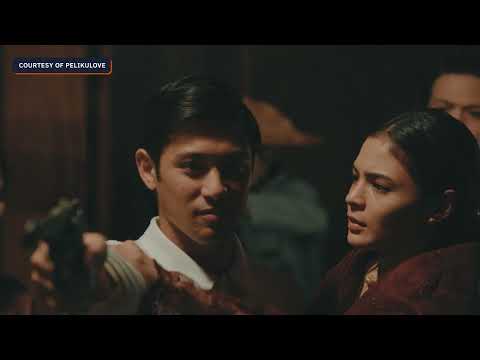
The narrative, like its stage counterparts, enunciates the place of women in the struggle for national liberation, allowing the film to be part of a broader feminist resistance literature in the Philippines.
Divided into chapters, Lakambini: Gregoria de Jesus chiefly explores the heroine’s active role in the Katipunan, an armed revolutionary group led by the Supremo Andres Bonifacio (played by Rocco Nacino in the film) that sought independence of the country from Spanish control at the tail end of the 1800s.
On one hand, it plays as an epistolary biopic suffused with histories both private and public that renegotiate Gregoria’s position in our national memory and in the revolution — past Andres and the men she loved.
On the other, it doubles as a meta documentary on the making of the film, beginning in 2015, when the script was initially submitted for consideration at the Metro Manila Film Festival, tapping Jeturian as the director, through 2025, when it was finally completed, with Rebeta already at the helm.
Producer Ellen Ongkeko-Marfil said in a talkback following the film’s final screening at QCinema that she labored for the film to be realized precisely due to the lack of local historical films featuring women when she was still conceiving the project in 2012. “It’s all men: Quezon, Gomburza, Rizal, Bonifacio, Sakay, Aguinaldo.”
“And maybe because I’m a woman, so I’m wondering ‘What has been the role of women [in the revolution?]’” she continued. “And I wanted someone from that perspective during the birthing of [our] nation. When I found her, well, she’s supposed to be married to the father of the Philippine revolution, the first to fight against Western colonization in Asia, but we don’t know anything about her. It’s as if when Bonifacio died, she died as well.”
 Lovi Poe is one of three actresses who play the title character.
From a formal standpoint, the movie is sort of a deconstruction of a typical historical biopic. Yet, heavily stylized as it is, it still leans on a linear sensibility. It makes use of its period setting to dramatize the curious corners in the life of its protagonist, but it tersely pulls you out of it through talking heads, pull quotes, and fact-checks that stubbornly interrupt its dramatic specifics, whose intensity dissipates as a consequence of that directorial language.
Its images are inescapably uneven, given the gap between the 2015 footage, shot for just nine days before the film’s sponsors backed out, and the latest material. Even so, it’s hard to deny that significant parts of it also work to fascinating effect, its primary impulse edging toward historical education and feminist conviction.
In the end, insistent as it is in blending the world of the film with the world of its makers, it is Gina Pareño’s bruised and grounded presence that holds the vision together.
“Walang bayang iniluluwal na hindi katuwang ang kababaihan (No nation is born without the support of women),” Ongkeko-Marfil asserted. “I think to acknowledge women leaders of the past is to empower women of today.”
Jeturian, who was also present at the QCinema screening alongside the film’s cast and crew and relatives of Ka Oryang, admitted that the form inevitably changed because of the funding restrictions the project had to endure in its infancy. “
Actually, every time I see the footage that we were able to complete and fail to complete, there’s regret because it could have turned out to be a beautiful film,” the director said in a mix of English and Filipino. “But watching the film as it is now, I don’t think the [original] film could have matched the brilliance of the finished film.”
Rebeta, who joined the production in 2018, added that, after the original vision did not pan out, the challenge was to pick up from where Jeturian left off and make it work.
“I still read their script and learned what the material is about, and I added my own research and still anchored the film to the original intention,” he said in Filipino.
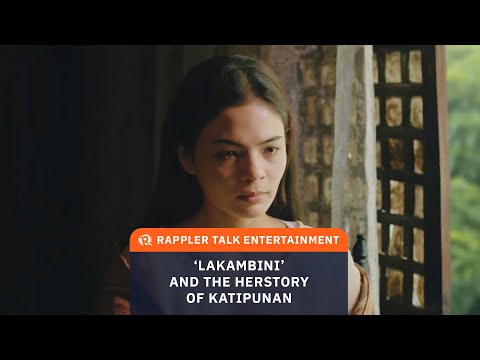
Part of the movie’s 10-year incubation results in three different actresses playing the title character: Lovi Poe and Elora Españo, who alternate as the younger Gregoria, and Gina Pareño as the senior version. It was Rebeta who thought of having Españo to share the younger Gregoria role with Poe, who was already abroad when production resumed.
“Last year, Direk Jeff reached out to me first through my manager, asking me if I could do the role,” shared Españo, who first entered the 2015 production as a bit player — a coffee server of Pareño’s character and the body double of Poe for her scenes in the mountainside.
“Of course, I wouldn’t say no because it’s work, and I really wanted to be part of a historical film about a woman who gave her life and knowledge to the country, so why not?”
Rebeta also noted how injustice serves as one of the film’s thematic assertions, and how Bonifacio might be the first victim of extrajudicial killing in the country, long before the term became notoriously popular under the Duterte regime.
“Ang tulad nitong pelikula ay pagpapalago at palaging pag-uusap ng ganitong mga usapin (A film like this is about nurturing and constantly discussing these issues},” said the director, adding that his next projects would also focus on the desaparecidos (disappeared), from the case of the lost sabungeros (cockfighters) to the disappeared farmers in the countryside.
“Lakambini will be timeless, and we could watch it again and again to remind us of our history,” Rebeta said.
Turning emotional towards the end of the talkback, Españo emphasized the significance of cultural work in addressing injustice.
“Nangyayari pa rin siya hanggang ngayon. Patuloy pa ring may nawawala, patuloy pa ring may kawalang-hustisya. Kung tayo’y titikom at hindi na magsasalita, paano na tayo makakalaban? Paano natin maibabahagi ‘yong sakit at hirap na dinanas [natin] noon?”
(It still happens today. There are still people missing, there are still injustices. If we keep quiet and don’t speak up, how can we fight back? How can we share the pain and suffering that we have suffered in the past?) — Rappler.com


You May Also Like

Vance blindsides church he's never visited by plastering it on cover of his faith memoir

355.19 BTC Moved Between Anonymous Wallets




