The post Pi Price Under Pressure—Is the $0.20 Support About to Fail? appeared first on Coinpedia Fintech News The Pi price action is flashing early warning signs as the token slips beneath a key trading range, threatening to deepen the correction that began after multiple rejections near $0.29. While the market remains in a consolidation phase, the structure is weakening, and Pi now sits at a make-or-break point that could define its December …The post Pi Price Under Pressure—Is the $0.20 Support About to Fail? appeared first on Coinpedia Fintech News The Pi price action is flashing early warning signs as the token slips beneath a key trading range, threatening to deepen the correction that began after multiple rejections near $0.29. While the market remains in a consolidation phase, the structure is weakening, and Pi now sits at a make-or-break point that could define its December …

Pi Price Under Pressure—Is the $0.20 Support About to Fail?
2025/12/05 22:21
Pi Network News: Network Growth Outpaces Market Performance in Q4 2025

The post Pi Price Under Pressure—Is the $0.20 Support About to Fail? appeared first on Coinpedia Fintech News

The Pi price action is flashing early warning signs as the token slips beneath a key trading range, threatening to deepen the correction that began after multiple rejections near $0.29. While the market remains in a consolidation phase, the structure is weakening, and Pi now sits at a make-or-break point that could define its December trend.

Pi Faces a Critical Retest of the Rising Trendline

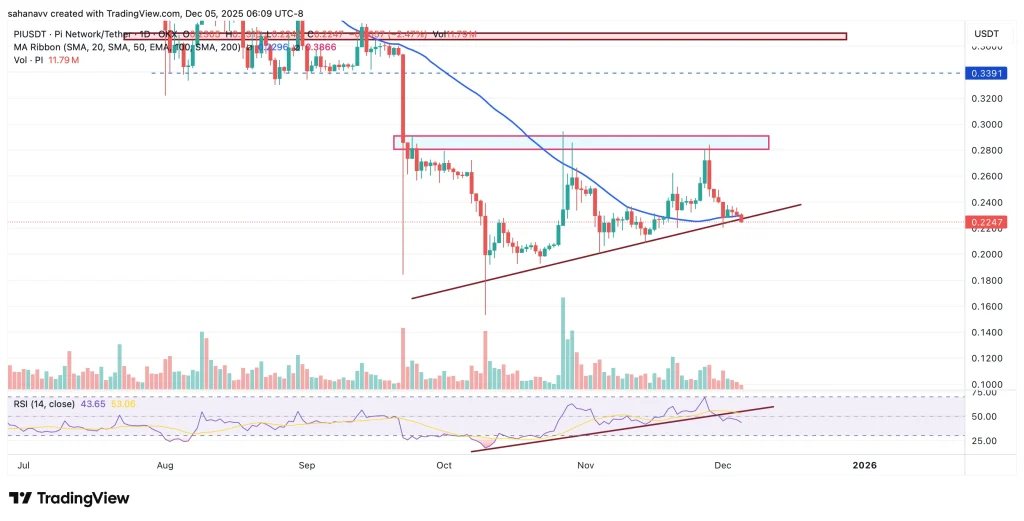
Pi is currently hovering directly above an ascending trendline that has supported the market since early October. But this support is no longer firm. Price has already slipped below the 50-day moving average, turning it into active resistance, and sellers are gradually overwhelming the structure with lower highs.
pi price

At the same time, the RSI — which had been forming higher lows—has now broken down from its own ascending support. This divergence between price stability and weakening momentum is typically an early indicator of trend exhaustion. Combined with declining volume, the market is showing signs of compression that often precedes a decisive move.

If Pi fails to hold its rising trendline at $0.223–$0.225, the breakdown could accelerate rapidly as liquidity below the level is thin. A slide toward $0.20 becomes the likely next step, and a deeper extension to $0.18 cannot be ruled out.

Loss of the Mid-Range Could Extend the Correction

The mid-range zone between $0.25 and $0.27 has been rejected three times in two months, confirming it as a strong supply region. Each rejection has produced a lower high, indicating that buyers are unable to regain momentum or reclaim lost market structure.

Now that Pi has lost its near-term trading range, the market is at risk of slipping into a broader descending structure. If the price closes firmly below $0.22, it would mark the first clean break of the multi-month uptrend—a shift that could turn the current pullback into a deeper correction phase.

However, bulls still have one final argument in their favor: the broader uptrend from the October lows remains intact as long as $0.20 holds. A rebound from the trendline, paired with increasing volume, could reset momentum and give Pi another attempt at $0.27.

Conclusion: December Hinges on $0.22 — Break or Bounce?

Pi price is approaching a decisive point. A sustained break below $0.22 would open the doors to a steeper correction toward $0.20–$0.18, while holding this zone could allow the price to rebound toward $0.25 and potentially retest $0.27.

Price targets:

  • Bearish: $0.20 → $0.18
  • Bullish: $0.25 → $0.27

At this stage, the chart is leaning bearish—but not fully broken yet. The next two daily closes will determine whether Pi stabilizes… or slips into a deeper downtrend.


Disclaimer: The articles reposted on this site are sourced from public platforms and are provided for informational purposes only. They do not necessarily reflect the views of MEXC. All rights remain with the original authors. If you believe any content infringes on third-party rights, please contact service@support.mexc.com for removal. MEXC makes no guarantees regarding the accuracy, completeness, or timeliness of the content and is not responsible for any actions taken based on the information provided. The content does not constitute financial, legal, or other professional advice, nor should it be considered a recommendation or endorsement by MEXC.

You May Also Like

Maryland Man Sentenced for Allegedly Aiding North Korea’s US Company Infiltration and Sensitive Data Access

Maryland Man Sentenced for Allegedly Aiding North Korea’s US Company Infiltration and Sensitive Data Access

The post Maryland Man Sentenced for Allegedly Aiding North Korea’s US Company Infiltration and Sensitive Data Access appeared on BitcoinEthereumNews.com. North Korea’s IT workers infiltrated US companies through a Maryland man’s scheme, earning over $970,000 while enabling access to sensitive government systems. This operation supported the regime’s cyber activities, including crypto hacks that stole $2 billion in 2025, funding nuclear programs. Minh Phuong Ngoc Vong sentenced to 15 months in prison for aiding North Korean infiltration. He used fake credentials to secure jobs at 13 US firms, passing work to overseas conspirators. North Korea stole $2 billion in crypto in 2025 via hacks, totaling over $6 billion recently, per blockchain analytics firm Elliptic. Discover how North Korea’s IT infiltration and crypto hacking schemes threaten US security. Learn the details of the Maryland case and regime’s $6B theft. Stay informed on cybersecurity risks today. What is North Korea’s IT Infiltration Scheme in US Companies? North Korea’s IT infiltration scheme involves covertly placing regime-affiliated workers into US companies using fake identities to generate revenue and access sensitive systems. In a recent Maryland case, Minh Phuong Ngoc Vong was sentenced to 15 months in prison and three years of supervised release for facilitating this for three years across 13 companies. The operation netted over $970,000, much of which funded North Korea’s weapons programs through software work performed by overseas actors, including those in China near the border. How Does North Korea Use Crypto Hacking to Fund Its Programs? North Korea employs sophisticated cyber groups to target cryptocurrency exchanges and wallets, stealing digital assets that convert to fiat for regime funding. According to blockchain analytics firm Elliptic, these groups pilfered approximately $2 billion in cryptocurrencies in 2025 alone, contributing to a total exceeding $6 billion in recent years from hacks on platforms like Bybit and Upbit. This influx directly supports nuclear and missile development, as confirmed by US intelligence assessments. Experts note the regime’s…
Share
BitcoinEthereumNews2025/12/06 09:12



