Online vs. Offline Active Learning: Performance Comparison Across Iterations
Table of Links
Abstract and 1 Introduction
-
Related work
2.1. Generative Data Augmentation
2.2. Active Learning and Data Analysis
-
Preliminary
-
Our method
4.1. Estimation of Contribution in the Ideal Scenario
4.2. Batched Streaming Generative Active Learning
-
Experiments and 5.1. Offline Setting
5.2. Online Setting
-
Conclusion, Broader Impact, and References
\
A. Implementation Details
B. More ablations
C. Discussion
D. Visualization
B. More ablations
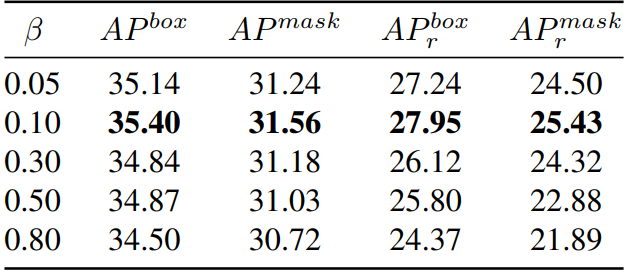
Momentum Coefficient β. In Algorithm 3, we introduce a momentum coefficient β to update the grad cache. Here we explore the effect of different β on the model performance. A larger beta signifies a greater focus on global information, while a smaller beta indicates a higher attention to the current test batch Ub. Detailed results are presented in Table 9. Observations suggest that when β is 0.1, the performance is the best, which is also the β we finally adopted.
\ 
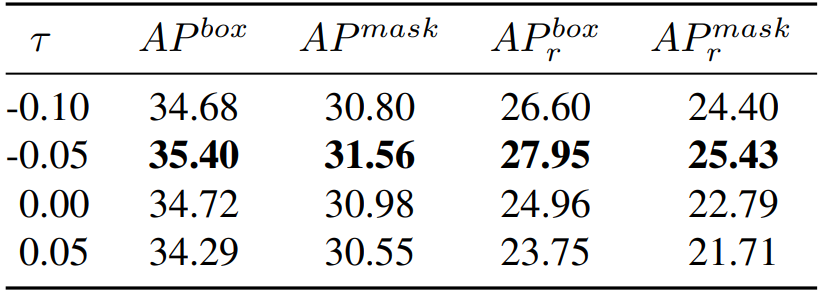
\ Contribution threshold τ. In Algorithm 3, we incorporate a contribution threshold τ , intended for filtering the produced data. Here we investigate the impact of varying values of τ on the model’s performance. The larger τ implies a stricter filtration of the generated data, while the smaller τ signifies a looser filtering of the generated data. The specific results are shown in Table 10. We can see the performance is optimal when τ equals -0.05, which is also the τ we eventually settle on for our final model.
\ 
\ Online learning vs. Offline learning We compare online learning and offline learning under different iterations. The result is shown in Figure 9.
\
:::info Authors:
(1) Muzhi Zhu, with equal contribution from Zhejiang University, China;
(2) Chengxiang Fan, with equal contribution from Zhejiang University, China;
(3) Hao Chen, Zhejiang University, China (haochen.cad@zju.edu.cn);
(4) Yang Liu, Zhejiang University, China;
(5) Weian Mao, Zhejiang University, China and The University of Adelaide, Australia;
(6) Xiaogang Xu, Zhejiang University, China;
(7) Chunhua Shen, Zhejiang University, China (chunhuashen@zju.edu.cn).
:::
:::info This paper is available on arxiv under CC BY-NC-ND 4.0 Deed (Attribution-Noncommercial-Noderivs 4.0 International) license.
:::
\
You May Also Like

USD/MXN: Critical Warning for Peso After Banxico’s Surprising Rate Cut – Standard Chartered Analysis

OpenVPP accused of falsely advertising cooperation with the US government; SEC commissioner clarifies no involvement