On-chain data shows the Bitcoin Realized Cap Growth indicator has continued to decline recently, a sign new capital inflows lack momentum. Bitcoin Realized Cap Growth Has Been Heading Down Recently As explained by CryptoQuant community analyst Maartunn in a new post on X, the Bitcoin Realized Cap Growth has been trending lower recently. The “Realized Cap” is an on-chain capitalization model for BTC that calculates its total value by assuming the value of each individual token is equal to the spot price at which it was last transacted on the blockchain. Related Reading: Solana Enters Bear Territory: Realized Loss Now Outweighs Profit This is unlike the usual market cap, which simply calculates the total valuation of the asset by multiplying the number of tokens in circulation with the current spot price, considering the latest value of the cryptocurrency to be the one value for all coins. In short, what the Realized Cap represents is the amount of capital that the Bitcoin investors as a whole used to purchase the asset’s supply. On the other hand, the market cap is the value that the investors are carrying in the present. The Realized Cap itself isn’t the indicator of interest in the current discussion, but rather the Realized Cap Growth, measuring the 365-day changes occurring in the Realized Cap. Changes in the indicator naturally reflect the amount of capital exiting or entering the cryptocurrency. In other words, the Realized Cap Growth contains information about the asset’s netflow. Now, here is the chart shared by Maartunn that shows the trend in the 7-day and 59-day moving averages (MAs) of the Bitcoin Realized Cap Growth over the last few years: As displayed in the above graph, the Bitcoin Realized Cap Growth has witnessed both its 7-day and 59-day MAs reverse down recently, with the former line crossing under the latter. The trend indicates that growth in the Realized Cap has been slowing down during the recent market downturn. “This suggests Bitcoin is lacking momentum from new cost basis inflows,” noted the analyst. With the 7-day MA falling below the 59-day MA, the indicator is now flagging the current market to be in a “bear phase.” The last time this signal maintained for an extended duration was alongside BTC’s decline over the first few months of 2025. It now remains to be seen how long momentum from new capital inflows will stay weak for Bitcoin this time around. Related Reading: Bitcoin In An Opportunity Zone? Hash Ribbons Flash New Buy Signal In some other news, the Bitcoin short-term holders are still under a notable amount of stress, as CryptoQuant author IT Tech has pointed out in an X post. Short-term holders (STHs) are defined as the Bitcoin buyers who got into the market during the past 155 days. Despite the rebound BTC has seen since its November low, STHs are still in a loss of 10%. BTC Price At the time of writing, Bitcoin is floating around $92,400, down 1.5% over the last 24 hours. Featured image from Dall-E, CryptoQuant.com, chart from TradingView.comOn-chain data shows the Bitcoin Realized Cap Growth indicator has continued to decline recently, a sign new capital inflows lack momentum. Bitcoin Realized Cap Growth Has Been Heading Down Recently As explained by CryptoQuant community analyst Maartunn in a new post on X, the Bitcoin Realized Cap Growth has been trending lower recently. The “Realized Cap” is an on-chain capitalization model for BTC that calculates its total value by assuming the value of each individual token is equal to the spot price at which it was last transacted on the blockchain. Related Reading: Solana Enters Bear Territory: Realized Loss Now Outweighs Profit This is unlike the usual market cap, which simply calculates the total valuation of the asset by multiplying the number of tokens in circulation with the current spot price, considering the latest value of the cryptocurrency to be the one value for all coins. In short, what the Realized Cap represents is the amount of capital that the Bitcoin investors as a whole used to purchase the asset’s supply. On the other hand, the market cap is the value that the investors are carrying in the present. The Realized Cap itself isn’t the indicator of interest in the current discussion, but rather the Realized Cap Growth, measuring the 365-day changes occurring in the Realized Cap. Changes in the indicator naturally reflect the amount of capital exiting or entering the cryptocurrency. In other words, the Realized Cap Growth contains information about the asset’s netflow. Now, here is the chart shared by Maartunn that shows the trend in the 7-day and 59-day moving averages (MAs) of the Bitcoin Realized Cap Growth over the last few years: As displayed in the above graph, the Bitcoin Realized Cap Growth has witnessed both its 7-day and 59-day MAs reverse down recently, with the former line crossing under the latter. The trend indicates that growth in the Realized Cap has been slowing down during the recent market downturn. “This suggests Bitcoin is lacking momentum from new cost basis inflows,” noted the analyst. With the 7-day MA falling below the 59-day MA, the indicator is now flagging the current market to be in a “bear phase.” The last time this signal maintained for an extended duration was alongside BTC’s decline over the first few months of 2025. It now remains to be seen how long momentum from new capital inflows will stay weak for Bitcoin this time around. Related Reading: Bitcoin In An Opportunity Zone? Hash Ribbons Flash New Buy Signal In some other news, the Bitcoin short-term holders are still under a notable amount of stress, as CryptoQuant author IT Tech has pointed out in an X post. Short-term holders (STHs) are defined as the Bitcoin buyers who got into the market during the past 155 days. Despite the rebound BTC has seen since its November low, STHs are still in a loss of 10%. BTC Price At the time of writing, Bitcoin is floating around $92,400, down 1.5% over the last 24 hours. Featured image from Dall-E, CryptoQuant.com, chart from TradingView.com

Bitcoin Lacks Fresh Momentum As Realized Cap Growth Still Declining

2025/12/11 14:00

On-chain data shows the Bitcoin Realized Cap Growth indicator has continued to decline recently, a sign new capital inflows lack momentum.

Bitcoin Realized Cap Growth Has Been Heading Down Recently

As explained by CryptoQuant community analyst Maartunn in a new post on X, the Bitcoin Realized Cap Growth has been trending lower recently. The “Realized Cap” is an on-chain capitalization model for BTC that calculates its total value by assuming the value of each individual token is equal to the spot price at which it was last transacted on the blockchain.

This is unlike the usual market cap, which simply calculates the total valuation of the asset by multiplying the number of tokens in circulation with the current spot price, considering the latest value of the cryptocurrency to be the one value for all coins.

In short, what the Realized Cap represents is the amount of capital that the Bitcoin investors as a whole used to purchase the asset’s supply. On the other hand, the market cap is the value that the investors are carrying in the present.

The Realized Cap itself isn’t the indicator of interest in the current discussion, but rather the Realized Cap Growth, measuring the 365-day changes occurring in the Realized Cap.

Changes in the indicator naturally reflect the amount of capital exiting or entering the cryptocurrency. In other words, the Realized Cap Growth contains information about the asset’s netflow.

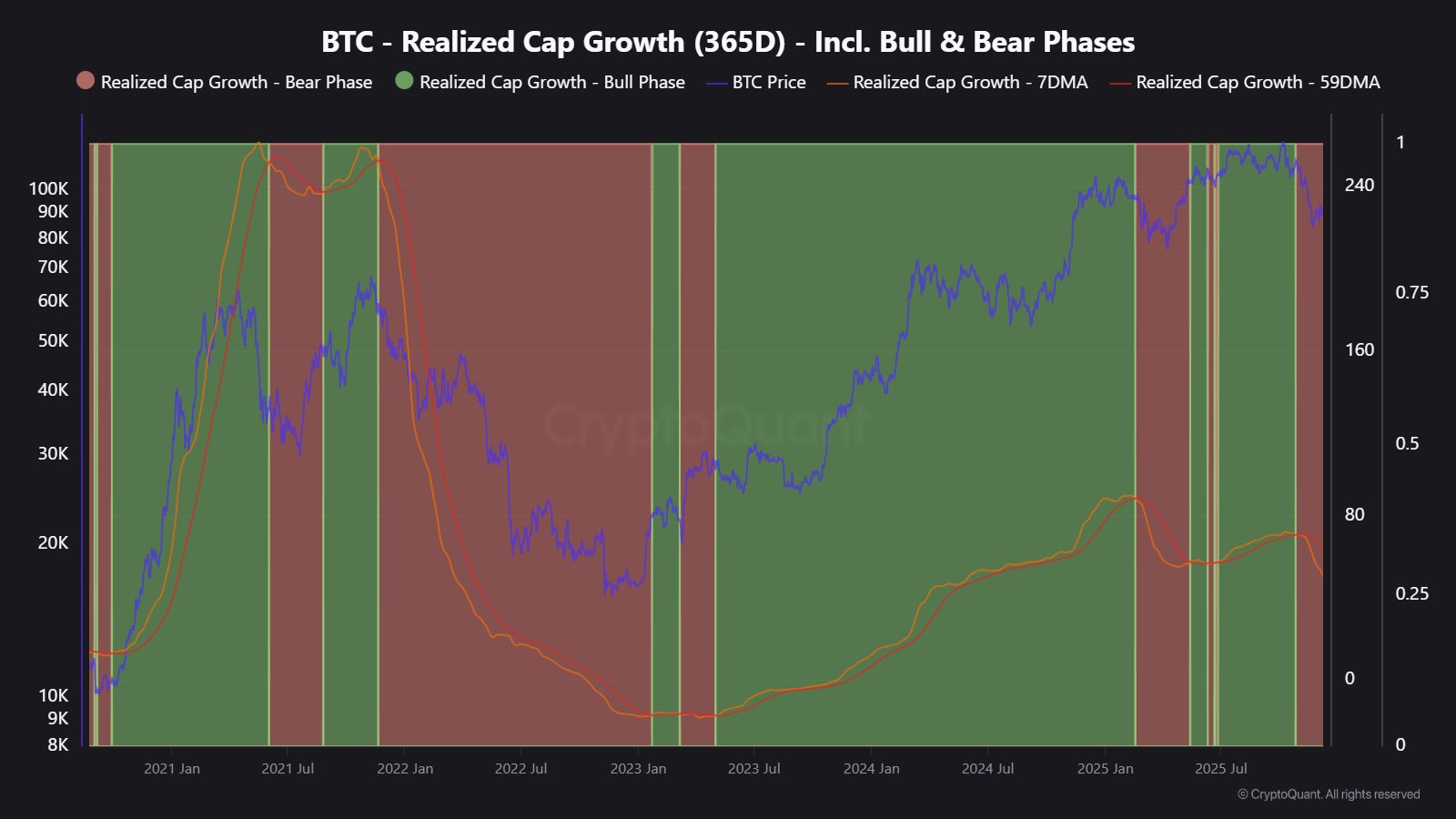
Now, here is the chart shared by Maartunn that shows the trend in the 7-day and 59-day moving averages (MAs) of the Bitcoin Realized Cap Growth over the last few years:
Bitcoin Realized Cap Growth

As displayed in the above graph, the Bitcoin Realized Cap Growth has witnessed both its 7-day and 59-day MAs reverse down recently, with the former line crossing under the latter.

The trend indicates that growth in the Realized Cap has been slowing down during the recent market downturn. “This suggests Bitcoin is lacking momentum from new cost basis inflows,” noted the analyst.

With the 7-day MA falling below the 59-day MA, the indicator is now flagging the current market to be in a “bear phase.” The last time this signal maintained for an extended duration was alongside BTC’s decline over the first few months of 2025. It now remains to be seen how long momentum from new capital inflows will stay weak for Bitcoin this time around.

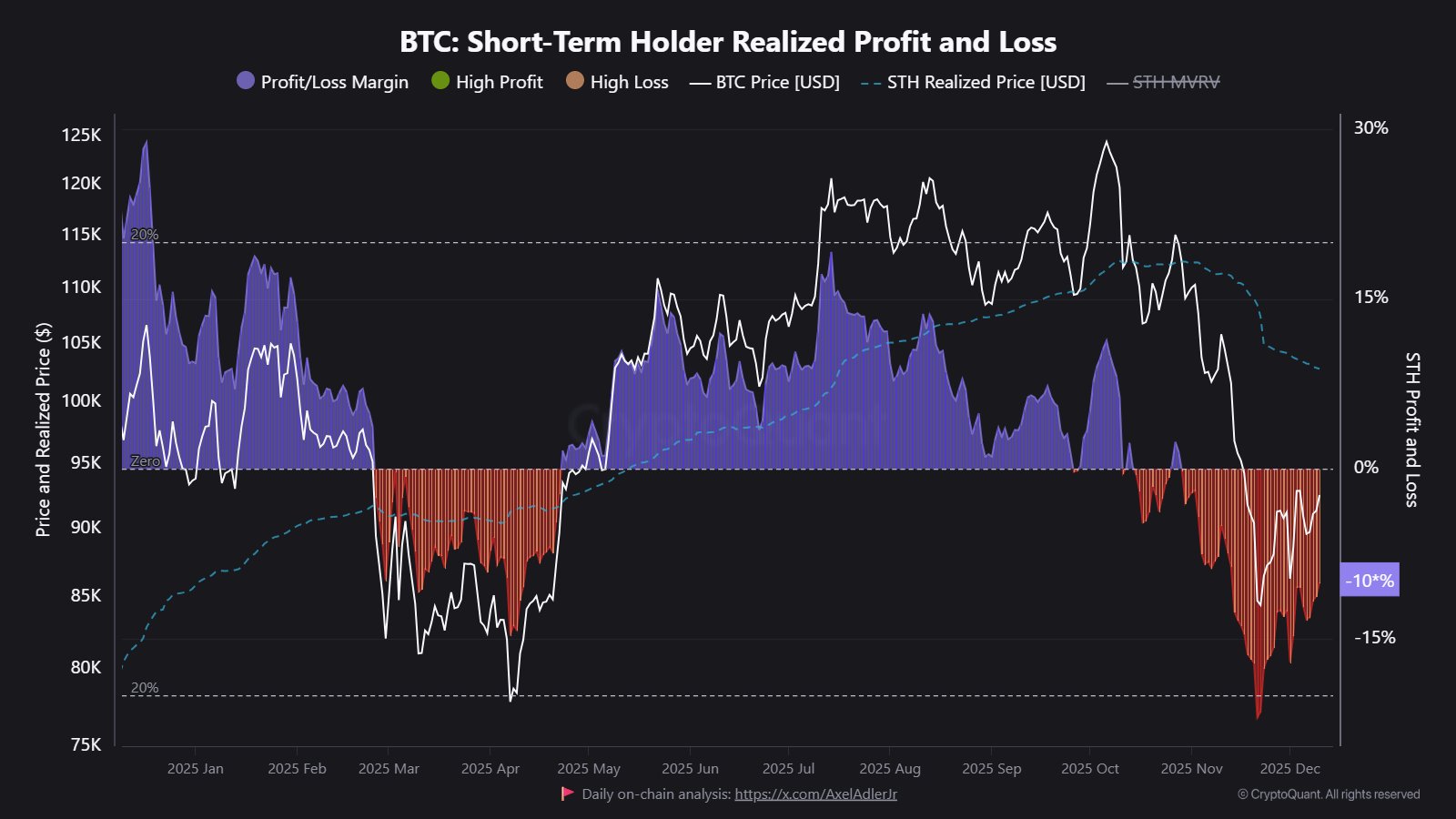
In some other news, the Bitcoin short-term holders are still under a notable amount of stress, as CryptoQuant author IT Tech has pointed out in an X post.
Bitcoin STH Profit/Loss Margin

Short-term holders (STHs) are defined as the Bitcoin buyers who got into the market during the past 155 days. Despite the rebound BTC has seen since its November low, STHs are still in a loss of 10%.

BTC Price

At the time of writing, Bitcoin is floating around $92,400, down 1.5% over the last 24 hours.

Bitcoin Price Chart
Disclaimer: The articles reposted on this site are sourced from public platforms and are provided for informational purposes only. They do not necessarily reflect the views of MEXC. All rights remain with the original authors. If you believe any content infringes on third-party rights, please contact service@support.mexc.com for removal. MEXC makes no guarantees regarding the accuracy, completeness, or timeliness of the content and is not responsible for any actions taken based on the information provided. The content does not constitute financial, legal, or other professional advice, nor should it be considered a recommendation or endorsement by MEXC.

You May Also Like

Gareth Soloway Reveals What’s Comes Next For XRP, ETH, SOL and AVAX

Gareth Soloway Reveals What’s Comes Next For XRP, ETH, SOL and AVAX

The post Gareth Soloway Reveals What’s Comes Next For XRP, ETH, SOL and AVAX appeared on BitcoinEthereumNews.com. The post Gareth Soloway Reveals What’s Comes Next For XRP, ETH, SOL and AVAX appeared first on Coinpedia Fintech News Gareth Soloway, chief market strategist, has shared his predictions on four major altcoins: Ethereum (ETH), Solana (SOL), XRP, and Avalanche (AVAX). His analysis focuses on immediate support and resistance levels that could shape price action in the weeks ahead. Ethereum Faces a Critical Test Ethereum has been trading within a series of parallel channels. The current focus is on support near $4,350. Soloway said this level is important because a confirmed breakdown could send ETH toward $3,750. If the level holds, ETH may attempt to retest the highs above $5,000, with a possible next target around $5,500. Solana Maintains a Strong Setup Solana remains one of the stronger altcoins on the charts. It recently broke above the $205–$215 range and continues to form higher highs and higher lows. As long as it stays above $235, the outlook remains positive. A move back to its previous all-time high near $295, or even above $300, is possible. If the trend breaks, support sits again in the $215–$205 zone. XRP Shows a Neutral Pattern XRP’s chart is less clear. It has support near $2.95, but lower highs signal caution. A drop below $2.95 could open the door to $2.75–$2.67. On the other hand, a breakout above $3.12 would signal strength and could trigger a move higher by 10–20 percent. Avalanche Pulls Back After a Rally Avalanche recently surged from $26 to $36 before meeting strong resistance. Soloway said that this level acted as a ceiling. He expects a short-term pullback, which could later set up a new buying opportunity if support holds. Soloway said that these projections are short-term, spanning weeks or months. Clear support and resistance zones remain the important signals to…
Share
BitcoinEthereumNews2025/09/21 12:41






