

Sei price retests $0.14 resistance: Will Xiaomi’s wallet integration help reverse the trend?
Sei price is testing a key resistance level after a surge in trading activity, with its new Xiaomi integration drawing fresh attention to the project’s long-term outlook.
- Sei is trading around a multi-day resistance level, with volume jumping sharply as traders reopen positions across spot and derivatives markets.
- Xiaomi’s built-in Sei wallet introduces a major distribution channel that could add millions of new users.
- The chart shows early signs of stabilizing momentum, though $0.145–$0.146 remains a tough resistance zone.
Sei was trading at $0.1421 at press time, up 2.1% in the past 24 hours. The token has remained in slightly positive territory over the past week, gaining 2.3%, although it is still down 24% over the last 30 days.
Trading activity has picked up meaningfully. Sei (SEI) recorded $237 million in volume in the past 24 hours, a 261% jump. This suggests stronger participation from traders after weeks of quiet price action.
According to CoinGlass data, derivatives volume rose 202% to $400 million, while open interest climbed 8.7% to $100 million. Rising volume paired with higher open interest often means traders are opening new positions rather than closing old ones, usually a sign that a fresh move is building in the market.
Xiaomi partnership: a real distribution event
On Dec. 10, Sei announced a built-in next-generation finance app that will ship with new Xiaomi smartphones. The wallet, powered directly by Sei, will support stablecoin payments, P2P transfers, and a discovery hub for decentralized applications.
Xiaomi, with over 680 million global users and more than 170 million annual device sales, will pre-install the “Sei Mobile App” on all new phones shipped outside China and the U.S. That covers large regions such as Europe, Southeast Asia, Latin America, and Africa.
Early launch regions, including Hong Kong and the EU, are planned for Q2 2026, where users may eventually be able to buy Xiaomi products, including smartphones and even electric vehicles, using stablecoins over Sei.
Analysts view this integration as a rare hardware-level distribution move, not dependent on app store downloads or manual onboarding steps. With even a 10% activation rate, Sei could add upward of 17 million new users each year.
Alongside the partnership, Sei is rolling out a $5 million mobile innovation fund, supporting apps that run directly on consumer devices. It’s landing right before the Giga Upgrade, which will boost Sei to around 200,000 transactions per second and move the chain firmly in a payments-first direction.
Sei price technical analysis
The chart shows a long downtrend, marked by steady lower highs and lower lows over several months. That said, the recent price action hints at early stability.
Sei has begun to flatten after its long decline, and candles have now closed above the mid-Bollinger band for the first time in weeks. This is an early sign that momentum is trying to change.
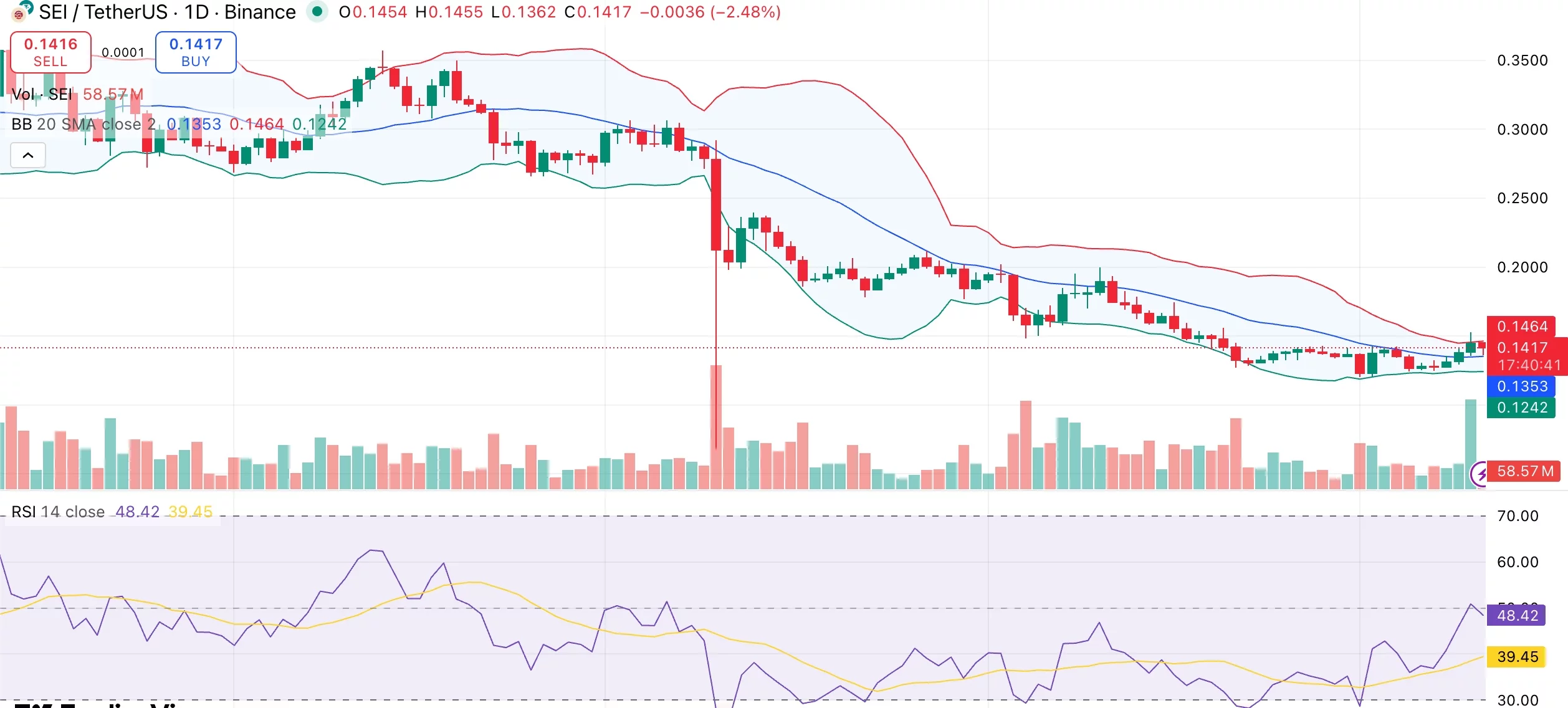
After months of selling pressure, the Bollinger Bands have tightened, and now the price is getting close to the upper band. If the breakout holds, this usually indicates increasing strength.
The relative strength index has been rising steadily from oversold levels and is currently close to 48. The upward slope indicates increasing momentum. In addition, the RSI crossed above its signal line, which is often a bullish early indicator.
Most short-term moving averages (10- and 20-day) are now flipping upward and showing buy signals, while the longer-term MAs remain firmly bearish. This mix suggests a market in the very early stages of attempting a recovery, but still facing the weight of a deeper trend.
From a price-structure view, support remains at $0.124–$0.135, while resistance sits tightly at $0.145–$0.146, where price is currently stalled. A firm break and close above this zone could open a path toward $0.17–$0.18, where the next cluster of past activity sits.
A bearish case returns if price slips back under $0.135 and the recent volume surge proves to be a one-off spike rather than real accumulation.


You May Also Like

The changing face of elder care in Malaysia — Sayed Mohammad Reza Yamani Sayed Umar

Not a loophole: Singapore AI export controls let China tap US AI legally

Bitcoin, Gold, and U.S. Stocks Dive as Trump Pledges to Hit Iran ‘Extremely Hard’



