Stellar is testing a Privacy Pools prototype. The network reports about 2 billion transactions in 2025 and 2 99.99% lifetime uptime. Stellar has started testingStellar is testing a Privacy Pools prototype. The network reports about 2 billion transactions in 2025 and 2 99.99% lifetime uptime. Stellar has started testing

Stellar Smart Contracts Get Privacy Upgrade as Privacy Pools Prototype Goes Live

2025/12/12 20:22
  • Stellar is testing a Privacy Pools prototype.
  • The network reports about 2 billion transactions in 2025 and 2 99.99% lifetime uptime.

Stellar has started testing a Privacy Pools prototype on its smart contract platform, aiming to support private transfers with compliance options built into the design. The Stellar Development Foundation described the release as a prototype and said the work remains early stage.

The project uses zero knowledge proofs to enable selective disclosure, which lets users keep transaction details private while still proving specific facts when needed. Stellar framed the approach as a way to make privacy compatible with regulated workflows, instead of treating them as opposites.

In its announcement on X, Stellar said the prototype uses ZK powered selective disclosure and a model it says can support compliant private transfers. The foundation also signaled that the code and design may change as testing continues.
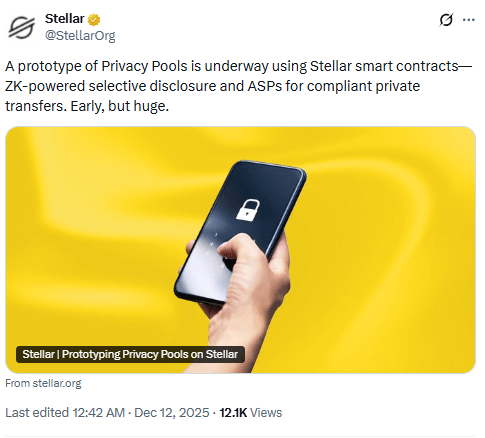
Stellar Privacy Pools Prototype. Source: StellarOrg on XStellar Privacy Pools Prototype. Source: StellarOrg on X

Stellar Adds a Compliance Layer to Private Transfers

The prototype introduces authorized set providers, or ASPs, which can define who may join a privacy pool under specific rules. Stellar presented ASPs as a mechanism for creating private transfer sets that can align with compliance requirements without making all activity public by default.

The Stellar blog post said the goal is selective disclosure rather than blanket anonymity. That means users can keep information private in normal conditions, then disclose only what is required to a counterparty, auditor, or other permitted party.

The foundation has also published separate research focused on privacy strategy, while it tests different approaches through prototypes.

Stellar said it processed about 2 billion transactions in 2025 and moved about $13 billion in real world asset payment volume while keeping 99.99% lifetime uptime, as summarized in our earlier news story.

Meanwhile, Stellar reported faster developer growth and higher smart contract usage, including a 37% rise in full time developers since January and about 1 million contract invocations per day after a 700% quarterly jump.
It also pointed to partnerships, including work with US Bank and PWC to test custom stablecoin issuance on the network

]]>
Disclaimer: The articles reposted on this site are sourced from public platforms and are provided for informational purposes only. They do not necessarily reflect the views of MEXC. All rights remain with the original authors. If you believe any content infringes on third-party rights, please contact service@support.mexc.com for removal. MEXC makes no guarantees regarding the accuracy, completeness, or timeliness of the content and is not responsible for any actions taken based on the information provided. The content does not constitute financial, legal, or other professional advice, nor should it be considered a recommendation or endorsement by MEXC.

You May Also Like

Fed Makes First Rate Cut of the Year, Lowers Rates by 25 Bps

Fed Makes First Rate Cut of the Year, Lowers Rates by 25 Bps

The post Fed Makes First Rate Cut of the Year, Lowers Rates by 25 Bps appeared on BitcoinEthereumNews.com. The Federal Reserve has made its first Fed rate cut this year following today’s FOMC meeting, lowering interest rates by 25 basis points (bps). This comes in line with expectations, while the crypto market awaits Fed Chair Jerome Powell’s speech for guidance on the committee’s stance moving forward. FOMC Makes First Fed Rate Cut This Year With 25 Bps Cut In a press release, the committee announced that it has decided to lower the target range for the federal funds rate by 25 bps from between 4.25% and 4.5% to 4% and 4.25%. This comes in line with expectations as market participants were pricing in a 25 bps cut, as against a 50 bps cut. This marks the first Fed rate cut this year, with the last cut before this coming last year in December. Notably, the Fed also made the first cut last year in September, although it was a 50 bps cut back then. All Fed officials voted in favor of a 25 bps cut except Stephen Miran, who dissented in favor of a 50 bps cut. This rate cut decision comes amid concerns that the labor market may be softening, with recent U.S. jobs data pointing to a weak labor market. The committee noted in the release that job gains have slowed, and that the unemployment rate has edged up but remains low. They added that inflation has moved up and remains somewhat elevated. Fed Chair Jerome Powell had also already signaled at the Jackson Hole Conference that they were likely to lower interest rates with the downside risk in the labor market rising. The committee reiterated this in the release that downside risks to employment have risen. Before the Fed rate cut decision, experts weighed in on whether the FOMC should make a 25 bps cut or…
Share
BitcoinEthereumNews2025/09/18 04:36