Tilray stock price continued its recent rally, reaching its highest point since October 20, ahead of the potential cannabis reclassification executive order by Tilray stock price continued its recent rally, reaching its highest point since October 20, ahead of the potential cannabis reclassification executive order by

​​Tilray stock rallies as cannabis reclassification looms, yet risks linger

Tilray stock price continued its recent rally, reaching its highest point since October 20, ahead of the potential cannabis reclassification executive order by President Donald Trump. 

Summary
  • Tilray Brands stock price rallied as Trump prepared to sign an executive order on cannabis reclassification.
  • That reclassification will move cannabis from a Schedule 1 drug to Schedule 3.
  • While the stock may keep rising, it faces more headwinds in the near term.

Tilray Brands (TLRY), a leading company in the Cannabis industry, reached a high of $15.71. This surge brought its valuation to over $1.7 billion.

As of the last check, it was trading at approximately $13.05 per share, up approximately 240% over the past six months.

Trump has hinted that he will sign an executive order that will move cannabis classification from Schedule 1 to Schedule 3. That transition will make it easy for companies to sell cannabis and its products in the U.S.

It will also help Tilray Brands establish a presence in the country, either organically or through acquisitions. Moreover, it has a strong balance sheet that may be leveraged to engineer a buyout. 

Still, there are potential risks that may impact Tilray shares and those of other cannabis companies. First, Trump’s executive order will not automatically reschedule cannabis. Instead, it will have to undergo a lengthy process, including public comment. 

Most importantly, it will likely face litigation, as opponents will likely sue. This is what derailed Joe Biden’s attempt to reclassify the product in his first term. 

Second, the rescheduling will not address other challenges that cannabis companies face in the U.S. For example, companies in the industry will still face the banking challenges they have always had. This will only change when the Senate and House pass a cannabis bill. 

Third, Tilray stock has jumped ahead of the rescheduling executive order. Therefore, it is likely to decline after the event, as investors sell the news and wait for the next catalyst. 

Additionally, the company’s pivot to the beverage industry is not working out. In its recent report, TLRY said that the segment’s revenue dropped to $55.7 million from the $56 million it made in the same period last year. Its gross margin also declined to 38% from 41%.

Tilray stock price technical analysis 
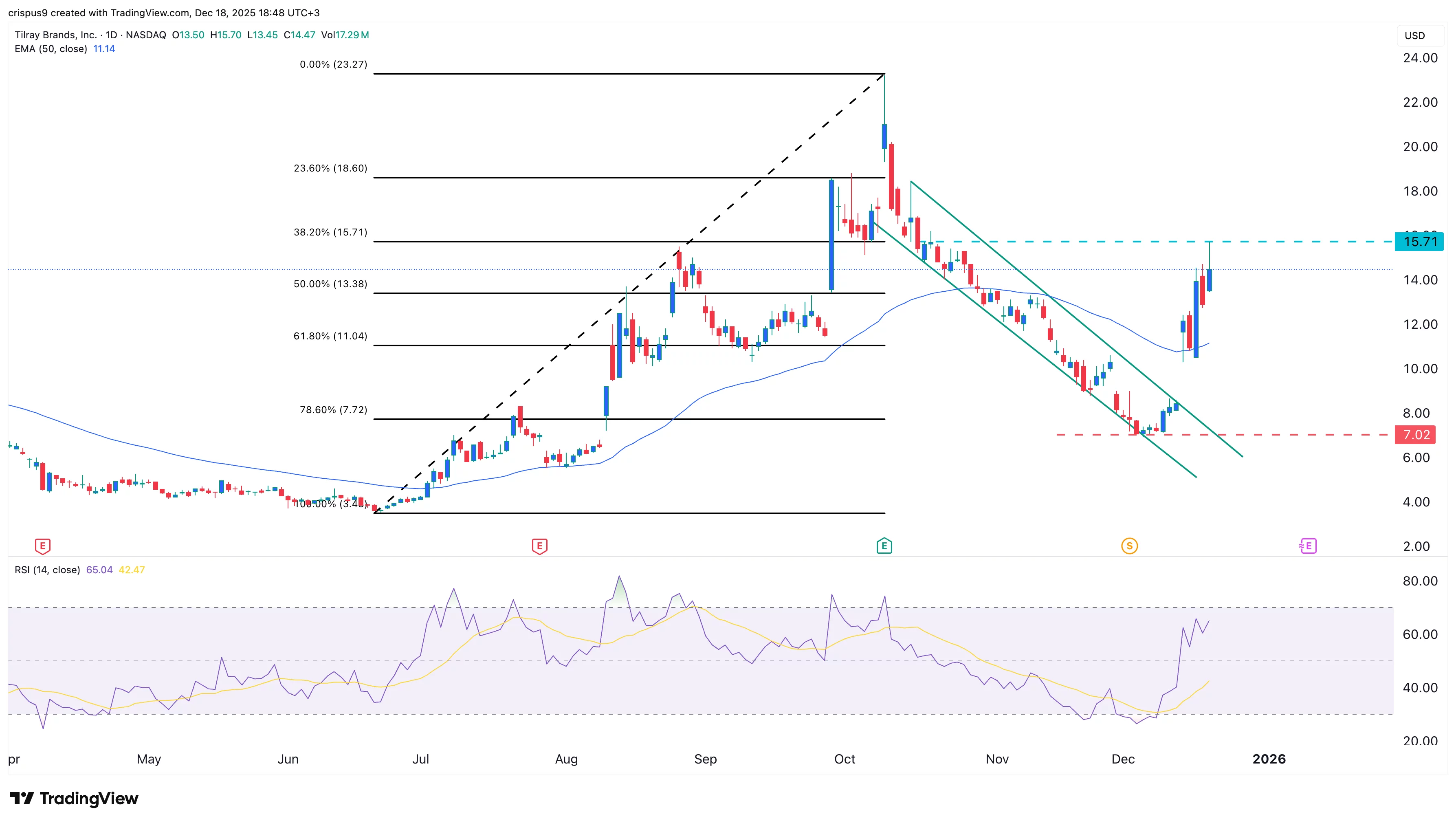
tilray stock

The daily chart shows that the TLRY stock price bottomed at $7 on Dec. 4 and has reached a high of $15.7 today. It rebounded after forming a falling wedge pattern, a bullish reversal sign. 

It formed a bullish gap on Dec. 11 and has now moved above the 50-day and 100-day Exponential Moving Averages. It also rose above the 50% Fibonacci Retracement level. 

The Relative Strength Index is nearing the overbought level at 70. Therefore, the stock price will likely continue to rise ahead of the rescheduling and then pull back after it occurs. If this happens, it may retreat to the support at $10.


Market Opportunity
Orderly Network Logo
Orderly Network Price(ORDER)
$0.0867
$0.0867$0.0867
0.00%
USD
Orderly Network (ORDER) Live Price Chart
Disclaimer: The articles reposted on this site are sourced from public platforms and are provided for informational purposes only. They do not necessarily reflect the views of MEXC. All rights remain with the original authors. If you believe any content infringes on third-party rights, please contact service@support.mexc.com for removal. MEXC makes no guarantees regarding the accuracy, completeness, or timeliness of the content and is not responsible for any actions taken based on the information provided. The content does not constitute financial, legal, or other professional advice, nor should it be considered a recommendation or endorsement by MEXC.

You May Also Like

Building a DEXScreener Clone: A Step-by-Step Guide

Building a DEXScreener Clone: A Step-by-Step Guide

DEX Screener is used by crypto traders who need access to on-chain data like trading volumes, liquidity, and token prices. This information allows them to analyze trends, monitor new listings, and make informed investment decisions. In this tutorial, I will build a DEXScreener clone from scratch, covering everything from the initial design to a functional app. We will use Streamlit, a Python framework for building full-stack apps.
Share
Hackernoon2025/09/18 15:05
Which DOGE? Musk's Cryptic Post Explodes Confusion

Which DOGE? Musk's Cryptic Post Explodes Confusion

A viral chart documenting a sharp decline in U.S. federal employment during President Trump's second term has sparked unexpected confusion in cryptocurrency markets
Share
Coinstats2025/12/20 01:13
Google's AP2 protocol has been released. Does encrypted AI still have a chance?

Google's AP2 protocol has been released. Does encrypted AI still have a chance?

Following the MCP and A2A protocols, the AI Agent market has seen another blockbuster arrival: the Agent Payments Protocol (AP2), developed by Google. This will clearly further enhance AI Agents' autonomous multi-tasking capabilities, but the unfortunate reality is that it has little to do with web3AI. Let's take a closer look: What problem does AP2 solve? Simply put, the MCP protocol is like a universal hook, enabling AI agents to connect to various external tools and data sources; A2A is a team collaboration communication protocol that allows multiple AI agents to cooperate with each other to complete complex tasks; AP2 completes the last piece of the puzzle - payment capability. In other words, MCP opens up connectivity, A2A promotes collaboration efficiency, and AP2 achieves value exchange. The arrival of AP2 truly injects "soul" into the autonomous collaboration and task execution of Multi-Agents. Imagine AI Agents connecting Qunar, Meituan, and Didi to complete the booking of flights, hotels, and car rentals, but then getting stuck at the point of "self-payment." What's the point of all that multitasking? So, remember this: AP2 is an extension of MCP+A2A, solving the last mile problem of AI Agent automated execution. What are the technical highlights of AP2? The core innovation of AP2 is the Mandates mechanism, which is divided into real-time authorization mode and delegated authorization mode. Real-time authorization is easy to understand. The AI Agent finds the product and shows it to you. The operation can only be performed after the user signs. Delegated authorization requires the user to set rules in advance, such as only buying the iPhone 17 when the price drops to 5,000. The AI Agent monitors the trigger conditions and executes automatically. The implementation logic is cryptographically signed using Verifiable Credentials (VCs). Users can set complex commission conditions, including price ranges, time limits, and payment method priorities, forming a tamper-proof digital contract. Once signed, the AI Agent executes according to the conditions, with VCs ensuring auditability and security at every step. Of particular note is the "A2A x402" extension, a technical component developed by Google specifically for crypto payments, developed in collaboration with Coinbase and the Ethereum Foundation. This extension enables AI Agents to seamlessly process stablecoins, ETH, and other blockchain assets, supporting native payment scenarios within the Web3 ecosystem. What kind of imagination space can AP2 bring? After analyzing the technical principles, do you think that's it? Yes, in fact, the AP2 is boring when it is disassembled alone. Its real charm lies in connecting and opening up the "MCP+A2A+AP2" technology stack, completely opening up the complete link of AI Agent's autonomous analysis+execution+payment. From now on, AI Agents can open up many application scenarios. For example, AI Agents for stock investment and financial management can help us monitor the market 24/7 and conduct independent transactions. Enterprise procurement AI Agents can automatically replenish and renew without human intervention. AP2's complementary payment capabilities will further expand the penetration of the Agent-to-Agent economy into more scenarios. Google obviously understands that after the technical framework is established, the ecological implementation must be relied upon, so it has brought in more than 60 partners to develop it, almost covering the entire payment and business ecosystem. Interestingly, it also involves major Crypto players such as Ethereum, Coinbase, MetaMask, and Sui. Combined with the current trend of currency and stock integration, the imagination space has been doubled. Is web3 AI really dead? Not entirely. Google's AP2 looks complete, but it only achieves technical compatibility with Crypto payments. It can only be regarded as an extension of the traditional authorization framework and belongs to the category of automated execution. There is a "paradigm" difference between it and the autonomous asset management pursued by pure Crypto native solutions. The Crypto-native solutions under exploration are taking the "decentralized custody + on-chain verification" route, including AI Agent autonomous asset management, AI Agent autonomous transactions (DeFAI), AI Agent digital identity and on-chain reputation system (ERC-8004...), AI Agent on-chain governance DAO framework, AI Agent NPC and digital avatars, and many other interesting and fun directions. Ultimately, once users get used to AI Agent payments in traditional fields, their acceptance of AI Agents autonomously owning digital assets will also increase. And for those scenarios that AP2 cannot reach, such as anonymous transactions, censorship-resistant payments, and decentralized asset management, there will always be a time for crypto-native solutions to show their strength? The two are more likely to be complementary rather than competitive, but to be honest, the key technological advancements behind AI Agents currently all come from web2AI, and web3AI still needs to keep up the good work!
Share
PANews2025/09/18 07:00




