Grayscale said this growth in the tokenization industry will drive higher on-chain activity across major smart-contract platforms such as Ethereum, Solana, BNB Grayscale said this growth in the tokenization industry will drive higher on-chain activity across major smart-contract platforms such as Ethereum, Solana, BNB

Grayscale Says Tokenized Assets Could Grow 1,000x by 2030, Driving Activity on ETH, BNB, SOL, AVAX and LINK

  • Grayscale said this growth in the tokenization industry will drive higher on-chain activity across major smart-contract platforms such as Ethereum, Solana, BNB Chain, and Avalanche.
  • It noted that middleware providers like Chainlink will play a crucial role in offering data delivery, compliance, interoperability, and privacy for institutional tokenization.

Even as the broader crypto market has remained volatile throughout 2025, one theme that’s capturing everyone’s attention is the tokenization of real-world assets (RWA). Earlier this month, digital asset manager Grayscale shared that this industry could see 1000x growth by 2030. It cited an industry-wide shift taking place and how traditional financial firms are moving towards tokenized assets amid major benefits.

Grayscale Bets on Tokenization Among Top 10 Investing Themes

In its latest report, dubbed the 2026 Digital Asset Outlook, crypto asset manager Grayscale said tokenized assets currently account for only around 0.01% of global equity and bond markets. However, the asset manager believes that this could expand by as much as 1,000 times by 2030 with improvements in regulatory clarity and blockchain infrastructure.

The asset manager said that this growth will lead to a major increase in on-chain activity across blockchain networks. It includes some of the top blockchains like Ethereum, Solana, BNB Chain, and Avalanche. Furthermore, the asset manager also highlighted the importance of middleware providers.

It noted that oracle services provider Chainlink will play a key role by allowing secure data flows and connectivity needed to support large-scale tokenization of traditional financial assets. As per the latest report from Blockworks Research, Chainlink will be a major player of institutional tokenization. The network will support critical functions across data delivery, compliance, interoperability, and privacy.
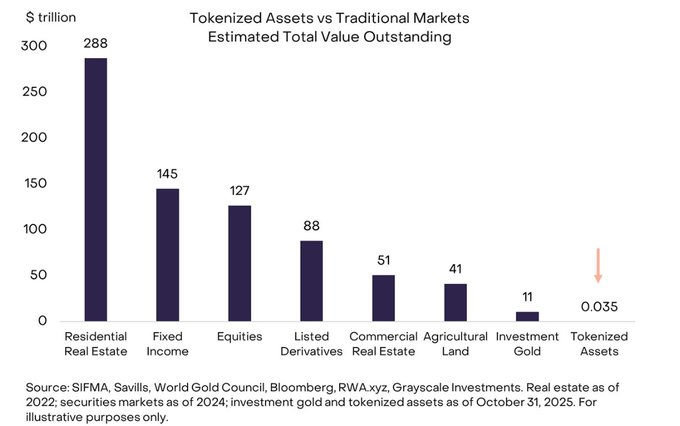
Grayscale Says Tokenized Assets Could Grow 1,000x by 2030, Driving Activity on ETH, BNB, SOL, AVAX and LINKSource: Grayscale on X

Grayscale also added that core blockchain infrastructure and smart contract platforms, including Ethereum, Solana, Avalanche, and BNB Chain, are well-positioned to benefit as tokenization adoption expands.

Rising Adoption By Top Blockchain Platforms

Some of the top blockchain platforms, as well as traditional market players, are shifting towards tokenized assets, while seeing their greater market benefits. Last week, Russia’s largest banking institution, Sberbank, stated that it has started testing different decentralized finance (DeFi) products amid the rising crypto demand from clients. As reported by CNF, the banking institution has chosen the Ethereum blockchain network, to offer tokenized assets to clients.

At the same time, Pakistan has signed a memorandum of understanding (MoU) with crypto exchange Binance in order to explore the tokenization of the $2 billion worth of government bonds and reserves. As per the non-binding agreement, Binance will advise the government on different blockchain-based ways to approve the digital versions of treasury bills and sovereign bonds.

SBI Ripple Asia also announced a partnership with decentralized finance startup Doppler Finance to develop new blockchain-based financial offerings built on the XRP Ledger. Under the collaboration, the two firms plan to introduce XRP-focused products alongside initiatives centered on real-world asset (RWA) tokenization, aiming to expand institutional and enterprise use cases on the XRPL.

]]>


Market Opportunity
Ethereum Logo
Ethereum Price(ETH)
$2,056.69
$2,056.69$2,056.69
+3.85%
USD
Ethereum (ETH) Live Price Chart
Disclaimer: The articles reposted on this site are sourced from public platforms and are provided for informational purposes only. They do not necessarily reflect the views of MEXC. All rights remain with the original authors. If you believe any content infringes on third-party rights, please contact service@support.mexc.com for removal. MEXC makes no guarantees regarding the accuracy, completeness, or timeliness of the content and is not responsible for any actions taken based on the information provided. The content does not constitute financial, legal, or other professional advice, nor should it be considered a recommendation or endorsement by MEXC.

You May Also Like

Cashing In On University Patents Means Giving Up On Our Innovation Future

Cashing In On University Patents Means Giving Up On Our Innovation Future

The post Cashing In On University Patents Means Giving Up On Our Innovation Future appeared on BitcoinEthereumNews.com. “It’s a raid on American innovation that would deliver pennies to the Treasury while kneecapping the very engine of our economic and medical progress,” writes Pipes. Getty Images Washington is addicted to taxing success. Now, Commerce Secretary Howard Lutnick is floating a plan to skim half the patent earnings from inventions developed at universities with federal funding. It’s being sold as a way to shore up programs like Social Security. In reality, it’s a raid on American innovation that would deliver pennies to the Treasury while kneecapping the very engine of our economic and medical progress. Yes, taxpayer dollars support early-stage research. But the real payoff comes later—in the jobs created, cures discovered, and industries launched when universities and private industry turn those discoveries into real products. By comparison, the sums at stake in patent licensing are trivial. Universities collectively earn only about $3.6 billion annually in patent income—less than the federal government spends on Social Security in a single day. Even confiscating half would barely register against a $6 trillion federal budget. And yet the damage from such a policy would be anything but trivial. The true return on taxpayer investment isn’t in licensing checks sent to Washington, but in the downstream economic activity that federally supported research unleashes. Thanks to the bipartisan Bayh-Dole Act of 1980, universities and private industry have powerful incentives to translate early-stage discoveries into real-world products. Before Bayh-Dole, the government hoarded patents from federally funded research, and fewer than 5% were ever licensed. Once universities could own and license their own inventions, innovation exploded. The result has been one of the best returns on investment in government history. Since 1996, university research has added nearly $2 trillion to U.S. industrial output, supported 6.5 million jobs, and launched more than 19,000 startups. Those companies pay…
Share
BitcoinEthereumNews2025/09/18 03:26
China Blocks Nvidia’s RTX Pro 6000D as Local Chips Rise

China Blocks Nvidia’s RTX Pro 6000D as Local Chips Rise

The post China Blocks Nvidia’s RTX Pro 6000D as Local Chips Rise appeared on BitcoinEthereumNews.com. China Blocks Nvidia’s RTX Pro 6000D as Local Chips Rise China’s internet regulator has ordered the country’s biggest technology firms, including Alibaba and ByteDance, to stop purchasing Nvidia’s RTX Pro 6000D GPUs. According to the Financial Times, the move shuts down the last major channel for mass supplies of American chips to the Chinese market. Why Beijing Halted Nvidia Purchases Chinese companies had planned to buy tens of thousands of RTX Pro 6000D accelerators and had already begun testing them in servers. But regulators intervened, halting the purchases and signaling stricter controls than earlier measures placed on Nvidia’s H20 chip. Image: Nvidia An audit compared Huawei and Cambricon processors, along with chips developed by Alibaba and Baidu, against Nvidia’s export-approved products. Regulators concluded that Chinese chips had reached performance levels comparable to the restricted U.S. models. This assessment pushed authorities to advise firms to rely more heavily on domestic processors, further tightening Nvidia’s already limited position in China. China’s Drive Toward Tech Independence The decision highlights Beijing’s focus on import substitution — developing self-sufficient chip production to reduce reliance on U.S. supplies. “The signal is now clear: all attention is focused on building a domestic ecosystem,” said a representative of a leading Chinese tech company. Nvidia had unveiled the RTX Pro 6000D in July 2025 during CEO Jensen Huang’s visit to Beijing, in an attempt to keep a foothold in China after Washington restricted exports of its most advanced chips. But momentum is shifting. Industry sources told the Financial Times that Chinese manufacturers plan to triple AI chip production next year to meet growing demand. They believe “domestic supply will now be sufficient without Nvidia.” What It Means for the Future With Huawei, Cambricon, Alibaba, and Baidu stepping up, China is positioning itself for long-term technological independence. Nvidia, meanwhile, faces…
Share
BitcoinEthereumNews2025/09/18 01:37
Silver Price Crash Is Over “For Real This Time,” Analyst Predicts a Surge Back Above $90

Silver Price Crash Is Over “For Real This Time,” Analyst Predicts a Surge Back Above $90

Silver has been taking a beating lately, and the Silver price hasn’t exactly been acting like a safe haven. After running up into the highs, the whole move reversed
Share
Captainaltcoin2026/02/07 03:15