VanEck is setting expectations for Bitcoin in 2026 with a tone that’s closer to the risk committee than crypto Twitter: the next year looks more like consolidationVanEck is setting expectations for Bitcoin in 2026 with a tone that’s closer to the risk committee than crypto Twitter: the next year looks more like consolidation

Bitcoin Prediction: VanEck Warns 2026 Won’t Be A Melt-Up Or A Crash

VanEck is setting expectations for Bitcoin in 2026 with a tone that’s closer to the risk committee than crypto Twitter: the next year looks more like consolidation than a dramatic regime shift.

In its Dec. 18 note, “Plan for 2026: Predictions from Our Portfolio Managers,” Matthew Sigel, VanEck’s head of digital assets research, argues that the signal set heading into 2026 is “mixed but constructive.” The framework is deliberately restrained: volatility has come down, leverage has been washed out in stages, and on-chain activity is still soft but not deteriorating the way it tends to during deeper cyclical breaks.

“Realized volatility has… dropped by roughly half. That implies a proportional drawdown of about 40%. The market has already absorbed roughly 35%.”

Sigel anchors part of the call in cycle structure. He writes that Bitcoin’s historical four-year rhythm, which has tended to peak in the immediate post-election window, “remains intact following the early October 2025 high.” If that template is still operative, 2026 is less likely to be a clean continuation year.

Bitcoin Prediction For 2026: What To Expect

“That pattern suggests 2026 is more likely a consolidation year. Not a melt-up. Not a collapse.” The more interesting part is the “why,” because VanEck isn’t leaning on a single factor. Sigel describes three lenses shaping the outlook, and they are not uniformly supportive. “Global liquidity is mixed. Likely rate cuts provide support. US liquidity is tightening somewhat.”

He ties that tightening to a specific macro dynamic: “AI-driven capex fears” colliding with a more fragile funding market and pushing credit spreads wider. Put differently, even if policy rates drift lower, the broader cost-of-capital environment can still work against risk-taking at the margin — especially where refinancing needs are persistent and investor selectivity is rising.

Against that backdrop, the portfolio guidance is measured. VanEck favors a “disciplined 1 to 3% Bitcoin allocation,” built through dollar-cost averaging, with adds during leverage-driven dislocations and trims into speculative excess. It’s positioning for a market that oscillates, not one that trends cleanly.

Sigel also flags a topic that has shifted from niche to mainstream inside the Bitcoin community: quantum security. VanEck doesn’t present it as an imminent risk to the chain, but it does treat it as an organizing question that could draw serious attention.

“Quantum security has become an active topic. It’s not an immediate threat. A coordinated response could resemble the first blocksize debates.”

That last line matters more than it sounds. The blocksize era wasn’t only a technical dispute; it was a public process that pulled in new stakeholders, forced trade-offs into the open, and hardened long-term norms. VanEck’s suggestion is that, if quantum planning becomes a sustained coordination exercise, it could have a similar “transparent and technically rich” dynamic, messy, visible, and ultimately strengthening engagement.

Where VanEck is most constructive for 2026 is not necessarily spot BTC, but the capital cycle around Bitcoin mining. Sigel argues the strongest opportunity sits in what he calls the “capital-intensive pivot” as operators try to finance both hash-rate expansion and AI/HPC infrastructure simultaneously.

That combination is stretching balance sheets and widening dispersion across the sector: miners with hyperscaler partnerships can raise straight debt on comparatively favorable terms, while weaker names are pushed toward dilutive converts or selling BTC into weakness.

“This creates the cleanest consolidation setup since 2020 to 2021. The best risk-reward is in miners transitioning into energy-backed compute platforms. Credible HPC economics, advantaged power, and financing paths that avoid serial dilution.”

A second opportunity set is digital payments and stablecoin settlement, but VanEck is selective. Sigel sees stablecoins moving into real B2B payment flows, improving working capital management and lowering cross-border settlement costs.

“The more investable angle may sit in fintech and e-commerce platforms that can unlock margin leverage by shifting supplier payments, payouts, and cross-border settlement onto stablecoins. High-throughput chains will support much of this activity, and a few tokens tied to genuine usage may benefit, but we believe the most durable opportunity may lie in the operating companies enabling adoption rather than in broad token exposure,” Sigel writes.

The overall message is not bearish, and it is not euphoric. It is, in a very deliberate way, a call for discipline: expect range-bound conditions, look for dislocations, and focus on parts of the ecosystem where balance-sheet stress and real-world adoption can create asymmetry.

At press time, Bitcoin traded at $87,423.
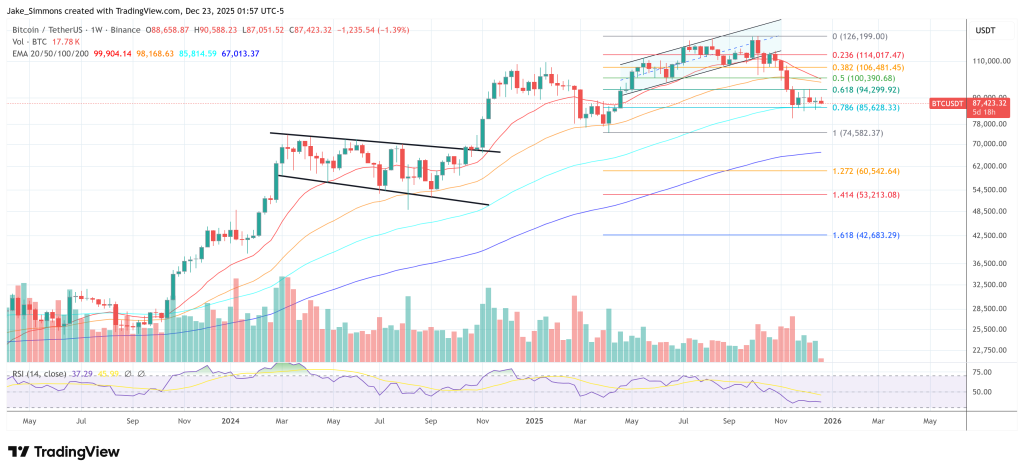
Bitcoin price chart

Featured image created with DALL.E, chart from TradingView.com

Market Opportunity
Threshold Logo
Threshold Price(T)
$0,008783
$0,008783$0,008783
+0,49%
USD
Threshold (T) Live Price Chart
Disclaimer: The articles reposted on this site are sourced from public platforms and are provided for informational purposes only. They do not necessarily reflect the views of MEXC. All rights remain with the original authors. If you believe any content infringes on third-party rights, please contact service@support.mexc.com for removal. MEXC makes no guarantees regarding the accuracy, completeness, or timeliness of the content and is not responsible for any actions taken based on the information provided. The content does not constitute financial, legal, or other professional advice, nor should it be considered a recommendation or endorsement by MEXC.

You May Also Like

Bitcoin Has Taken Gold’s Role In Today’s World, Eric Trump Says

Bitcoin Has Taken Gold’s Role In Today’s World, Eric Trump Says

Eric Trump on Tuesday described Bitcoin as a “modern-day gold,” calling it a liquid store of value that can act as a hedge to real estate and other assets. Related Reading: XRP’s Biggest Rally Yet? Analyst Projects $20+ In October 2025 According to reports, the remark came during a TV appearance on CNBC’s Squawk Box, tied to the launch of American Bitcoin, the mining and treasury firm he helped start. Company Holdings And Strategy Based on public filings and company summaries, American Bitcoin has accumulated 2,443 BTC on its balance sheet. That stash has been valued in the low hundreds of millions of dollars at recent spot prices. The firm mixes large-scale mining with the goal of holding Bitcoin as a strategic reserve, which it says will help it grow both production and asset holdings over time. Eric Trump’s comments were direct. He told viewers that institutions are treating Bitcoin more like a store of value than a fringe idea, and he warned firms that resist blockchain adoption. The tone was strong at times, and the line about Bitcoin being a modern equivalent of gold was used to frame American Bitcoin’s role as both miner and holder.   Eric Trump has said: bitcoin is modern-day gold — unusual_whales (@unusual_whales) September 16, 2025 How The Company Went Public American Bitcoin moved toward a public listing via an all-stock merger with Gryphon Digital Mining earlier this year, a deal that kept most of the original shareholders in control and positioned the new entity for a Nasdaq debut. Reports show that mining partner Hut 8 holds a large ownership stake, leaving the Trump family and other backers with a minority share. The listing brought fresh attention and capital to the firm as it began trading under the ticker ABTC. Market watchers say the firm’s public debut highlights two trends: mining companies are trying to grow by both producing and holding Bitcoin, and political ties are bringing more headlines to crypto firms. Some analysts point out that holding large amounts of Bitcoin on the balance sheet exposes a company to price swings, while supporters argue it aligns incentives between miners and investors. Related Reading: Ethereum Bulls Target $8,500 With Big Money Backing The Move – Details Reaction And Possible Risks Based on coverage of the launch, investors have reacted with both enthusiasm and caution. Supporters praise the prospect of a US-based miner that aims to be transparent and aggressive about building a reserve. Critics point to governance questions, possible conflicts tied to high-profile backers, and the usual risks of a volatile asset being held on corporate balance sheets. Eric Trump’s remark that Bitcoin has taken gold’s role in today’s world reflects both his belief in its value and American Bitcoin’s strategy of mining and holding. Whether that view sticks will depend on how investors and institutions respond in the months ahead. Featured image from Meta, chart from TradingView
Share
NewsBTC2025/09/18 06:00
Nasdaq-listed iPower reaches $30 million convertible note financing agreement to launch DAT strategy.

Nasdaq-listed iPower reaches $30 million convertible note financing agreement to launch DAT strategy.

PANews reported on December 23 that, according to Globenewswire, Nasdaq-listed e-commerce and supply chain platform iPower announced it has reached a $30 million
Share
PANews2025/12/23 22:19
DOGE ETF Hype Fades as Whales Sell and Traders Await Decline

DOGE ETF Hype Fades as Whales Sell and Traders Await Decline

The post DOGE ETF Hype Fades as Whales Sell and Traders Await Decline appeared on BitcoinEthereumNews.com. Leading meme coin Dogecoin (DOGE) has struggled to gain momentum despite excitement surrounding the anticipated launch of a US-listed Dogecoin ETF this week. On-chain data reveals a decline in whale participation and a general uptick in coin selloffs across exchanges, hinting at the possibility of a deeper price pullback in the coming days. Sponsored Sponsored DOGE Faces Decline as Whales Hold Back, Traders Sell The market is anticipating the launch of Rex-Osprey’s Dogecoin ETF (DOJE) tomorrow, which is expected to give traditional investors direct exposure to Dogecoin’s price movements.  However, DOGE’s price performance has remained muted ahead of the milestone, signaling a lack of enthusiasm from traders. According to on-chain analytics platform Nansen, whale accumulation has slowed notably over the past week. Large investors, with wallets containing DOGE coins worth more than $1 million, appear unconvinced by the ETF narrative and have reduced their holdings by over 4% in the past week.  For token TA and market updates: Want more token insights like this? Sign up for Editor Harsh Notariya’s Daily Crypto Newsletter here. Dogecoin Whale Activity. Source: Nansen When large holders reduce their accumulation, it signals a bearish shift in market sentiment. This reduced DOGE demand from significant players can lead to decreased buying pressure, potentially resulting in price stagnation or declines in the near term. Sponsored Sponsored Furthermore, DOGE’s exchange reserve has risen steadily in the past week, suggesting that more traders are transferring DOGE to exchanges with the intent to sell. As of this writing, the altcoin’s exchange balance sits at 28 billion DOGE, climbing by 12% in the past seven days. DOGE Balance on Exchanges. Source: Glassnode A rising exchange balance indicates that holders are moving their assets to trading platforms to sell rather than to hold. This influx of coins onto exchanges increases the available supply in…
Share
BitcoinEthereumNews2025/09/18 05:07





