85% Hyperliquid validators voted in support of the permanent burning of HYPE tokens in the Assistance Fund address. HYPE price plunged to $23.93 despite token burn85% Hyperliquid validators voted in support of the permanent burning of HYPE tokens in the Assistance Fund address. HYPE price plunged to $23.93 despite token burn

Hyper Foundation Confirms Permanent Burn of HYPE Tokens at Assistance Fund Address

  • 85% Hyperliquid validators voted in support of the permanent burning of HYPE tokens in the Assistance Fund address.
  • HYPE price plunged to $23.93 despite token burn and other major developments on the Hyperliquid network.

The Hyper Foundation has confirmed the permanent burn of all HYPE tokens in the Assistance Fund Address. This move is backed by an 85% stake-weighted validator positive vote, while 7% voted against and 8% abstained. Hyper Foundation, the organization behind Hyperliquid, a decentralized perpetual futures exchange, confirmed the HYPE token burn on X.

The Assistance Fund is a built-in protocol mechanism in Hyperliquid. It automatically converts a portion of the platform’s trading fees into HYPE tokens. These tokens are transferred to a special system address, 0xfefefefefefefefefefefefefefefefefefefefe.
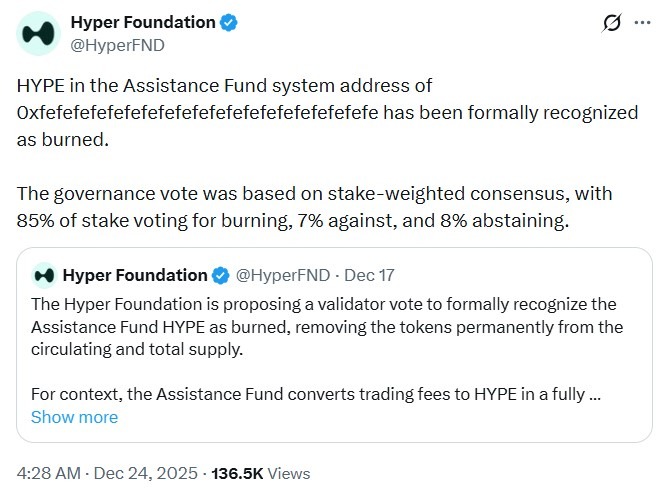
Hyperliquid Token BurnsHyperliquid Token Burns | Source: Hyper Foundation

This Assistance Fund address has no private key and is designed to be inaccessible, similar to the zero address. The tokens there are mathematically irretrievable without a major protocol hard fork or upgrade. While the HYPE tokens were technically already out of circulation, they were still counted in the official total circulating supply metrics. 

Hence, the Hyper Foundation proposed a governance validator vote on December 17, which ran until December 24, 2025. They designed the proposal as a binding social consensus via governance. Validators’ votes were weighted by the amount of HYPE staked or delegated to them. Accordingly, token holders could delegate their stake to influence the vote outcome. According to the result, 85% validators voted in favor of burning, 7% against, while 8% were absent. 

In the future, trading fees routed to the Assistance Fund will also be considered burned. Accordingly, trading fees now act like a continuous buyback-and-burn mechanism. Additionally, the confirmation from Hyper Foundation removes uncertainty about whether the Assistance Fund tokens could return to circulation.

A Strong Hyperliquid Network

The burning of all HYPE tokens on the Assistance Fund address is a major governance win for Hyperliquid. It formalizes a deflationary move that aligns reported token economics with the actual design of the protocol.  Additionally, it signals strong community support for long-term scarcity and transparency. Furthermore, it shows that validators can make technical and economic decisions without relying on emergency upgrades. 

It also highlights a growing trend in blockchain governance. Networks increasingly rely on social consensus to formalize outcomes that code already enforces. Currently, the HYPE token is down 1.7% over the previous day to trade at $23.93. The daily trading volume also decreased by 14.05% to $179.7 million.

Intriguingly, the HYPE token burn news follows some major developments on the network. For instance, Hyperliquid has introduced a portfolio margin for spot and perps integration. As we discussed earlier, the new feature allows positions to be managed from a single, unified balance.

In a related development, Sonnet BioTherapeutics shareholders approved a merger between Hyperliquid Strategies and Rorschach I LLC. This approval clears the final hurdle in its transition into a digital asset treasury holding HYPE tokens.

]]>


Market Opportunity
Hyperlane Logo
Hyperlane Price(HYPER)
$0.12304
$0.12304$0.12304
-2.62%
USD
Hyperlane (HYPER) Live Price Chart
Disclaimer: The articles reposted on this site are sourced from public platforms and are provided for informational purposes only. They do not necessarily reflect the views of MEXC. All rights remain with the original authors. If you believe any content infringes on third-party rights, please contact service@support.mexc.com for removal. MEXC makes no guarantees regarding the accuracy, completeness, or timeliness of the content and is not responsible for any actions taken based on the information provided. The content does not constitute financial, legal, or other professional advice, nor should it be considered a recommendation or endorsement by MEXC.

You May Also Like

XRP and SOL ETFs Attract Inflows Amid BTC, ETH Outflows

XRP and SOL ETFs Attract Inflows Amid BTC, ETH Outflows

Spot XRP and SOL ETFs gain inflows as BTC and ETH face outflows, signaling a market shift.
Share
CoinLive2025/12/26 05:14
SEC Backs Nasdaq, CBOE, NYSE Push to Simplify Crypto ETF Rules

SEC Backs Nasdaq, CBOE, NYSE Push to Simplify Crypto ETF Rules

The US SEC on Wednesday approved new listing rules for major exchanges, paving the way for a surge of crypto spot exchange-traded funds. On Wednesday, the regulator voted to let Nasdaq, Cboe BZX and NYSE Arca adopt generic listing standards for commodity-based trust shares. The decision clears the final hurdle for asset managers seeking to launch spot ETFs tied to cryptocurrencies beyond Bitcoin and Ether. In July, the SEC outlined how exchanges could bring new products to market under the framework. Asset managers and exchanges must now meet specific criteria, but will no longer need to undergo drawn-out case-by-case reviews. Solana And XRP Funds Seen to Be First In Line Under the new system, the time from filing to launch can shrink to as little as 75 days, compared with up to 240 days or more under the old rules. “This is the crypto ETP framework we’ve been waiting for,” Bloomberg research analyst James Seyffart said on X, predicting a wave of new products in the coming months. The first filings likely to benefit are those tracking Solana and XRP, both of which have sat in limbo for more than a year. SEC Chair Paul Atkins said the approval reflects a commitment to reduce barriers and foster innovation while maintaining investor protections. The move comes under the administration of President Donald Trump, which has signaled strong support for digital assets after years of hesitation during the Biden era. New Standards Replace Lengthy Reviews And Repeated Denials Until now, the commission reviewed each application separately, requiring one filing from the exchange and another from the asset manager. This dual process often dragged on for months and led to repeated denials. Even Bitcoin spot ETFs, finally approved in Jan. 2024, arrived only after years of resistance and a legal battle with Grayscale. According to Bloomberg ETF analyst Eric Balchunas, the streamlined rules could apply to any cryptocurrency with at least six months of futures trading on the Coinbase Derivatives Exchange. That means more than a dozen tokens may now qualify for listing, potentially unleashing a new wave of altcoin ETFs. SEC Clears Grayscale Large Cap Fund Tracking CoinDesk 5 Index The SEC also approved the Grayscale Digital Large Cap Fund, which tracks the CoinDesk 5 Index, including Bitcoin, Ether, XRP, Solana and Cardano. Alongside this, it cleared the launch of options linked to the Cboe Bitcoin US ETF Index and its mini contract, broadening the set of crypto-linked derivatives on regulated US markets. Analysts say the shift shows how far US policy has moved. Where once regulators resisted digital assets, the latest changes show a growing willingness to bring them into the mainstream financial system under established safeguards
Share
CryptoNews2025/09/18 12:40
New Trump appointee Miran calls for half-point cut in only dissent as rest of Fed bands together

New Trump appointee Miran calls for half-point cut in only dissent as rest of Fed bands together

The post New Trump appointee Miran calls for half-point cut in only dissent as rest of Fed bands together appeared on BitcoinEthereumNews.com. Stephen Miran, chairman of the Council of Economic Advisers and US Federal Reserve governor nominee for US President Donald Trump, arrives for a Senate Banking, Housing, and Urban Affairs Committee confirmation hearing in Washington, DC, US, on Thursday, Sept. 4, 2025. The Senate Banking Committee’s examination of Stephen Miran’s appointment will provide the first extended look at how prominent Republican senators balance their long-standing support of an independent central bank against loyalty to their party leader. Photographer: Daniel Heuer/Bloomberg via Getty Images Daniel Heuer | Bloomberg | Getty Images Newly-confirmed Federal Reserve Governor Stephen Miran dissented from the central bank’s decision to lower the federal funds rate by a quarter percentage point on Wednesday, choosing instead to call for a half-point cut. Miran, who was confirmed by the Senate to the Fed Board of Governors on Monday, was the sole dissenter in the Federal Open Market Committee’s statement. Governors Michelle Bowman and Christopher Waller, who had dissented at the Fed’s prior meeting in favor of a quarter-point move, were aligned with Fed Chair Jerome Powell and the others besides Miran this time. Miran was selected by Trump back in August to fill the seat that was vacated by former Governor Adriana Kugler after she suddenly announced her resignation without stating a reason for doing so. He has said that he will take an unpaid leave of absence as chair of the White House’s Council of Economic Advisors rather than fully resign from the position. Miran’s place on the board, which will last until Jan. 31, 2026 when Kugler’s term was due to end, has been viewed by critics as a threat from Trump to the Fed’s independence, as the president has nominated three of the seven members. Trump also said in August that he had fired Federal Reserve Board Governor…
Share
BitcoinEthereumNews2025/09/18 02:26