U.S. Outflows Persist as Bitcoin Institutional Investment Shows Signs of Decline Institutional investors continue to pull funds from Bitcoin, with significant outflowsU.S. Outflows Persist as Bitcoin Institutional Investment Shows Signs of Decline Institutional investors continue to pull funds from Bitcoin, with significant outflows

Bitcoin ETFs Experience $175 Million Outflows on Christmas Eve
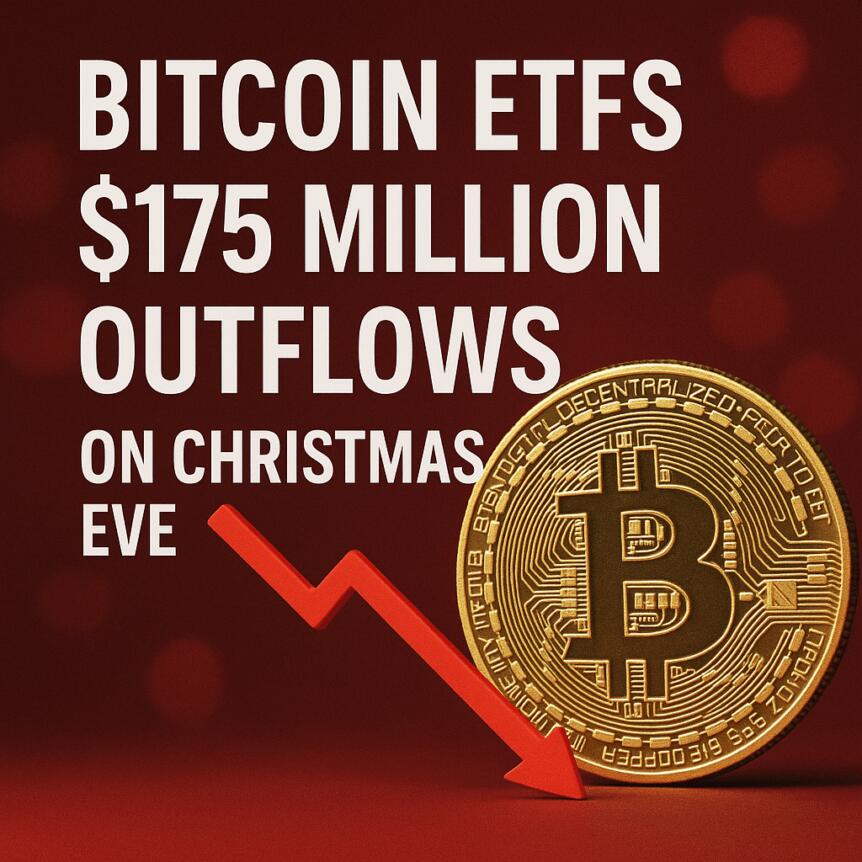
Bitcoin Etfs Experience $175 Million Outflows On Christmas Eve

U.S. Outflows Persist as Bitcoin Institutional Investment Shows Signs of Decline

Institutional investors continue to pull funds from Bitcoin, with significant outflows recorded during the holiday season. Data indicates that the United States has emerged as the leading seller of Bitcoin since December, amid broader market uncertainties and seasonal factors.

Key points:

  • Bitcoin ETF netflows remain negative through Christmas Eve, with over $175 million withdrawn from institutional ETF holdings.
  • Tax considerations and quarterly options expiry are cited as primary reasons for subdued trading activity.
  • Market analysts remain optimistic that the pending holiday period will be followed by renewed buying interest.
  • Persistent negative sentiment is reflected in the Coinbase Premium index, signaling reduced US buyer demand and increased Asian participation.

According to Farside Investors, a UK-based asset management firm, Bitcoin’s institutional outflows on Christmas Eve surpassed $175 million, continuing a trend that has persisted since mid-December. Despite the seasonal slowdown typical around the holidays, traders indicate that market activity is influenced by specific events such as tax loss harvesting and options expiry, which often lead to temporary selling pressure.

“Most of the selling pressure is due to tax loss harvesting, which should conclude within a week,” commented trader Alek. He also noted that the upcoming options expiry on Friday could temporarily impact traders’ risk appetite but remains optimistic about a swift rebound post-holidays.

Supporting this perspective, the Coinbase Premium Index—a measure of price divergence between Coinbase’s BTC/USD and Binance’s BTC/USDT markets—has experienced a sustained negative trend throughout December. This suggests a lack of buying demand in the U.S., with Asian markets emerging as dominant buyers, a shift that could influence future price movements.

Crypto analyst Ted Pillows highlighted this shift, noting that the U.S. has become the primary seller of Bitcoin, while Asia has taken a leading role in acquisitions. A negative Premium typically indicates diminished U.S. buyer enthusiasm, which may hinder Bitcoin’s ability to sustain higher price levels unless demand rebalances.

Institutional ETF Flows and Market Outlook

Despite the recent outflows, traders like BitBull suggest that negative ETF netflows over the past month do not indicate an imminent market top. They emphasize that price stabilization and neutral liquidity are prerequisites for a genuine rally, and that the current liquidity conditions are not indicative of a final downturn.

“A trend change typically begins with ETF flows turning positive before a pronounced price surge,” they pointed out, referencing the ongoing patterns seen in Bitcoin and Ether ETF activity. Notably, ETF netflows for these assets have remained negative since early November, underscoring the need for renewed institutional interest to ignite a sustained rally.

As the market navigates through seasonal and technical influences, the outlook remains cautiously optimistic that a turnaround could materialize in the near future. Investors should watch for signs of flow reversal and increased buying activity to confirm a potential bullish shift.

This article was originally published as Bitcoin ETFs Experience $175 Million Outflows on Christmas Eve on Crypto Breaking News – your trusted source for crypto news, Bitcoin news, and blockchain updates.

Disclaimer: The articles reposted on this site are sourced from public platforms and are provided for informational purposes only. They do not necessarily reflect the views of MEXC. All rights remain with the original authors. If you believe any content infringes on third-party rights, please contact service@support.mexc.com for removal. MEXC makes no guarantees regarding the accuracy, completeness, or timeliness of the content and is not responsible for any actions taken based on the information provided. The content does not constitute financial, legal, or other professional advice, nor should it be considered a recommendation or endorsement by MEXC.

You May Also Like

And the Big Day Has Arrived: The Anticipated News for XRP and Dogecoin Tomorrow

And the Big Day Has Arrived: The Anticipated News for XRP and Dogecoin Tomorrow

The first-ever ETFs for XRP and Dogecoin are expected to launch in the US tomorrow. Here's what you need to know. Continue Reading: And the Big Day Has Arrived: The Anticipated News for XRP and Dogecoin Tomorrow
Share
Coinstats2025/09/18 04:33
Tokenized Assets Shift From Wrappers to Building Blocks in DeFi

Tokenized Assets Shift From Wrappers to Building Blocks in DeFi

The post Tokenized Assets Shift From Wrappers to Building Blocks in DeFi appeared on BitcoinEthereumNews.com. RWAs are rapidly moving on-chain, unlocking new opportunities for investors and DeFi protocols, according to a new report from Dune and RWAxyz. Tokenized real-world assets (RWAs) are moving beyond digital versions of traditional securities to become key building blocks of decentralized finance (DeFi), according to the 2025 RWA Report from Dune and RWAxyz. The report notes that Treasuries, bonds, credit, and equities are now being used in DeFi as collateral, trading instruments, and yield products. This marks tokenization’s “real breakthrough” – composability, or the ability to combine and reuse assets across different protocols. Projects are already showing how this works in practice. Asset manager Maple Finance’s syrupUSDC, for example, has grown to $2.5 billion, with more than 30% placed in DeFi apps like Spark ($570 million). Centrifuge’s new deJAAA token, a wrapper for Janus Henderson’s AAA CLO fund, is already trading on Aerodrome, Coinbase and other exchanges, with Stellar planned next. Meanwhile, Aave’s Horizon RWA Market now lets institutional users post tokenized Treasuries and CLOs as collateral. This trend underscores a bigger shift: RWAs are no longer just copies of traditional assets; instead, they are becoming core parts of on-chain finance, powering lending, liquidity, and yield, and helping to close the gap between traditional finance (TradFi) and DeFi. “RWAs have crossed the chasm from experimentation to execution,” Sid Powell, CEO of Maple Finance, says in the report. “Our growth to $3.5B AUM reflects a broader shift: traditional financial services are adopting crypto assets while institutions seek exposure to on-chain markets.” Investor demand for higher returns and more diversified options is mainly driving this growth. Tokenized Treasuries proved there is strong demand, with $7.3 billion issued by September 2025 – up 85% year-to-date. The growth was led by BlackRock, WisdomTree, Ondo, and Centrifuge’s JTRSY (Janus Henderson Anemoy Treasury Fund). Spark’s $1…
Share
BitcoinEthereumNews2025/09/18 06:10
SlowMist: ClawHub is increasingly becoming a new target for attackers to poison supply chains.

SlowMist: ClawHub is increasingly becoming a new target for attackers to poison supply chains.

PANews reported on February 9th that, according to SlowMist monitoring, ClawHub, the official plugin center of the open-source AI agent project OpenClaw, is increasingly
Share
PANews2026/02/09 10:51



