BitcoinWorld Revealing: The Crucial BTC Perpetual Futures Long/Short Ratio You Can’t Ignore For any serious Bitcoin trader, understanding market sentiment is notBitcoinWorld Revealing: The Crucial BTC Perpetual Futures Long/Short Ratio You Can’t Ignore For any serious Bitcoin trader, understanding market sentiment is not

Revealing: The Crucial BTC Perpetual Futures Long/Short Ratio You Can’t Ignore

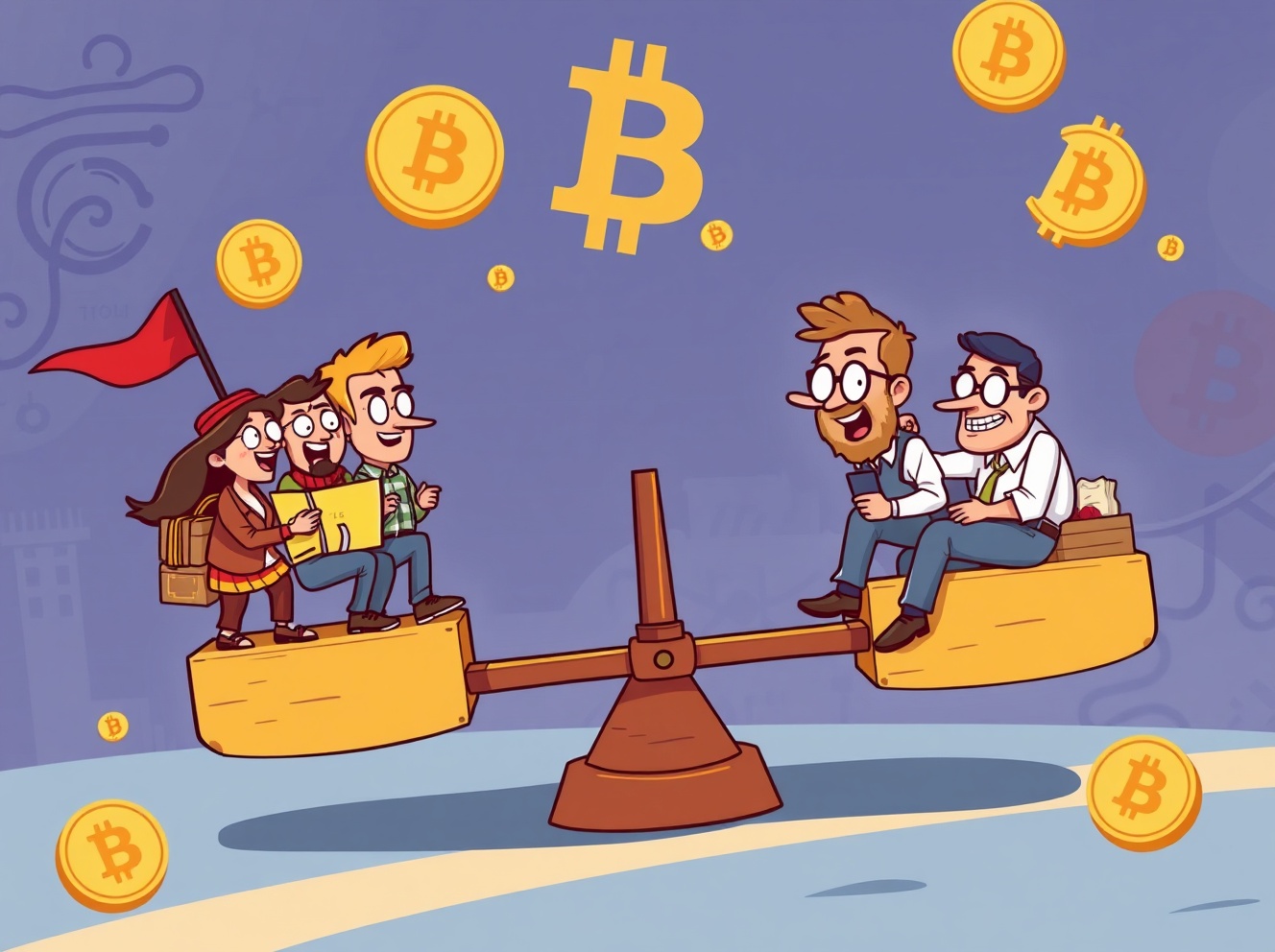
A cartoon illustration analyzing the BTC perpetual futures long/short ratio as a balanced scale.

BitcoinWorld

Revealing: The Crucial BTC Perpetual Futures Long/Short Ratio You Can’t Ignore

For any serious Bitcoin trader, understanding market sentiment is not just helpful—it’s essential. One of the most powerful, real-time gauges of this sentiment is the BTC perpetual futures long/short ratio. This metric reveals whether traders are leaning bullish or bearish on the world’s leading cryptocurrency at any given moment. Let’s decode the latest data from the world’s top exchanges and uncover what it truly means for your next move.

What Does the BTC Perpetual Futures Long/Short Ratio Tell Us?

The BTC perpetual futures long/short ratio is a simple yet profound indicator. It shows the percentage of traders holding long positions (betting the price will rise) versus those holding short positions (betting the price will fall) on perpetual futures contracts. Therefore, a ratio above 50% long suggests bullish sentiment, while below 50% indicates bearish leanings. However, interpreting this data requires looking beyond a single number.

Breaking Down the Latest Market Sentiment

Current data paints a fascinating picture of a market in near-perfect equilibrium, but with subtle nuances. The overall 24-hour BTC perpetual futures long/short ratio across major platforms shows a market almost perfectly balanced between fear and greed.

  • Overall: 49.34% long, 50.66% short
  • Binance: 48.99% long, 51.01% short
  • OKX: 49.95% long, 50.05% short
  • Bybit: 48.69% long, 51.31% short

This collective data reveals a market that is cautiously bearish in the very short term. The slight edge towards short positions suggests traders are hedging or anticipating potential downward pressure.

Why Should You Care About This Ratio?

Monitoring the BTC perpetual futures long/short ratio offers actionable insights. First, extreme readings can act as a contrarian indicator. For instance, when an overwhelming majority are long, it might signal a market top is near. Conversely, extreme short positioning can hint at a potential bounce. Secondly, divergences between exchanges can reveal where different trader demographics (retail vs. institutional) are placing their bets, offering a deeper layer of analysis.

Actionable Insights for Traders

So, what can you do with this knowledge? Don’t just observe—strategize. The current neutral-to-bearish BTC perpetual futures long/short ratio suggests a few things. It may indicate a period of consolidation is underway before the next significant price move. Traders should watch for a decisive shift in this ratio, as it could precede strong momentum. Furthermore, use this data in conjunction with other indicators like funding rates and open interest for a more complete picture.

The Final Verdict on Current Market Sentiment

In conclusion, the latest BTC perpetual futures long/short ratio data reveals a market at a crossroads. The slight dominance of short positions across Binance, OKX, and Bybit points to short-term caution among derivatives traders. However, the closeness of the numbers also shows a lack of strong conviction, leaving the door open for a rapid sentiment shift. For the astute observer, this equilibrium is a watchful waiting game, where the next tilt in the ratio could signal the direction of Bitcoin’s next major move.

Frequently Asked Questions (FAQs)

What is a perpetual futures contract?
A perpetual futures contract is a derivative tool that allows traders to speculate on an asset’s price without an expiry date, using a funding rate mechanism to tether it to the spot price.

How often does the BTC perpetual futures long/short ratio update?
The data typically updates in real-time or at very short intervals (e.g., every few minutes or hourly), providing a near-live pulse of market sentiment.

Is a high long ratio always bullish for the price?
Not necessarily. Extremely high long ratios can indicate over-optimism or “crowded trades,” which sometimes precede sharp price corrections as positions are liquidated.

Which exchange’s ratio is most important?
Binance often holds the most weight due to its largest open interest, but analyzing all major exchanges together provides a more robust view of global sentiment.

Can this ratio predict Bitcoin’s price?
It is a sentiment indicator, not a crystal ball. It shows trader positioning, which can influence price, but should be used alongside technical and fundamental analysis.

Share Your Take on the Market

Does the current balance between bulls and bears surprise you? What’s your interpretation of the BTC perpetual futures long/short ratio? Share this analysis with your trading community on X (Twitter) or Telegram to spark a discussion and see how others are navigating this nuanced market landscape.

To learn more about the latest Bitcoin trends, explore our article on key developments shaping Bitcoin price action and institutional adoption.

This post Revealing: The Crucial BTC Perpetual Futures Long/Short Ratio You Can’t Ignore first appeared on BitcoinWorld.


Market Opportunity
Bitcoin Logo
Bitcoin Price(BTC)
$88,727.98
$88,727.98$88,727.98
+0.44%
USD
Bitcoin (BTC) Live Price Chart
Disclaimer: The articles reposted on this site are sourced from public platforms and are provided for informational purposes only. They do not necessarily reflect the views of MEXC. All rights remain with the original authors. If you believe any content infringes on third-party rights, please contact service@support.mexc.com for removal. MEXC makes no guarantees regarding the accuracy, completeness, or timeliness of the content and is not responsible for any actions taken based on the information provided. The content does not constitute financial, legal, or other professional advice, nor should it be considered a recommendation or endorsement by MEXC.

You May Also Like

Why 100 Percent Test Coverage is Not Possible — Lessons from Testing Banking and Healthcare Systems

Why 100 Percent Test Coverage is Not Possible — Lessons from Testing Banking and Healthcare Systems

Quality is not about testing everything; quality is about testing what is most important.
Share
Hackernoon2025/12/26 16:05
US eyes crypto mining at disputed nuclear plant in Russia-Ukraine conflict: report

US eyes crypto mining at disputed nuclear plant in Russia-Ukraine conflict: report

The plant is located in Ukraine and has been under Russian control since 2022, with its future management a key issue in peace talks.
Share
Coinstats2025/12/26 18:58
Google's AP2 protocol has been released. Does encrypted AI still have a chance?

Google's AP2 protocol has been released. Does encrypted AI still have a chance?

Following the MCP and A2A protocols, the AI Agent market has seen another blockbuster arrival: the Agent Payments Protocol (AP2), developed by Google. This will clearly further enhance AI Agents' autonomous multi-tasking capabilities, but the unfortunate reality is that it has little to do with web3AI. Let's take a closer look: What problem does AP2 solve? Simply put, the MCP protocol is like a universal hook, enabling AI agents to connect to various external tools and data sources; A2A is a team collaboration communication protocol that allows multiple AI agents to cooperate with each other to complete complex tasks; AP2 completes the last piece of the puzzle - payment capability. In other words, MCP opens up connectivity, A2A promotes collaboration efficiency, and AP2 achieves value exchange. The arrival of AP2 truly injects "soul" into the autonomous collaboration and task execution of Multi-Agents. Imagine AI Agents connecting Qunar, Meituan, and Didi to complete the booking of flights, hotels, and car rentals, but then getting stuck at the point of "self-payment." What's the point of all that multitasking? So, remember this: AP2 is an extension of MCP+A2A, solving the last mile problem of AI Agent automated execution. What are the technical highlights of AP2? The core innovation of AP2 is the Mandates mechanism, which is divided into real-time authorization mode and delegated authorization mode. Real-time authorization is easy to understand. The AI Agent finds the product and shows it to you. The operation can only be performed after the user signs. Delegated authorization requires the user to set rules in advance, such as only buying the iPhone 17 when the price drops to 5,000. The AI Agent monitors the trigger conditions and executes automatically. The implementation logic is cryptographically signed using Verifiable Credentials (VCs). Users can set complex commission conditions, including price ranges, time limits, and payment method priorities, forming a tamper-proof digital contract. Once signed, the AI Agent executes according to the conditions, with VCs ensuring auditability and security at every step. Of particular note is the "A2A x402" extension, a technical component developed by Google specifically for crypto payments, developed in collaboration with Coinbase and the Ethereum Foundation. This extension enables AI Agents to seamlessly process stablecoins, ETH, and other blockchain assets, supporting native payment scenarios within the Web3 ecosystem. What kind of imagination space can AP2 bring? After analyzing the technical principles, do you think that's it? Yes, in fact, the AP2 is boring when it is disassembled alone. Its real charm lies in connecting and opening up the "MCP+A2A+AP2" technology stack, completely opening up the complete link of AI Agent's autonomous analysis+execution+payment. From now on, AI Agents can open up many application scenarios. For example, AI Agents for stock investment and financial management can help us monitor the market 24/7 and conduct independent transactions. Enterprise procurement AI Agents can automatically replenish and renew without human intervention. AP2's complementary payment capabilities will further expand the penetration of the Agent-to-Agent economy into more scenarios. Google obviously understands that after the technical framework is established, the ecological implementation must be relied upon, so it has brought in more than 60 partners to develop it, almost covering the entire payment and business ecosystem. Interestingly, it also involves major Crypto players such as Ethereum, Coinbase, MetaMask, and Sui. Combined with the current trend of currency and stock integration, the imagination space has been doubled. Is web3 AI really dead? Not entirely. Google's AP2 looks complete, but it only achieves technical compatibility with Crypto payments. It can only be regarded as an extension of the traditional authorization framework and belongs to the category of automated execution. There is a "paradigm" difference between it and the autonomous asset management pursued by pure Crypto native solutions. The Crypto-native solutions under exploration are taking the "decentralized custody + on-chain verification" route, including AI Agent autonomous asset management, AI Agent autonomous transactions (DeFAI), AI Agent digital identity and on-chain reputation system (ERC-8004...), AI Agent on-chain governance DAO framework, AI Agent NPC and digital avatars, and many other interesting and fun directions. Ultimately, once users get used to AI Agent payments in traditional fields, their acceptance of AI Agents autonomously owning digital assets will also increase. And for those scenarios that AP2 cannot reach, such as anonymous transactions, censorship-resistant payments, and decentralized asset management, there will always be a time for crypto-native solutions to show their strength? The two are more likely to be complementary rather than competitive, but to be honest, the key technological advancements behind AI Agents currently all come from web2AI, and web3AI still needs to keep up the good work!
Share
PANews2025/09/18 07:00