

Ondo Brings US Stocks to Solana, but Who Secures Them? $BMIC Is Building the Security DeFi Will Need

The line between traditional finance and DeFi keeps getting thinner. This week, that line moved again after Ondo Finance confirmed plans to launch tokenized US stocks and ETFs on Solana in early 2026. The assets will be custody-backed, transferable on-chain, and available 24/7, bringing Wall Street-style exposure directly into crypto-native markets.
For many traders and early adopters, this kind of news is exactly why the market is shifting. Instead of chasing fragile narratives, attention is turning toward infrastructure that can actually support this new financial layer.
As tokenized equities move on-chain, the question is no longer whether DeFi will intersect with traditional finance, but whether it can secure it. That is where a crypto presale like BMIC ($BMIC) starts to enter the conversation as something fundamentally different from a typical altcoin to buy.
What Ondo’s Solana Expansion Really Signals
Tokenized stocks and ETFs introduce assets with real-world value, regulatory expectations, and long-term holding behavior. Once these assets live on-chain, they inherit the security model of the crypto infrastructure beneath them.
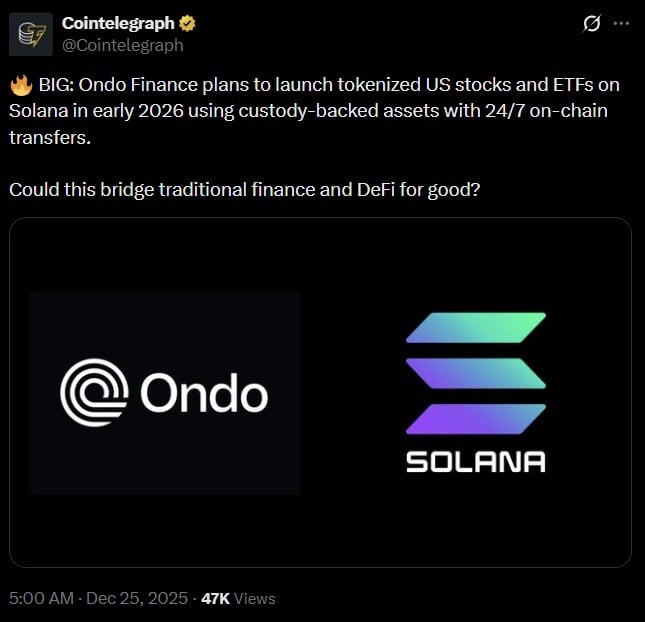
Source: X/@Cointelegraph
Solana offers speed and composability, but tokenized TradFi products also raise new risks. Custody-backed assets, continuous transfers, and institutional participation all increase the importance of wallet security, transaction authentication, and key management. In simple terms, higher-value assets amplify the cost of security failures.
This is a broader reality. As DeFi matures, the weakest point is no longer liquidity or throughput. It is cryptographic exposure. Public keys, signing mechanisms, and legacy wallet structures were never designed for an environment where tokenized stocks move alongside native crypto assets.
Why Security Infrastructure Is Becoming the Real Altcoin to Buy
BMIC approaches this problem from the ground up. Instead of focusing on trading or asset issuance, it concentrates on removing the most persistent weakness in crypto security: public-key exposure. Most wallets today still reveal public keys on-chain, creating a future vulnerability once quantum computing reaches maturity.
BMIC’s architecture avoids that exposure entirely through signature-hiding smart accounts and post-quantum cryptography. This design choice reshapes the risk profile for wallets, staking, and payments, making it better suited for an ecosystem where tokenized stocks and institutional capital coexist with DeFi.
In that context, BMIC is not competing with applications built on top of blockchains. It is positioning itself as a foundational layer beneath them. That is why it increasingly shows up in discussions about which crypto to buy when the market shifts away from short-term speculation and toward long-term infrastructure.
A Crypto Presale Designed for a More Mature DeFi Market
Unlike many early-stage launches, BMIC’s crypto presale is structured around function rather than excitement cycles. The project defines a clear role inside the ecosystem: securing assets, identities, and transactions as DeFi absorbs more real-world value. That focus defines both the technology and the token’s role within it.

The platform combines a quantum-secure wallet, a staking system that avoids classical key leakage, and a payment layer built with protected authentication and private routing. AI is embedded to monitor threats, fine-tune post-quantum performance, and adjust cryptographic standards as global frameworks evolve. These elements are core requirements for the next stage of on-chain finance.
BMIC also extends beyond individual users. Its Quantum Security-as-a-Service model allows enterprises and institutions to integrate custody, secure communications, and key management without rebuilding their existing systems. As tokenized assets gain traction, this type of infrastructure becomes a necessity rather than a niche feature.
Crypto Presale Structure: Why Early Phases Matter
From a numbers perspective, BMIC maintains a disciplined setup. Total supply is capped at 1,500,000,000 tokens, with 750,000,000 allocated to the ICO. The fundraising target is €40 million while over $300,000 has been raised already.
Entry pricing begins at $0.048485 and rises to $0.058182 by the final presale tier (~20% pump for early buyers). The planned launch price sits above the last presale level; a clear distinction between early and late participation without relying on exaggerated promises.
The presale operates on Ethereum and accepts ETH, USDT, and USDC. Token utility is tied directly to platform usage, including access to wallet features, staking, enterprise services, governance, and a deflationary mechanism.
As tokenized stocks and ETFs prepare to enter DeFi at scale, it’s important to understand what can safely support them. In that environment, infrastructure-focused projects naturally stand apart from short-lived narratives. Early pricing phases of BMIC are now open, making it a good altcoin to invest in for those tracking where on-chain finance is headed next.
Discover the future of quantum-secure Web3 with BMIC:
Presale: https://bmic.ai
X (Twitter): https://x.com/BMIC_ai
Telegram: https://t.me/+6d1dX_uwKKdhZDFk
This article has been provided by one of our commercial partners and does not reflect Cryptonomist’s opinion. Please be aware our commercial partners may use affiliate programs to generate revenues through the links on this article.


You May Also Like

The Most Accumulated Cheap Crypto in Spring 2026

China Nabs Another Huione Group Core Member in Cambodia Extradition




