IA2 demonstrates significant database optimization on TPC-H benchmarks using PostgreSQL and HypoPG, achieving superior end-to-end runtime gains.IA2 demonstrates significant database optimization on TPC-H benchmarks using PostgreSQL and HypoPG, achieving superior end-to-end runtime gains.

PostgreSQL & HypoPG: The Experimental Foundation of IA2 Index Selection

Abstract and 1. Introduction

  1. Related Works

    2.1 Traditional Index Selection Approaches

    2.2 RL-based Index Selection Approaches

  2. Index Selection Problem

  3. Methodology

    4.1 Formulation of the DRL Problem

    4.2 Instance-Aware Deep Reinforcement Learning for Efficient Index Selection

  4. System Framework of IA2

    5.1 Preprocessing Phase

    5.2 RL Training and Application Phase

  5. Experiments

    6.1 Experimental Setting

    6.2 Experimental Results

    6.3 End-to-End Performance Comparison

    6.4 Key Insights

  6. Conclusion and Future Work, and References

6 Experiments

Our experiments are designed to evaluate the IA2 on several critical aspects of database optimization and index selection. Specifically, we aim to (1) analyze the performance of IA2’s core algorithm, TD3-TD-SWAR, against other reinforcement learning algorithms, showcasing its unique strengths and contributions; (2) assess the efficiency of the action masking technique in IA2 for action space reduction and learning process acceleration; and (3) measure the end-to-end (E2E) workload runtime improvements achieved with IA2, highlighting its practical impact on database performance.

6.1 Experimental Setting

Implementation and Environment: Our prototype is implemented in Python, utilizing PyTorch for model development. Interfaced with PostgreSQL 15.6, it integrates HypoPG for what-if analysis, aiding in query cost estimation. Experiments are conducted on a virtual machine powered by a shared Nvidia Quadro RTX8000 GPU and equipped with 8 CPU cores, within a single-threaded SQL-DB environment.

\ Benchmark Workloads: TPC-H (SF1) forms the basis for seven workloads (W1 - W7), derived from its 22 query templates plus additional queries for a broad evaluation scope. Each workload contains 50 queries, with complexity reflected in the diversity of tables and attributes. W7, uniquely, serves as a test for IA2’s ability to generalize, being unseen during training. W1-W6 are used for standard training and evaluation, while W7 undergoes slight fine-tuning on a subset of the training set for performance assessment on novel queries. Workload outlines are depicted in Figure 4.

\ Figure 4. Workloads’ Outline, W1-W7 with the increasing complexity and diverse patterns
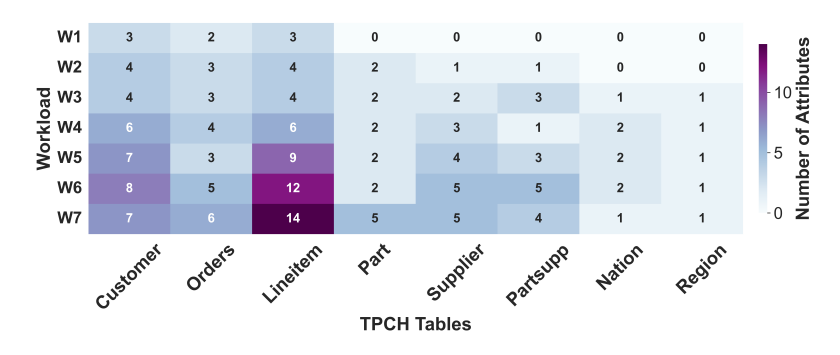
\ Competitors: Our evaluation includes comparisons with SWIRL, DRLinda, Extend, and Lan et al., as discussed in Section 2, to benchmark IA2 against the state-of-the-art in index selection. Comparison of these selected RL-based index advisors is shown in Tabel 1

\ Evaluation Metrics: The primary metric for assessing IA2 and its competitors is the end-to-end runtime of workloads, using the performance gain ratio for direct optimization comparisons across index advising methods. The evaluation covers trends in Storage Budget (2-8), Workloads, and Training Episodes (50-400), with storage quantified in units where 1 unit equals 128MB.

\

:::info Authors:

(1) Taiyi Wang, University of Cambridge, Cambridge, United Kingdom (Taiyi.Wang@cl.cam.ac.uk);

(2) Eiko Yoneki, University of Cambridge, Cambridge, United Kingdom (eiko.yoneki@cl.cam.ac.uk).

:::


:::info This paper is available on arxiv under CC BY-NC-SA 4.0 Deed (Attribution-Noncommercial-Sharelike 4.0 International) license.

:::

\

Market Opportunity
Index Cooperative Logo
Index Cooperative Price(INDEX)
$0.5061
$0.5061$0.5061
-2.61%
USD
Index Cooperative (INDEX) Live Price Chart
Disclaimer: The articles reposted on this site are sourced from public platforms and are provided for informational purposes only. They do not necessarily reflect the views of MEXC. All rights remain with the original authors. If you believe any content infringes on third-party rights, please contact service@support.mexc.com for removal. MEXC makes no guarantees regarding the accuracy, completeness, or timeliness of the content and is not responsible for any actions taken based on the information provided. The content does not constitute financial, legal, or other professional advice, nor should it be considered a recommendation or endorsement by MEXC.

You May Also Like

MoneyGram launches stablecoin-powered app in Colombia

MoneyGram launches stablecoin-powered app in Colombia

The post MoneyGram launches stablecoin-powered app in Colombia appeared on BitcoinEthereumNews.com. MoneyGram has launched a new mobile application in Colombia that uses USD-pegged stablecoins to modernize cross-border remittances. According to an announcement on Wednesday, the app allows customers to receive money instantly into a US dollar balance backed by Circle’s USDC stablecoin, which can be stored, spent, or cashed out through MoneyGram’s global retail network. The rollout is designed to address the volatility of local currencies, particularly the Colombian peso. Built on the Stellar blockchain and supported by wallet infrastructure provider Crossmint, the app marks MoneyGram’s most significant move yet to integrate stablecoins into consumer-facing services. Colombia was selected as the first market due to its heavy reliance on inbound remittances—families in the country receive more than 22 times the amount they send abroad, according to Statista. The announcement said future expansions will target other remittance-heavy markets. MoneyGram, which has nearly 500,000 retail locations globally, has experimented with blockchain rails since partnering with the Stellar Development Foundation in 2021. It has since built cash on and off ramps for stablecoins, developed APIs for crypto integration, and incorporated stablecoins into its internal settlement processes. “This launch is the first step toward a world where every person, everywhere, has access to dollar stablecoins,” CEO Anthony Soohoo stated. The company emphasized compliance, citing decades of regulatory experience, though stablecoin oversight remains fluid. The US Congress passed the GENIUS Act earlier this year, establishing a framework for stablecoin regulation, which MoneyGram has pointed to as providing clearer guardrails. This is a developing story. This article was generated with the assistance of AI and reviewed by editor Jeffrey Albus before publication. Get the news in your inbox. Explore Blockworks newsletters: Source: https://blockworks.co/news/moneygram-stablecoin-app-colombia
Share
BitcoinEthereumNews2025/09/18 07:04
Trading bots gain traction as crypto markets move sideways: HTX 2025 recap

Trading bots gain traction as crypto markets move sideways: HTX 2025 recap

                                                                               The cryptocurrency exchange reported sharp growth in automated trading as vol
Share
Coinstats2026/01/10 03:37
Gold continues to hit new highs. How to invest in gold in the crypto market?

Gold continues to hit new highs. How to invest in gold in the crypto market?

As Bitcoin encounters a "value winter", real-world gold is recasting the iron curtain of value on the blockchain.
Share
PANews2025/04/14 17:12