Ethereum price has struggled to recover from a local low established last week as whales continued to offload their holdings. Now, a multi-month symmetrical triangleEthereum price has struggled to recover from a local low established last week as whales continued to offload their holdings. Now, a multi-month symmetrical triangle

Ethereum price forms symmetrical triangle as whales sell, will it crash?

Ethereum price has struggled to recover from a local low established last week as whales continued to offload their holdings. Now, a multi-month symmetrical triangle suggests there could be more pain ahead.

Summary
  • Ethereum price is down 5% over this month.
  • Whale selling and outflows from spot Ethereum ETFs have contributed to its downtrend.
  • Multiple bearish patterns have formed on the daily chart.

According to data from crypto.news, Ethereum (ETH) price has dropped 2.5% over the past 7 days and 5% from this month’s high of $3,292. Trading at $3,115 at press time, the largest altcoin by market cap is down as much as 37% from its all-time high reached in August last year.

Ethereum price has been under pressure this month due to whale selling. Data from Santiment shows that the number of wallets holding between 10,000 and 1 million ETH has declined steadily since mid-December.
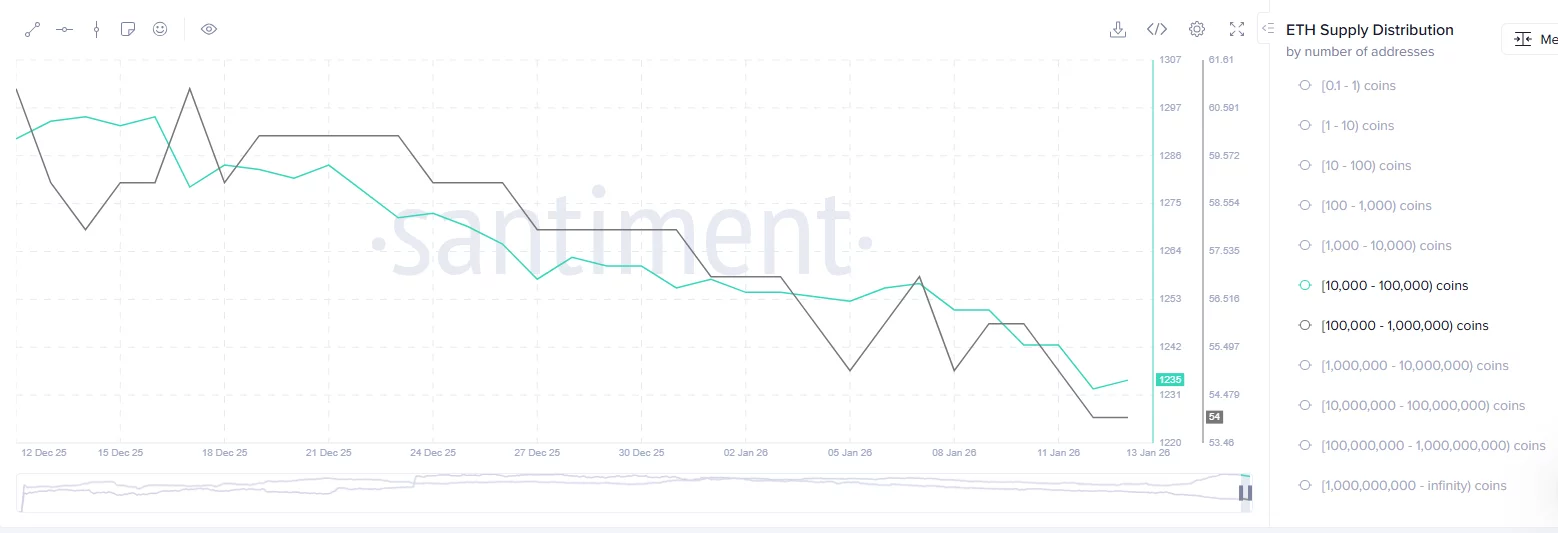
The number of addresses holding 10k-1 million ETH tokens have dropped since mid-December last year.

Large-scale offloading of tokens by such investors often injects panic into retail holders, which in turn leads to further selling and loss of confidence.

The outflows from spot Ethereum ETFs have not helped either. Data from SoSoValue shows that U.S. spot Ethereum ETFs have shed over $345 million over the past four trading sessions. Weak demand from institutional investors has likely kept retail investor appetite in check as they wait for more clarity before re-entering the market.

On-chain stats also point to weakness in Ethereum’s fundamentals that could be weighing on its price. DeFiLlama data shows that the total value locked across DeFi protocols on the Ethereum blockchain has dropped from a September high of $257 billion to $175 billion.

Declining TVL typically signals a slowdown in network usage and capital inflows, and as such, it could reflect reduced investor confidence across the broader Ethereum ecosystem.

Derivative traders are also showing reduced interest. Data from CoinGlass shows that Ethereum futures open interest has dropped since peaking at $70 billion in August to $39 billion at press time, highlighting a sharp decline in speculative positioning. 

Since August, Ethereum price has fallen by over 36%.

Ethereum price analysis

On the daily chart, Ethereum price has been forming a symmetrical triangle pattern since early November last year. A drop below the lower trendline of the pattern is usually a signal of bearish continuation, at least in the short term.
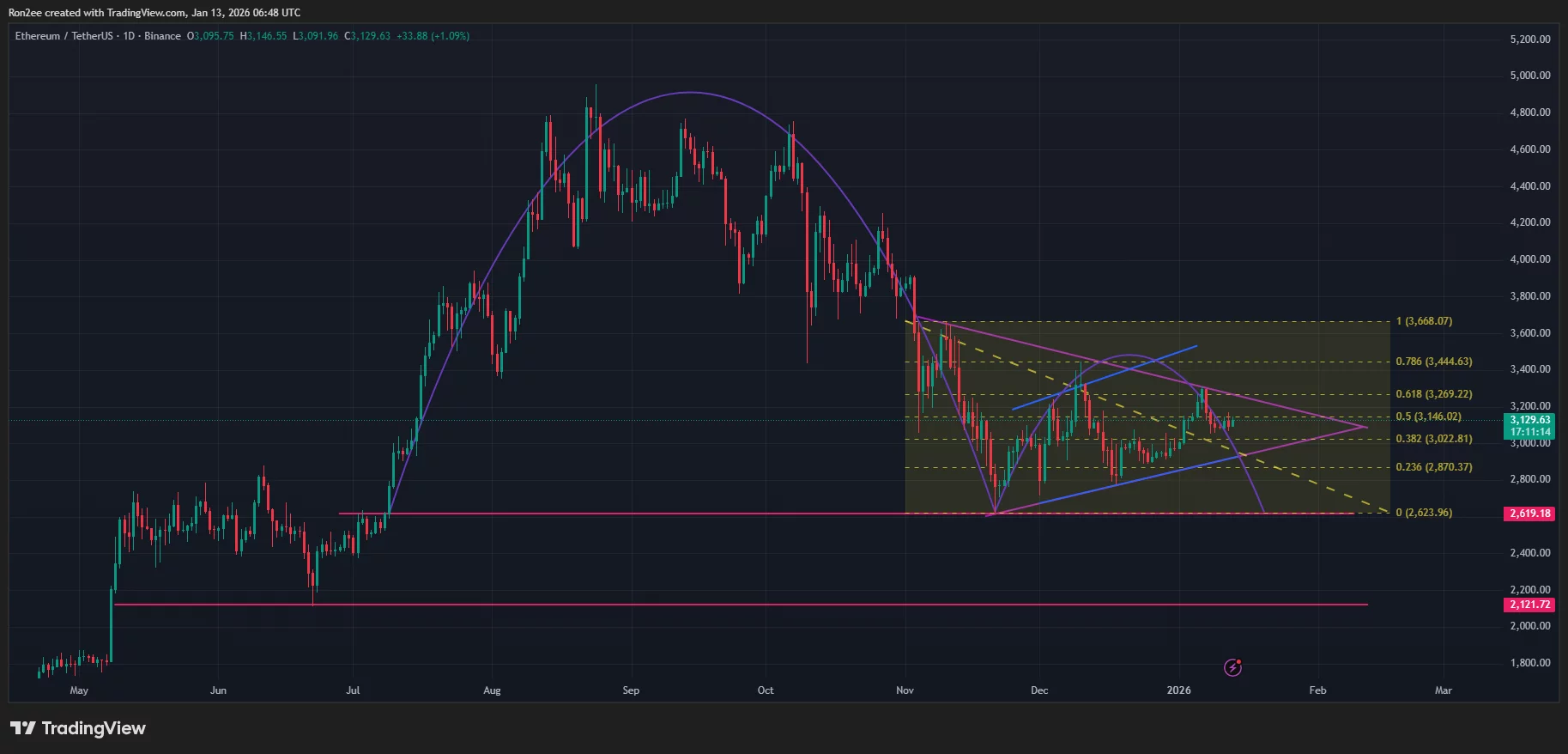
Ethereum price has formed a symmetrical triangle and an inverse cup and handle pattern on the daily chart.

The charts also appear to be forming a large-scale inverse cup and handle pattern. The neckline of this pattern was at $2,619 as shown on the chart above.

As such, a drop below the $3,000 psychological support could open up a path for more downside, specifically towards the Nov. 21 low at $2,619, which also aligns with the neckline of the cup and handle pattern.  Traders are likely to watch this area as a key support level.

A decisive break below that level would likely intensify selling pressure, potentially driving Ethereum down to $2,121.

On the contrary, if Ethereum price rebounds above the $3,269 resistance, which aligns with the 61.8% Fibonacci retracement level, it could invalidate the bearish setup and encourage a move toward higher targets.

Disclosure: This article does not represent investment advice. The content and materials featured on this page are for educational purposes only.


Market Opportunity
Nowchain Logo
Nowchain Price(NOW)
$0.00092
$0.00092$0.00092
0.00%
USD
Nowchain (NOW) Live Price Chart
Disclaimer: The articles reposted on this site are sourced from public platforms and are provided for informational purposes only. They do not necessarily reflect the views of MEXC. All rights remain with the original authors. If you believe any content infringes on third-party rights, please contact service@support.mexc.com for removal. MEXC makes no guarantees regarding the accuracy, completeness, or timeliness of the content and is not responsible for any actions taken based on the information provided. The content does not constitute financial, legal, or other professional advice, nor should it be considered a recommendation or endorsement by MEXC.

You May Also Like

The Channel Factories We’ve Been Waiting For

The Channel Factories We’ve Been Waiting For

The post The Channel Factories We’ve Been Waiting For appeared on BitcoinEthereumNews.com. Visions of future technology are often prescient about the broad strokes while flubbing the details. The tablets in “2001: A Space Odyssey” do indeed look like iPads, but you never see the astronauts paying for subscriptions or wasting hours on Candy Crush.  Channel factories are one vision that arose early in the history of the Lightning Network to address some challenges that Lightning has faced from the beginning. Despite having grown to become Bitcoin’s most successful layer-2 scaling solution, with instant and low-fee payments, Lightning’s scale is limited by its reliance on payment channels. Although Lightning shifts most transactions off-chain, each payment channel still requires an on-chain transaction to open and (usually) another to close. As adoption grows, pressure on the blockchain grows with it. The need for a more scalable approach to managing channels is clear. Channel factories were supposed to meet this need, but where are they? In 2025, subnetworks are emerging that revive the impetus of channel factories with some new details that vastly increase their potential. They are natively interoperable with Lightning and achieve greater scale by allowing a group of participants to open a shared multisig UTXO and create multiple bilateral channels, which reduces the number of on-chain transactions and improves capital efficiency. Achieving greater scale by reducing complexity, Ark and Spark perform the same function as traditional channel factories with new designs and additional capabilities based on shared UTXOs.  Channel Factories 101 Channel factories have been around since the inception of Lightning. A factory is a multiparty contract where multiple users (not just two, as in a Dryja-Poon channel) cooperatively lock funds in a single multisig UTXO. They can open, close and update channels off-chain without updating the blockchain for each operation. Only when participants leave or the factory dissolves is an on-chain transaction…
Share
BitcoinEthereumNews2025/09/18 00:09
Onyxcoin Price Breakout Coming — Is a 38% Move Next?

Onyxcoin Price Breakout Coming — Is a 38% Move Next?

The post Onyxcoin Price Breakout Coming — Is a 38% Move Next? appeared on BitcoinEthereumNews.com. Onyxcoin price action has entered a tense standoff between bulls
Share
BitcoinEthereumNews2026/01/14 00:33
Buterin pushes Layer 2 interoperability as cornerstone of Ethereum’s future

Buterin pushes Layer 2 interoperability as cornerstone of Ethereum’s future

Ethereum founder, Vitalik Buterin, has unveiled new goals for the Ethereum blockchain today at the Japan Developer Conference. The plan lays out short-term, mid-term, and long-term goals touching on L2 interoperability and faster responsiveness among others. In terms of technology, he said again that he is sure that Layer 2 options are the best way […]
Share
Cryptopolitan2025/09/18 01:15



