Vitalik Buterin is arguing that Ethereum’s long-term credibility hinges on a standard usually applied to applications, not base layers: the chain should remain Vitalik Buterin is arguing that Ethereum’s long-term credibility hinges on a standard usually applied to applications, not base layers: the chain should remain

Buterin Puts Ethereum On Notice: Pass The ‘Walkaway Test’

Vitalik Buterin is arguing that Ethereum’s long-term credibility hinges on a standard usually applied to applications, not base layers: the chain should remain meaningfully usable even if its stewards “walk away.” In a Jan. 12 post on X, the Ethereum co-founder framed the “walkaway test” as a requirement for a settlement layer meant to host “trustless and trust-minimized applications” across finance, governance, and beyond.

Buterin’s premise is that Ethereum’s core promise breaks down if the protocol itself depends on continuous, human-managed upgrades to stay safe and competitive. “But building such applications is not possible on a base layer which itself depends on ongoing updates from a vendor in order to continue being usable — even if that ‘vendor’ is the all core devs process,” he wrote. “Ethereum the blockchain must have the traits that we strive for in Ethereum’s applications. Hence, Ethereum itself must pass the walkaway test.”

Ethereum Can’t Rely on Endless Upgrades

The post lands amid a broader, recurring tension in Ethereum’s culture: the desire to keep evolving versus the benefits of stability. Buterin’s formulation doesn’t call for freezing the protocol immediately. Instead, he argues Ethereum should reach a position where it could “ossify” without sacrificing its value proposition.

“This means that Ethereum must get to a place where we can ossify if we want to,” Buterin said. “We do not have to stop making changes to the protocol, but we must get to a place where Ethereum’s value proposition does not strictly depend on any features that are not in the protocol already.” In other words, Ethereum can continue to improve—but it should not need to, in order to remain a credible base for durable, user-owned systems.

From there, Buterin lays out the technical and economic conditions he views as prerequisites for passing the test. The most time-sensitive in his framing is cryptography. “Full quantum-resistance” should not be treated as an upgrade to postpone until the last possible moment, he argues, warning against “the trap” of delaying in exchange for short-term efficiency.

The protocol, in his view, should be able to make a straightforward claim about long-lived safety: being able to say Ethereum “as it stands today, is cryptographically safe for a hundred years.”

Scalability is presented as an architectural destination rather than a perpetual series of feature-driven forks. Buterin points to “ZK-EVM validation and data sampling through PeerDAS” as key components, and suggests an ideal end-state where improvements increasingly come via “parameter only” changes—potentially implemented through validator voting mechanisms akin to how the gas limit can be adjusted.

He also emphasizes state growth as a durability risk that must be addressed at the protocol level. The goal, as he describes it, is a “state architecture that can last decades,” including “partial statelessness and state expiry” so that sustaining thousands of transactions per second over long periods doesn’t make syncing or hardware requirements untenable. Alongside that, he flags future-proofing storage structures to match that environment.

Other items in the framework target known fault lines for decentralized execution: moving toward a more general-purpose account model via “full account abstraction,” ensuring the gas schedule is resilient against denial-of-service risks in both execution and ZK-proving, and hardening proof-of-stake economics so the system “can last and remain decentralized for decades,” including ETH’s role as “trustless collateral.”

Finally, Buterin highlights block building as a centralization pressure point, arguing Ethereum needs a model that can “resist centralization pressure and guarantee censorship resistance even in unknown future environments.” Buterin’s closing message is less about a single roadmap item than a governance and engineering posture: do the heavy lifting now so later progress can be dominated by client optimization and parameter tuning, not perpetual redesign.

At press time, ETH traded at $3,132.
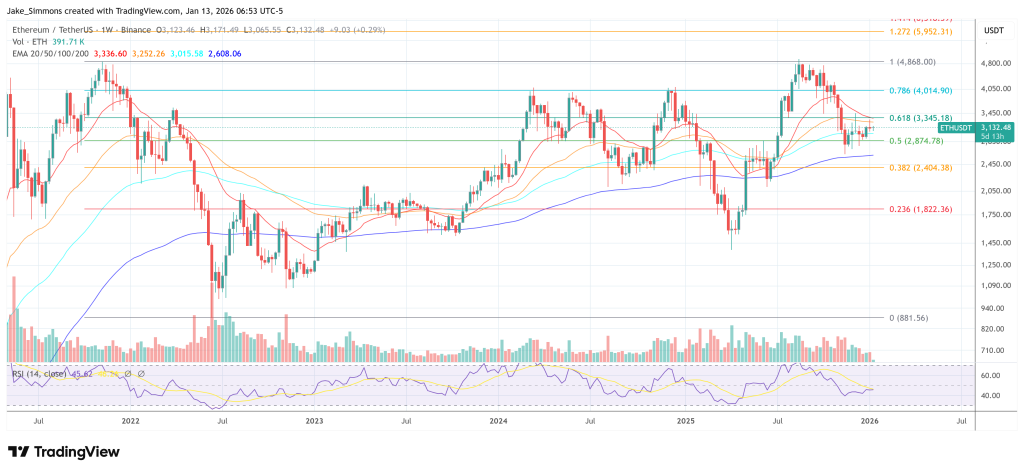
Ethereum price chart
Market Opportunity
Belong Logo
Belong Price(LONG)
$0.00347
$0.00347$0.00347
-0.31%
USD
Belong (LONG) Live Price Chart
Disclaimer: The articles reposted on this site are sourced from public platforms and are provided for informational purposes only. They do not necessarily reflect the views of MEXC. All rights remain with the original authors. If you believe any content infringes on third-party rights, please contact service@support.mexc.com for removal. MEXC makes no guarantees regarding the accuracy, completeness, or timeliness of the content and is not responsible for any actions taken based on the information provided. The content does not constitute financial, legal, or other professional advice, nor should it be considered a recommendation or endorsement by MEXC.

You May Also Like

The Channel Factories We’ve Been Waiting For

The Channel Factories We’ve Been Waiting For

The post The Channel Factories We’ve Been Waiting For appeared on BitcoinEthereumNews.com. Visions of future technology are often prescient about the broad strokes while flubbing the details. The tablets in “2001: A Space Odyssey” do indeed look like iPads, but you never see the astronauts paying for subscriptions or wasting hours on Candy Crush.  Channel factories are one vision that arose early in the history of the Lightning Network to address some challenges that Lightning has faced from the beginning. Despite having grown to become Bitcoin’s most successful layer-2 scaling solution, with instant and low-fee payments, Lightning’s scale is limited by its reliance on payment channels. Although Lightning shifts most transactions off-chain, each payment channel still requires an on-chain transaction to open and (usually) another to close. As adoption grows, pressure on the blockchain grows with it. The need for a more scalable approach to managing channels is clear. Channel factories were supposed to meet this need, but where are they? In 2025, subnetworks are emerging that revive the impetus of channel factories with some new details that vastly increase their potential. They are natively interoperable with Lightning and achieve greater scale by allowing a group of participants to open a shared multisig UTXO and create multiple bilateral channels, which reduces the number of on-chain transactions and improves capital efficiency. Achieving greater scale by reducing complexity, Ark and Spark perform the same function as traditional channel factories with new designs and additional capabilities based on shared UTXOs.  Channel Factories 101 Channel factories have been around since the inception of Lightning. A factory is a multiparty contract where multiple users (not just two, as in a Dryja-Poon channel) cooperatively lock funds in a single multisig UTXO. They can open, close and update channels off-chain without updating the blockchain for each operation. Only when participants leave or the factory dissolves is an on-chain transaction…
Share
BitcoinEthereumNews2025/09/18 00:09
Trading time: Tonight, the US GDP and the upcoming non-farm data will become the market focus. Institutions are bullish on BTC to $120,000 in the second quarter.

Trading time: Tonight, the US GDP and the upcoming non-farm data will become the market focus. Institutions are bullish on BTC to $120,000 in the second quarter.

Daily market key data review and trend analysis, produced by PANews.
Share
PANews2025/04/30 13:50
CEO Sandeep Nailwal Shared Highlights About RWA on Polygon

CEO Sandeep Nailwal Shared Highlights About RWA on Polygon

The post CEO Sandeep Nailwal Shared Highlights About RWA on Polygon appeared on BitcoinEthereumNews.com. Polygon CEO Sandeep Nailwal highlighted Polygon’s lead in global bonds, Spiko US T-Bill, and Spiko Euro T-Bill. Polygon published an X post to share that its roadmap to GigaGas was still scaling. Sentiments around POL price were last seen to be bearish. Polygon CEO Sandeep Nailwal shared key pointers from the Dune and RWA.xyz report. These pertain to highlights about RWA on Polygon. Simultaneously, Polygon underlined its roadmap towards GigaGas. Sentiments around POL price were last seen fumbling under bearish emotions. Polygon CEO Sandeep Nailwal on Polygon RWA CEO Sandeep Nailwal highlighted three key points from the Dune and RWA.xyz report. The Chief Executive of Polygon maintained that Polygon PoS was hosting RWA TVL worth $1.13 billion across 269 assets plus 2,900 holders. Nailwal confirmed from the report that RWA was happening on Polygon. The Dune and https://t.co/W6WSFlHoQF report on RWA is out and it shows that RWA is happening on Polygon. Here are a few highlights: – Leading in Global Bonds: Polygon holds 62% share of tokenized global bonds (driven by Spiko’s euro MMF and Cashlink euro issues) – Spiko U.S.… — Sandeep | CEO, Polygon Foundation (※,※) (@sandeepnailwal) September 17, 2025 The X post published by Polygon CEO Sandeep Nailwal underlined that the ecosystem was leading in global bonds by holding a 62% share of tokenized global bonds. He further highlighted that Polygon was leading with Spiko US T-Bill at approximately 29% share of TVL along with Ethereum, adding that the ecosystem had more than 50% share in the number of holders. Finally, Sandeep highlighted from the report that there was a strong adoption for Spiko Euro T-Bill with 38% share of TVL. He added that 68% of returns were on Polygon across all the chains. Polygon Roadmap to GigaGas In a different update from Polygon, the community…
Share
BitcoinEthereumNews2025/09/18 01:10