Ripple’s developer arm RippleX says the XRP Ledger’s “Permissioned Domains” amendment is nearing its activation threshold, positioning the network to roll out institutionRipple’s developer arm RippleX says the XRP Ledger’s “Permissioned Domains” amendment is nearing its activation threshold, positioning the network to roll out institution

Ripple Calls XRPL Permissioned Domains A ‘Gamechanger’ As Go-Live Nears

2026/01/14 17:30
3 min read
For feedback or concerns regarding this content, please contact us at crypto.news@mexc.com

Ripple’s developer arm RippleX says the XRP Ledger’s “Permissioned Domains” amendment is nearing its activation threshold, positioning the network to roll out institution-friendly access controls that could underpin a permissioned version of XRPL’s native decentralized exchange.

In a series of posts on X late Tuesday, RippleX framed Permissioned Domains as a “gamechanger” enabling layer for “permissioned flows” on a public blockchain, an approach aimed squarely at regulated firms that want on-chain settlement and trading without adopting fully private infrastructure.

Ripple’s Next ‘Gamechanger’ For The XPR Ledger

Via X, RippleX said: “The amendment for Permissioned Domains is nearing the threshold for activation.Ripple supports this feature, as well as the Permissioned DEX which this will ultimately enable. “

Under XRPL’s governance process, amendments become active after maintaining a 80% validator supermajority for a sustained period. According to xrpl.org, the PermissionedDEX is currently open for voting and has reached 50.00% thus far, while the PermissionedDomains amendment stands at 76.47%.

RippleX describes the feature as a “game-changer for XRPL because they bring institutional-grade controls to a public network, without sacrificing the trade-offs of a private chain.”

The company further writes: “While the Permissioned Domains amendment is an enabling feature, it sets the stage for financial institutions to engage in permissioned flows on a fast, scalable, and resilient blockchain network, the XRPL. The Permissioned DEX will enable permissioned trading flows, and the upcoming lending protocol may apply Permissioned Domains for controlled lending and borrowing flows.”

On XRPL’s documentation, permissioned domains are described as controlled environments that “do nothing on their own,” but can be used by higher-level features, such as permissioned DEX functionality and lending protocols,to restrict and manage access for compliance-driven deployments. Permissioned DEXes are the practical endpoint: regulated entities participating in XRPL’s native order books while enforcing who can interact with specific markets.

“Traditionally, any XRPL DEX offer can be matched by anyone. A permissioned DEX changes that,” Ripple wrote, describing permissioned trading as rules-based matching limited to approved participants.

RippleX also points to adjacent roadmap items, including an upcoming lending protocol that could apply the same domain-based controls to borrowing and lending flows, suggesting the design pattern is intended to extend beyond trading into broader onchain finance primitives.

The announcement drew immediate interest from XRP community voices. Popular community member Krippenreiter highlighted “on-chain FX” as a headline application, while Anodos Finance CEO Panos Mekras responded that “the only thing left is to bring the actual assets and liquidity to flow.” Krippenreiter agreed, calling for “more stablecoins, RWAs, and more market making.”

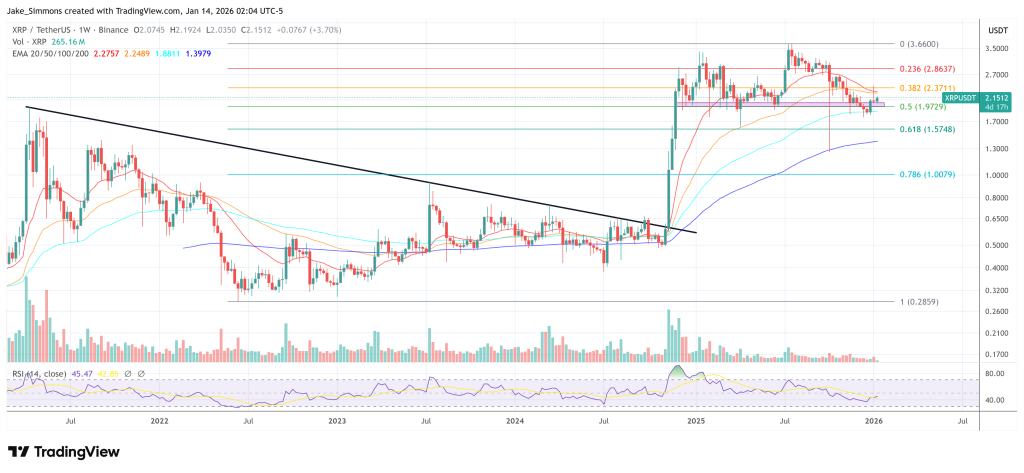
At press time, XRP traded at $2.15.
XRP price chart
Market Opportunity
XRP Logo
XRP Price(XRP)
$1.351
$1.351$1.351
-0.47%
USD
XRP (XRP) Live Price Chart
Disclaimer: The articles reposted on this site are sourced from public platforms and are provided for informational purposes only. They do not necessarily reflect the views of MEXC. All rights remain with the original authors. If you believe any content infringes on third-party rights, please contact crypto.news@mexc.com for removal. MEXC makes no guarantees regarding the accuracy, completeness, or timeliness of the content and is not responsible for any actions taken based on the information provided. The content does not constitute financial, legal, or other professional advice, nor should it be considered a recommendation or endorsement by MEXC.

You May Also Like

Cashing In On University Patents Means Giving Up On Our Innovation Future

Cashing In On University Patents Means Giving Up On Our Innovation Future

The post Cashing In On University Patents Means Giving Up On Our Innovation Future appeared on BitcoinEthereumNews.com. “It’s a raid on American innovation that would deliver pennies to the Treasury while kneecapping the very engine of our economic and medical progress,” writes Pipes. Getty Images Washington is addicted to taxing success. Now, Commerce Secretary Howard Lutnick is floating a plan to skim half the patent earnings from inventions developed at universities with federal funding. It’s being sold as a way to shore up programs like Social Security. In reality, it’s a raid on American innovation that would deliver pennies to the Treasury while kneecapping the very engine of our economic and medical progress. Yes, taxpayer dollars support early-stage research. But the real payoff comes later—in the jobs created, cures discovered, and industries launched when universities and private industry turn those discoveries into real products. By comparison, the sums at stake in patent licensing are trivial. Universities collectively earn only about $3.6 billion annually in patent income—less than the federal government spends on Social Security in a single day. Even confiscating half would barely register against a $6 trillion federal budget. And yet the damage from such a policy would be anything but trivial. The true return on taxpayer investment isn’t in licensing checks sent to Washington, but in the downstream economic activity that federally supported research unleashes. Thanks to the bipartisan Bayh-Dole Act of 1980, universities and private industry have powerful incentives to translate early-stage discoveries into real-world products. Before Bayh-Dole, the government hoarded patents from federally funded research, and fewer than 5% were ever licensed. Once universities could own and license their own inventions, innovation exploded. The result has been one of the best returns on investment in government history. Since 1996, university research has added nearly $2 trillion to U.S. industrial output, supported 6.5 million jobs, and launched more than 19,000 startups. Those companies pay…
Share
BitcoinEthereumNews2025/09/18 03:26
Subaru Motors Finance Reviews 2026

Subaru Motors Finance Reviews 2026

If you’re at a Subaru dealership, your heart is set on the perfect Outback or Forester. The salesperson asks, “Would you like to finance it today?” That’s where
Share
Fintechzoom2026/03/08 10:55
Shiba Inu Price Prediction: Dubai Cracks Down on KuCoin as Pepeto Outpaces DOGE and SHIB With $7.4M Raised

Shiba Inu Price Prediction: Dubai Cracks Down on KuCoin as Pepeto Outpaces DOGE and SHIB With $7.4M Raised

SHIB trades near cycle lows, but Pepeto is outpacing every Shiba Inu price prediction with $7.4M raised and a full exchange ecosystem approaching launch as Dubai
Share
Techbullion2026/03/08 10:54







