

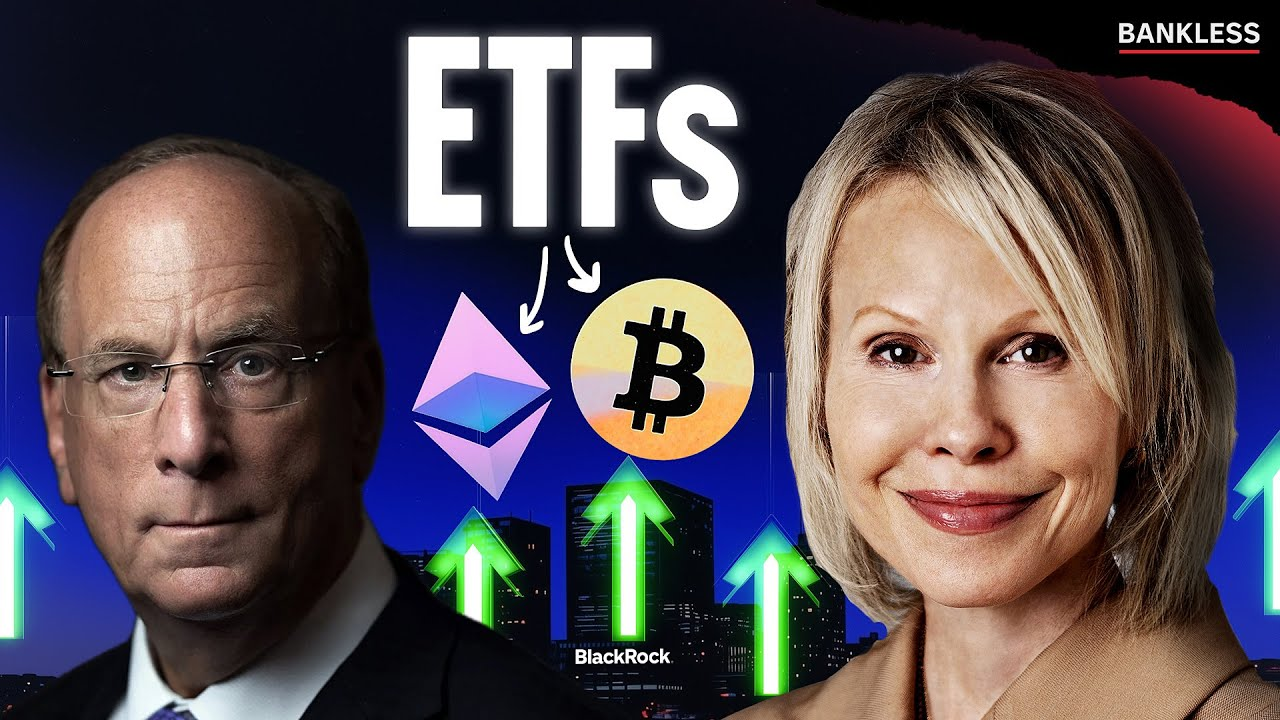
Conversation with Samara Cohen, the head of BlackRock ETF: Unveiling the crypto layout for 2025
Original article: Bankless
Compiled by: Yuliya, PANews
In the view of Samara Cohen, who is in charge of ETF and index investment at global asset management giant BlackRock, the financial market is at a critical stage of transformation. In this in-depth conversation hosted by Bankless, Samara, who manages $6.6 trillion in assets, shared her unique insights on digital asset ETFs, market modernization, and the integration of blockchain technology and traditional finance. PANews compiled this interview in text.
Samara: A driver of market modernization
Before joining the ETF industry, Samara worked at a large investment bank focusing on fixed income and derivatives. She describes herself as a "market modernizer" committed to enhancing market resilience, improving transparency and expanding investor participation. At BlackRock, she worked closely with Robbie Mitnik, head of the digital assets department, to explore the potential of cryptocurrencies and digital assets.
Samara believes that ETF itself is a disruptive technology, which is consistent with the goal of blockchain technology: to promote market modernization and achieve innovation and transformation in the financial market. She pointed out that technological innovation has always been the cornerstone of market modernization, and this law has never changed in the past thousands of years.
Integration of blockchain and traditional markets
Samara said that we are currently in the stage of integration between blockchain assets and traditional financial markets. She pointed out that the launch of the US Bitcoin ETP (Exchange Traded Product, not ETF, this subtle definition difference is very important) is exactly one year old, marking an important watershed moment, but it is also just the beginning.
The importance of these Bitcoin ETPs is that they build a bridge between the crypto world and the traditional finance (TradFi) world. Surprisingly, this bridge has a positive impact on participants in both worlds:
- Traditional investors can gain exposure to Bitcoin through familiar investment vehicles
- Digital native investors are also finding that ETPs can meet their needs
Data shows that many investors first came into contact with this product category through Bitcoin ETP, and then expanded to other ETPs. This integration currently involves only a few crypto assets and relies on traditional financial infrastructure. Samara believes that the ideal direction of development is to create a bridge and absorb the best practices of all parties, rather than completely subvert the existing system.
Technological evolution and market transformation
Samara used the transition from dial-up to broadband Internet as an analogy for the current development of crypto assets: initially Internet data was transmitted through telephone lines, but now the other way around, telephone calls are conducted over the Internet. There are two perspectives on the future development of crypto assets:
1. Current stage ("dial-up" stage):
- Bitcoin ETF, Ethereum ETF, etc. are "simulated versions" of crypto assets
- This is equivalent to forcing encryption technology into the traditional financial framework.
2. Future Vision ("Broadband Era"):
- Traditional financial institutions (such as BlackRock and Nasdaq) may move their businesses to blockchain
- Dedicated financial institution blockchains may emerge
But Samara raises a key question: Is this fully decentralized vision really the best fit for the current market and investors? She analyzes the issue from the perspective of the need for balance:
- Recognize the advantages of cryptography in terms of transparency and auditability
- Questioning the need for complete decentralization
- Point out the historical value of the existence of intermediaries: allowing people to focus on their own professional fields
- It is recommended to use encryption technology to improve the trust mechanism rather than completely replace the intermediary
The development of the options market
BlackRock’s iShares Bitcoin ETF and Ethereum ETP dominate options trading volume. BlackRock has built an options ecosystem by working with institutions such as Nasdaq, with Bitcoin ETF options launched one day earlier than similar products.
iShares platform covers multiple asset classes and national markets, and has established extensive connections with the trading ecosystem. In the Bitcoin market, the following features are the focus of market attention:
- High volatility
- The volatility of volatility (the fluctuation of volatility) is higher
- Positive skewness (volatility tends to rise when prices rise)
The development of the options market has brought a new trading mechanism for cryptocurrency ETFs. Although there are many sources of price information in the cryptocurrency market, by introducing volatility tools to exchanges and listings, the market has achieved:
- Standardization of funding methods
- Measurability of volatility trends
- Real-time monitoring of transactions
Data shows that the ETF market has experienced significant growth over the past 20 years, with a considerable number of institutional investors initially entering the market through ETF options. The options market provides investors with an additional way to participate in the market, allowing them to adjust their risk exposure according to their needs.
The development of the options market has expanded the diversity of market participation, as shown in the following aspects:
- Standardization of transaction methods
- Improvement of price discovery mechanism
- Increased risk management tools
- Improved market liquidity
“Price is the best marketing”
There is a famous saying in the Bitcoin community: "Price is the best marketing." However, from BlackRock's perspective, education is the best marketing for Bitcoin . This education mainly revolves around risk management, how to use risk to diversify the portfolio, and studying the interaction between portfolios.
Although Bitcoin has reached new highs at the end of the year, investors still need to be aware that although Bitcoin's price volatility has declined in recent years, it is still a high-risk, high-volatility asset compared to other assets in investors' portfolios. It is precisely this volatility that makes Bitcoin uniquely valuable as a portfolio diversification tool. Without these volatility characteristics, Bitcoin may not have the investment thesis it has now.
For an institution like BlackRock that is primarily targeting long-term investors, it is more important to communicate these fundamental factors to investors than to focus on the price trend of Bitcoin. This also reveals a common misunderstanding in the cryptocurrency community: many people believe that the success of ETFs is directly related to the increase in the price of the underlying assets. However, this is completely different from the actual measure of the success of ETF products.
BlackRock measures the success of ETPs (Exchange Traded Products) based on:
- Does the product meet the needs of investors?
- Is an effective market access mechanism provided?
- Does it have good liquidity?
- Is it possible to achieve effective price discovery?
Metrics for ETF success
As a traditional finance (TradFi) expert, Samara pointed out some misunderstandings between the cryptocurrency community and the traditional financial field, especially about the performance evaluation of Bitcoin ETF and Ethereum ETF. Samara specifically pointed out that many people believe that Ethereum ETF is not as successful as Bitcoin ETF, but from the professional standards of the ETF industry, the launch of Ethereum ETF is actually quite successful. She emphasized that the first criterion for judging whether an ETF is successful is whether it can achieve its expected goals.
ETF success metrics:
1. Tracking accuracy
- Must accurately track the underlying index
- The importance of Bitcoin ETFs comes from solving problems that investors previously faced
- Providing new options besides self-custody and exchange holding
- Avoids the position limit problem of futures ETFs
2. Market quality
- Need full ecosystem support
- Including trading volume, liquidity, exchange access
- Authorized Participant (AP) Creation and Redemption Mechanism
- Both Bitcoin and Ethereum ETFs demonstrate good market quality
Traffic difference analysis:
- ETFs themselves do not directly drive inflows
- Investor sentiment and investment philosophy are key
- Bitcoin investment ideas in 2020 are more specific and clear than Ethereum
- This explains the difference in capital inflows between the two
Actual performance:
- Bitcoin ETF breaks record
- Ethereum ETF still ranks in the top 20% of ETF issuance in the United States this year
- Both are considered successful products.
Key findings:
- Bitcoin’s marketing story is simpler and more direct (21 million limited, digital gold)
- Product success depends not only on technical performance, but also on clear narrative and identity positioning
ETF Trends
About the development history of Ethereum ETF:
- SEC unexpectedly approves Ethereum ETF in May 2023
- Industry faces uncertainty over deal launch timing between June and July
- Requires simultaneous preparation of portfolio, trading operations and education strategies
Current market trend analysis:
1. Investor characteristics
- From small investors to sophisticated investors
- Self-directed investors are the main driving force
- Investors generally understand the difference between Bitcoin and Ethereum
2. Advantages of Bitcoin Investment Thesis
- In line with current geopolitical tensions
- Responding to dollar deficit concerns
- As a diversification tool for traditional investment portfolios
- Especially in the context of the double kill of stocks and bonds in 2022, it is more valuable
3. Challenges facing Ethereum
- For U.S. investors who already own technology stocks
- Ethereum is more of an amplifier than a diversifier of existing investments
- High correlation with large-cap technology stocks
Market education process :
- Investors’ understanding of both assets continues to deepen
- Bitcoin is currently more in line with portfolio allocation needs
- Market education is still ongoing
ETF protocol upgrade
Regarding the possible future protocol upgrades of the Ethereum and Bitcoin blockchains, BlackRock’s position and views as an ETF issuer are worth noting. When participating in industry discussions, BlackRock’s views are mainly based on the following principles:
- Focus on how the ecosystem can best serve the needs of the company and its customers
- Tend to support open architecture and interoperability
- Consider the actual needs of institutional scale operations
Due to the large scale of BlackRock's operations, operating in a closed ecosystem often faces many limitations. This is why the company has clearly shifted to supporting public blockchains rather than permissioned chains in terms of tokenization in the past few years. This shift reflects the importance that institutions place on openness and scalability.
In terms of specific positions, BlackRock prefers to focus on:
- System scalability
- Counterparty Participation Conditions
- The openness of the overall ecosystem, rather than taking a stance on a specific crypto platform
ETF Development Forecast
In terms of the development prospects of ETFs in 2025, BlackRock put forward several key observation points and expectations.
- First, they hope to see further research on Bitcoin in portfolio construction. The focus of the discussion should shift from "whether to invest in Bitcoin" to "how to use Bitcoin reasonably in an investment portfolio."
- The second important development is the launch of Bitcoin ETP options. This innovation has already shown its importance in November 2023. Generally speaking, the options ecosystem helps to create a more balanced trading dynamics, with buyers appearing when the market falls and sellers appearing when it rises. However, innovation often comes with complexity. While many institutions are keen to launch and market option-based strategies, not all strategies are easy for investors to understand. Therefore, strengthening investor education will become increasingly important.
Other ETF Programs
Regarding BlackRock’s future plans for digital asset ETFs, the company has adopted a relatively cautious and pragmatic attitude. The following is an analysis of the main points:
Differences between market perception and reality:
- There is a common misunderstanding in the market that the launch of ETFs will inevitably lead to an increase in the price of underlying assets.
- The success of Bitcoin ETF has reinforced this perception to some extent.
- The performance of the Ethereum ETF shows that this correlation is not inevitable
The actual impact of ETFs on assets:
- Provides a more convenient investment channel
- Bringing a certain degree of legitimacy
- Reduced regulatory risk
- Potentially attracting new pools of funding
BlackRock's investment decision-making principles:
- Based on a clear investment case
- Focus on cash flow assessment of underlying assets
- Focus on risk measurement
- Consider customer portfolio needs
Observations on capital inflows:
- Bitcoin ETFs have accumulated about $36 billion in net inflows
- The trading volume of the secondary market is 9 times that of the primary market
- Institutional investors participate through a variety of channels, ETFs are just one of them
BlackRock’s current digital asset strategy focuses on:
- Operation and development of Bitcoin and Ethereum ETFs
- Tokenization projects, especially the tokenization of government bond funds
- Stablecoin related business
Looking ahead:
- The company is currently focusing on Bitcoin and Ethereum ETFs
- Digital asset strategy covers three pillars: cryptocurrency, stablecoin and tokenization
- New product development will continue to be customer-oriented
The impact of the new government
A new government is coming to power, and its orientation is more inclined towards free markets and pro-market policies. An important change for the cryptocurrency industry is that SEC Chairman Gary Gensler will leave. This change not only affects cryptocurrency native companies, but also BlackRock, a mainstream financial institution, is paying close attention. It is worth noting that the influence of the SEC is not limited to the US market, but actually extends to global financial markets.
Historically, the U.S. market has outperformed other global markets in its balance of supporting innovation and protecting investors, a balance that has led to its dominance today. The current regulatory environment was largely shaped by market changes in 2020-2021. During that period, individual investor participation increased significantly, thanks to trading platforms that began offering commission-free services, increased acceptance of technology during the pandemic, and government stimulus funds. Subsequently, many individual traders turned into index and ETP investors, a shift that has driven continued market change.
Future Outlook
BlackRock is optimistic about the future and expects the market to return to a balanced development direction. Although there is a lack of regulatory transparency in areas such as cryptocurrency ETFs, this situation is expected to improve. They look forward to a more supportive regulatory environment for innovation, while also emphasizing that proper regulation is essential to maintaining investor confidence.
For the specific outlook for 2025, BlackRock focuses on three core aspects:
- Establishment of basic definitions to clarify the attributes of various types of digital assets
- Clear division of jurisdiction, defining the scope of responsibilities of specific regulatory agencies
- Establishment of a collaborative mechanism between the public and private sectors
Regarding the existing FIT 21 Act and Stablecoin Act, BlackRock believes that these are positive developments, but they need to be better integrated with the traditional financial (TradFi) system to avoid creating a completely independent crypto ecosystem to prevent duplicate regulatory systems from hindering the participation of existing financial institutions.
She observed that while 2023 was challenging and there was strong dissatisfaction within the industry with the regulatory environment, it was time to refocus on the core mission: creating a more transparent and inclusive financial system.
The industry is entering a possible "golden age" thanks to three key factors:
- Lower cost of block space
- More convenient development environment
- A clearer regulatory landscape


You May Also Like

Iran invites global powers to negotiate Strait of Hormuz transit
Wall Street’s UBS uMINT yield-bearing collateral has reached Bybit – but there’s a catch

Searching For the Top Crypto Projects? How BlockDAG Leaves Ethereum, Bittensor, & Hyperliquid Behind with 1000x Potential!



