Pump.fun has rolled out a new social feature that is already stirring debate across Solana’s meme coin scene, after founder Alon Cohen said he would personally Pump.fun has rolled out a new social feature that is already stirring debate across Solana’s meme coin scene, after founder Alon Cohen said he would personally

Pump.fun CEO to Call Low-Cap Gem to Test New ‘Callouts’ Feature — Is a 100x Incoming?

Pump.fun has rolled out a new social feature that is already stirring debate across Solana’s meme coin scene, after founder Alon Cohen said he would personally use it to “call” a low market cap token as a live test.

The update arrives at a time when interest in ultra-low-cap launches remains high, even as volatility, account security concerns, and past pump-and-dump episodes continue to shape user behavior.

On Tuesday, Pump.fun announced that “callouts” are now live inside its mobile app, with a feature that allows users to alert all of their followers about a specific coin through push notifications.

Each account can make one call every six hours, and users are ranked on a global leaderboard that tracks activity and engagement.

Pump.fun Callouts Draw Attention and Questions

Users who actively make calls are ranked on a global leaderboard, adding a competitive layer that ties visibility to engagement.

Pump.fun says the feature is meant to help surface coins earlier in their lifecycle, particularly within its bonding curve system, where prices rise as demand increases.

Shortly after the launch, Cohen said the mobile app would become a major focus for Pump.fun in the coming months.

He also warned users to follow only his verified Pump.fun account, “alonalon,” amid concerns about impersonation.

According to on-chain data visible on the platform, the account holds just over $112,000 in assets, including SOL and several meme tokens, has more than 11,500 followers, follows no other users, and has never launched a coin.

The announcement immediately triggered speculation among traders, with some framing the test call as a potential catalyst for outsized gains.

A high-profile callout, especially from the platform’s founder, can therefore draw attention and liquidity very quickly, even if only briefly.

At the same time, some traders are questioning whether the account could be compromised or whether the test call might resemble past influencer-driven pumps.

Those concerns are rooted in recent history, as Pump.fun’s main X account was hacked in February 2025 and used to promote fake tokens.

Later that year, Cohen’s personal X account was temporarily suspended alongside the project account before being restored, although that incident was attributed to platform enforcement rather than a confirmed hack.

However, there is no public record of Cohen’s Pump.fun account being compromised.

Speculation Stays Hot as Pump.fun Rebuilds Its Meme Economy

Pump.fun’s callout feature also arrives alongside deeper structural changes to the platform.

In recent days, the company rolled out new creator tools and shifted away from its previous dynamic fee model, allowing token creators to now split fees across multiple wallets, transfer ownership after launch, and revoke update authority to signal long-term commitment.

The changes followed internal findings that earlier fee mechanics encouraged mass token creation without sustaining trading activity. The new direction places more emphasis on market participation and creator accountability.

Despite the risks, usage data shows Pump.fun remains one of the most active meme coin launchpads in crypto.

In the past 24 hours alone, over 30,000 new tokens were launched, with just over 200 reaching graduation. Trading volume during that period exceeded $113 million, and daily active wallets have roughly doubled over the past week, pointing to renewed speculative interest.
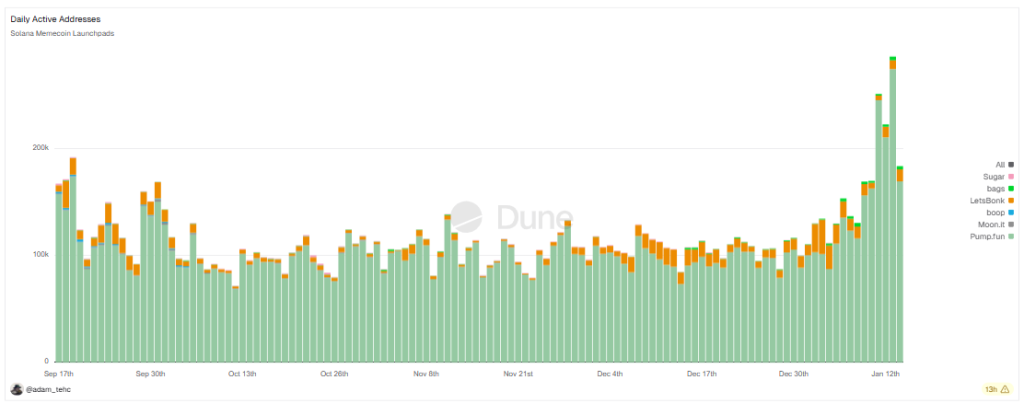
Source: Dune/adam_tehc

The Pump.fun token itself has seen mixed market conditions, as its token PUMP is currently trading around $0.0027, down about 7% on the day and roughly 69% below its all-time high.

Trading volume for the token has also declined modestly over the last 24 hours, reflecting broader cooldowns across the meme coin market.

Market Opportunity
Capverse Logo
Capverse Price(CAP)
$0.13154
$0.13154$0.13154
+1.87%
USD
Capverse (CAP) Live Price Chart
Disclaimer: The articles reposted on this site are sourced from public platforms and are provided for informational purposes only. They do not necessarily reflect the views of MEXC. All rights remain with the original authors. If you believe any content infringes on third-party rights, please contact service@support.mexc.com for removal. MEXC makes no guarantees regarding the accuracy, completeness, or timeliness of the content and is not responsible for any actions taken based on the information provided. The content does not constitute financial, legal, or other professional advice, nor should it be considered a recommendation or endorsement by MEXC.

You May Also Like

This U.S. politician’s suspicious stock trade just returned over 200% in weeks

This U.S. politician’s suspicious stock trade just returned over 200% in weeks

The post This U.S. politician’s suspicious stock trade just returned over 200% in weeks appeared on BitcoinEthereumNews.com. United States Representative Cloe Fields has seen his stake in Opendoor Technologies (NASDAQ: OPEN) stock return over 200% in just a matter of weeks. According to congressional trade filings, the lawmaker purchased a stake in the online real estate company on July 21, 2025, investing between $1,001 and $15,000. At the time, the stock was trading around $2 and had been largely stagnant for months. Receive Signals on US Congress Members’ Stock Trades Stocks Stay up-to-date on the trading activity of US Congress members. The signal triggers based on updates from the House disclosure reports, notifying you of their latest stock transactions. Enable signal The trade has since paid off, with Opendoor surging to $10, a gain of nearly 220% in under two months. By comparison, the broader S&P 500 index rose less than 5% during the same period. OPEN one-week stock price chart. Source: Finbold Assuming he invested a minimum of $1,001, the purchase would now be worth about $3,200, while a $15,000 stake would have grown to nearly $48,000, generating profits of roughly $2,200 and $33,000, respectively. OPEN’s stock rally Notably, Opendoor’s rally has been fueled by major corporate shifts and market speculation. For instance, in August, the company named former Shopify COO Kaz Nejatian as CEO, while co-founders Keith Rabois and Eric Wu rejoined the board, moves seen as a return to the company’s early innovative spirit.  Outgoing CEO Carrie Wheeler’s resignation and sale of millions in stock reinforced the sense of a new chapter. Beyond leadership changes, Opendoor’s surge has taken on meme-stock characteristics. In this case, retail investors piled in as shares climbed, while short sellers scrambled to cover, pushing prices higher.  However, the stock is still not without challenges, where its iBuying model is untested at scale, margins are thin, and debt tied to…
Share
BitcoinEthereumNews2025/09/18 04:02
Iran’s Crypto Use Reaches $7.8 Billion Amid Protests

Iran’s Crypto Use Reaches $7.8 Billion Amid Protests

Iran's crypto usage hit $7.8 billion in 2025, fueled by protests and economic instability, says Chainalysis.
Share
bitcoininfonews2026/01/16 05:51
Bitcoin devs cheer block reconstruction stats, ignore security budget concerns

Bitcoin devs cheer block reconstruction stats, ignore security budget concerns

The post Bitcoin devs cheer block reconstruction stats, ignore security budget concerns appeared on BitcoinEthereumNews.com. This morning, Bitcoin Core developers celebrated improved block reconstruction statistics for node operators while conveniently ignoring the reason for these statistics — the downward trend in fees for Bitcoin’s security budget. Reacting with heart emojis and thumbs up to a green chart showing over 80% “successful compact block reconstructions without any requested transactions,” they conveniently omitted red trend lines of the fees that Bitcoin users pay for mining security which powered those green statistics. Block reconstructions occur when a node requests additional information about transactions within a compact block. Although compact blocks allow nodes to quickly relay valid bundles of transactions across the internet, the more frequently that nodes can reconstruct without extra, cumbersome transaction requests from their peers is a positive trend. Because so many nodes switched over in August to relay transactions bidding 0.1 sat/vB across their mempools, nodes now have to request less transaction data to reconstruct blocks containing sub-1 sat/vB transactions. After nodes switched over in August to accept and relay pending transactions bidding less than 1 sat/vB, disparate mempools became harmonized as most nodes had a better view of which transactions would likely join upcoming blocks. As a result, block reconstruction times improved, as nodes needed less information about these sub-1 sat/vB transactions. In July, several miners admitted that user demand for Bitcoin blockspace had persisted at such a low that they were willing to accept transaction fees of just 0.1 satoshi per virtual byte — 90% lower than their prior 1 sat/vB minimum. With so many blocks partially empty, they succumbed to the temptation to accept at least something — even 1 billionth of one bitcoin (BTC) — rather than $0 to fill up some of the excess blockspace. Read more: Bitcoin’s transaction fees have fallen to a multi-year low Green stats for block reconstruction after transaction fees crash After…
Share
BitcoinEthereumNews2025/09/18 04:07