What are the best long-term investments? A practical guide from FinancePolice
FinancePolice focuses on plain-language explanations so you can compare options and make informed choices. Use this guide as a starting point and verify detailed assumptions with primary institutional sources before making major changes.
What is long term investing and why it matters
Definition and time horizon (long term investing)
Long term investing means holding a mix of assets with a planning horizon of many years, typically measured in decades rather than months. The main objective is wealth accumulation for goals such as retirement or long-range financial security, not short-term trading or timing market moves.
A multi-decade horizon changes how you think about risk. Compounding rewards time in the market. Volatility tends to smooth out over long periods, so short-term price swings matter less for the final outcome. Those ideas are central to investor guidance on asset allocation and diversification U.S. Securities and Exchange Commission investor guidance.
Choices still depend on personal factors. Time horizon, liquidity needs, tax situation and risk tolerance shape what mix of assets is sensible for any individual. For forward-looking return assumptions, it is wise to check recent capital-market outlooks before fixing a final plan.
Core principles of long term investing: diversification, low costs, and a long horizon
Diversification explained
The three foundational ideas most long-term investors can use are diversification, keeping costs low, and keeping a multi-decade horizon. Together these tend to reduce the chance that a single holding or high fees erode decades of progress, and they form the backbone of prudent long-term investing advice Vanguard principles for long-term investing.
Diversification spreads risk across asset classes and within equities, for example by market-cap and geographic exposure. That reduces idiosyncratic risk, which is the chance a single company or local market drags down your overall progress. Broad diversification is simple to achieve with low-cost, broad index funds and ETFs.
Advertise with FinancePolice, learn options and audience reach
Use the checklist later in this article to map these principles to your own timeline and tax situation.
Contact us about advertising
Why fees and tracking error compound
Small annual fees reduce long-run returns because they compound against your portfolio over many years. For example, a higher expense ratio or persistent tracking error can meaningfully lower the ending value of a multi-decade investment, which explains why low-cost index funds and broadly diversified ETFs are commonly recommended for many savers Morningstar capital market context.
Index fund investing typically lowers both explicit fees and the chance of manager underperformance, which helps net returns over time. That makes cost control one of the most predictable ways to improve long-term outcomes.
How a long horizon changes trade-offs
A long horizon increases the relative value of growth assets, because time allows you to recover from downturns and benefit from compounding. At the same time, a long horizon does not remove risk. Sequence-of-returns risk and life events still matter, so plan for near-term needs and emergency liquidity even if you are mainly focused on growth.
Maintaining a long horizon usually lets investors lean more toward equities for higher expected long-run returns, while using bonds and cash buffers to protect nearer-term capital.

Historical data and institutional market guides show equities have produced higher average returns over long horizons than bonds, but they also carry materially greater volatility and sequence-of-returns risk. Those are important trade-offs when you save for multi-decade goals or plan withdrawals in retirement J.P. Morgan Guide to the Markets.
That higher volatility means the timing of returns matters more for near-term withdrawals even if long-term averages favor equities. For long-horizon accumulation, equities tend to be a dominant source of growth in many institutional scenarios.
Bonds and cash: volatility dampening and lower expected real returns
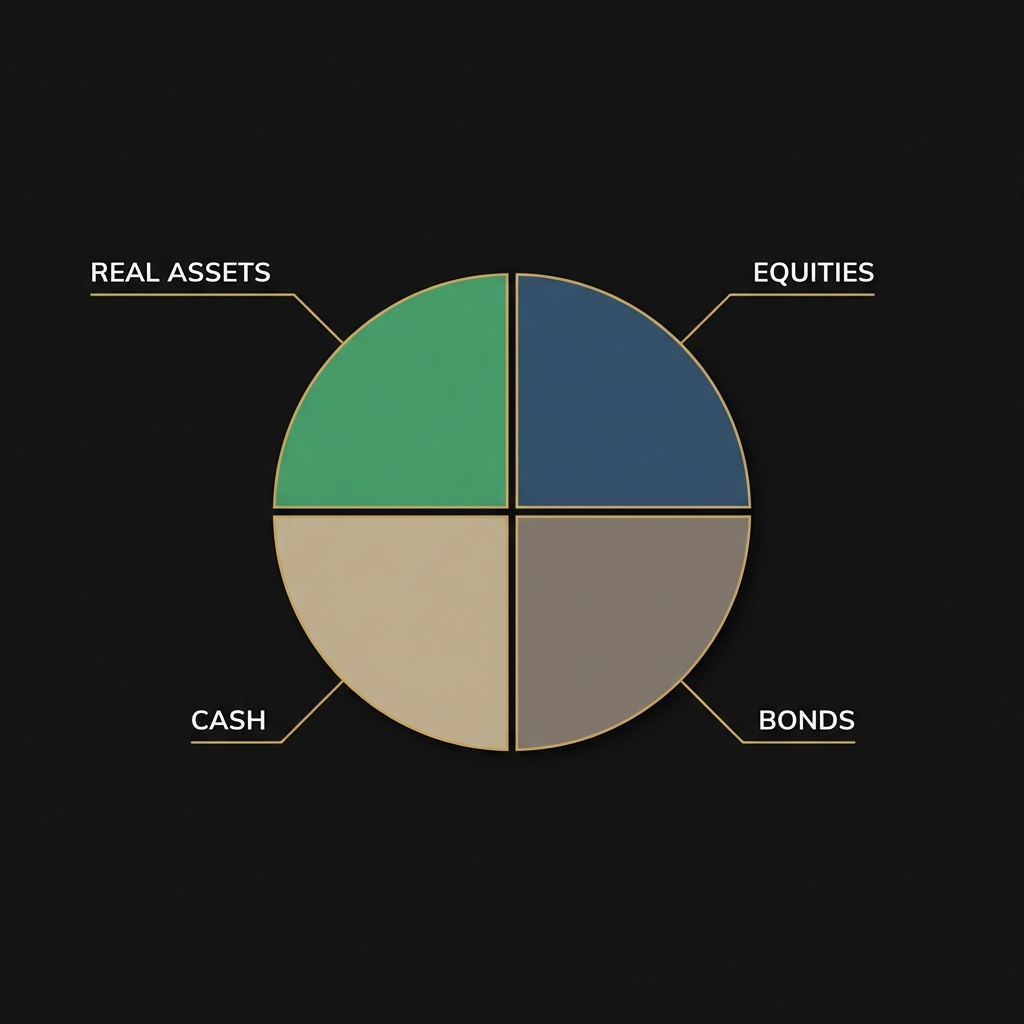
That expected shift means income-focused savers may need to balance the desire for lower volatility with the reality of lower expected returns from fixed income when designing a long-term plan.
Bonds and cash reduce portfolio volatility and protect capital needed in the short term. Institutional capital-market assumptions in the mid-2020s project lower expected real returns for fixed income than the historical equity premium, which affects how investors set allocations for income and safety Morningstar capital market context.
That expected shift means income-focused savers may need to balance the desire for lower volatility with the reality of lower expected returns from fixed income when designing a long-term plan.
Real assets and property: heterogeneity and liquidity differences
Real estate returns are heterogeneous. Direct property performance depends heavily on local markets, leverage, taxes and transaction costs. Because of that heterogeneity, owning a few rental properties can produce very different outcomes across investors and locations OECD global housing outlook.
REITs provide a liquid, diversified way to gain exposure to property returns without the day-to-day management and the same degree of local concentration that comes with a few individual properties. They are a practical route for investors who want real-estate exposure while keeping liquidity and diversification.
Choosing the best long-term investments for your situation
Decision factors to weigh
Start by listing your personal decision factors: time horizon, liquidity needs, taxes, fees, complexity tolerance, and whether you need local market exposure. These items change the relative attractiveness of index funds, ETFs, direct ownership and alternatives.
Time horizon and liquidity are often the clearest determinants. If your horizon is decades and you can tolerate short-term swings, broad equity exposure tends to play a larger role. If you need money in the near term, more conservative allocations and cash buffers make sense.
Checklist for choosing investments: time horizon, liquidity needs, tax situation, fees and provider choice, local market exposure, and how much time you will spend managing assets.
Choose a diversified core of low-cost, broad funds or ETFs, prioritize tax-advantaged accounts, consider bonds or cash for near-term needs, and adjust allocations based on your time horizon, liquidity needs and tax situation.
Simple frameworks to choose between funds, ETFs, or direct ownership
For many individual investors, low-cost broad index funds or ETFs are a practical default because they deliver diversification and low fees with little ongoing work, a pattern supported by long-term investing principles and provider guidance Vanguard principles for long-term investing.
Direct ownership of property or niche allocations can make sense when you have specific advantages, such as local market expertise, the time to manage assets, or tax rules that favor real property. Otherwise, REITs or diversified funds often give similar economic exposure with less complexity.
Building a diversified long-term portfolio: sample frameworks
Age and glidepath considerations
A simple way to think about allocation is to match equity exposure to your time horizon and volatility tolerance. Younger savers with long horizons typically hold more equities, while those approaching retirement often shift toward more bonds and cash to protect near-term capital. This glidepath approach aligns with common asset allocation guidance and can be adapted to your comfort with volatility SEC asset allocation guidance.
Glidepaths can be automated through target-date funds or implemented manually by adjusting allocations over time. Either approach aims to reduce the chance that a market decline near retirement severely damages your withdrawal plans.
Simple portfolio mixes for different risk tolerances
Here are adaptable, illustrative mixes, framed as starting points rather than prescriptions. Conservative: more bonds and cash for capital protection. Balanced: a mix of equities and bonds for growth with risk control. Growth: higher equity share for longer horizons and more growth potential.
Rebalancing basics: review allocations at set intervals or when they deviate by pre-set bands. Rebalancing preserves your intended risk profile and can improve control of volatility over decades.
Tax-advantaged accounts, fees, and other high-impact steps
How 401(k) and IRAs change long-term outcomes
Tax-advantaged accounts like 401(k)s and IRAs can materially improve after-tax long-term outcomes by deferring or exempting taxes on investment gains and by encouraging regular saving. Prioritizing contributions, especially to capture employer match, is a high-impact step many providers and regulators recommend Vanguard principles for long-term investing.
Maximizing tax-advantaged contributions and minimizing fees in these accounts often has a larger effect on long-run take-home wealth than fine-tuning asset selection in taxable accounts.
Fee-minimization and provider choice
High fees compound over decades. Choosing low-cost providers and broad funds helps preserve more of your return. Comparing expense ratios, fund structure and tracking error are practical steps to reduce costs. Institutional guidance consistently points to fees as a predictable drag on long-term returns Vanguard principles for long-term investing.
Simple annual checklist: maximize employer match, choose low-cost broad funds for core holdings, review plan fees annually, and prefer tax-advantaged vehicles for long-horizon savings where rules permit.
Real estate and alternatives: when to use REITs, direct property, or skip them
Differences between REITs and direct ownership
REITs offer a liquid, professionally managed path to real-estate exposure and are generally more diversified than owning a small number of individual properties. Direct ownership can produce different risks and rewards because of leverage, local market concentration, transaction costs and tax treatments OECD global housing outlook.
If you are considering property, evaluate local market fundamentals, expected rental demand, tax rules and the time you can commit to management. For many investors, a small allocation to REITs delivers the real-estate exposure they want without the operational burden.
Costs, taxes, leverage and local market factors
Direct property typically has higher transaction costs and requires active management, while leverage amplifies both gains and losses. Taxes and local regulations can change returns materially, so verify local information before committing to direct ownership OECD global housing outlook.
Alternatives can diversify portfolios, but they also add complexity. Use them when they address a specific need, such as inflation protection or noncorrelated exposure, and only after considering fees and liquidity.
Managing risk: volatility, sequence-of-returns, and rebalancing over decades
What sequence-of-returns risk means for retirees
Sequence-of-returns risk describes how the order of investment returns affects the sustainability of withdrawals. A prolonged market decline early in retirement can make a planned withdrawal rate unsustainable, even when long-term averages are favorable. That problem is well documented in institutional market guides and retirement research J.P. Morgan Guide to the Markets.
Practical steps include keeping a bond or cash buffer for near-term needs, diversifying sources of income, and adjusting withdrawal plans if markets undergo large declines. These choices reduce short-term pain but may alter long-run expected returns, so weigh trade-offs carefully.
estimate a bond cushion size for near-term withdrawals
–
USD
use as a rough starting point
Practical steps to reduce risk without sacrificing long-term growth
To manage risk while staying invested for growth, diversify broadly, maintain a bond or cash cushion for near-term liabilities, and rebalance periodically to keep your allocation on track. These steps tend to reduce severe short-term drops in income or principal without giving up long-term participation in markets SEC asset allocation guidance.
Behavioral risk is also important. Having a written plan and periodic rebalancing rules reduces the chance of reactive decisions that lock in losses during downturns.
Common mistakes, practical scenarios, and example plans
Typical mistakes to avoid
Common pitfalls include chasing past winners, ignoring fees, poor diversification, failing to use tax-advantaged accounts, and overleveraging in real estate. These mistakes often compound over time and reduce the chance of meeting long-term goals Vanguard principles for long-term investing.
Avoid complexity for its own sake. Simpler core holdings, low fees, and a clear plan usually help beginners more than frequent trading or speculative bets.
Three short example investor scenarios
Young saver: long horizon, high tolerance for volatility. A core of broad equity index funds or ETFs, supplemented by tax-advantaged contributions and emergency savings, is a reasonable starting approach.
Mid-career accumulator: steady contributions, mix of equities and bonds, prioritize tax-advantaged accounts and fee review. Consider targeted real-estate exposure through REITs if you want property diversification without active management.
Near-retiree: reduce sequence-of-returns risk by holding a larger cash or bond cushion for near-term withdrawals, keep a portion in equities for long-term growth, and plan withdrawals adaptively rather than using fixed rules.
In every case, cross-check forward-looking return assumptions against recent capital-market outlooks and your local tax rules before locking in a plan.
Conclusion: a simple checklist and next steps for long term investing
One-page checklist
Checklist: define your horizon; prioritize tax-advantaged accounts and employer match; choose low-cost, diversified funds for core holdings; set an allocation and rebalance; review fees and capital-market assumptions annually.
Where to verify assumptions: consult institutional capital-market outlooks and official investor guidance for updated return expectations and tax rules before making major changes to your allocation. For example, see J.P. Morgan’s long-term assumptions J.P. Morgan long-term capital market assumptions, Morningstar’s forecasts Morningstar experts forecast 2026, and Schwab’s expectations Schwab long-term capital market expectations.
Long term usually means a multi-decade horizon, often measured in decades rather than months, and is used for goals like retirement or long-range wealth accumulation.
Low-cost index funds and broad ETFs are practical defaults for many long-term investors because they provide diversification and low fees, though individual circumstances can justify alternatives.
Real estate can diversify a portfolio, but direct property results depend on local markets, leverage, taxes and management. REITs offer a liquid, diversified alternative.
If you want a simple next step, pick a low-cost, diversified fund for your core holdings, set a rebalancing rule, and check your fees and account choices annually.
References
- https://www.investor.gov/introduction-investing/investing-basics/asset-allocation-diversification
- https://investor.vanguard.com/investing/principles/long-term-investing
- https://www.morningstar.com/articles/2024-capital-market-assumptions
- https://am.jpmorgan.com/content/dam/jpm-am-aem/americas/us/en/institutional/insights/portfolio-insights/ltcma-full-report.pdf
- https://www.oecd.org/housing/global-housing-outlook-2024.htm
- https://financepolice.com/advertise/
- https://financepolice.com/category/personal-finance/
- https://financepolice.com/
- https://financepolice.com/category/investing/
- https://www.morningstar.com/markets/experts-forecast-stock-bond-returns-2026-edition
- https://www.schwab.com/learn/story/schwabs-long-term-capital-market-expectations


You May Also Like

USD/CAD edges higher after strong US NFP

US S&P Global Services PMI posts first contraction since 2023