From Data Platforms to Enterprise AI Outcomes: Architecting Governed, Scalable AI Systems
Enterprise leaders ask a pointed question: why does artificial intelligence deliver convincing demonstrations yet fail to reshape how the organization actually makes decisions?
The constraint sits upstream from models and algorithms. AI systems operate inside data platforms, access controls, and governance structures that determine how information moves across the enterprise. When those foundations are fragmented or poorly defined, AI produces disconnected insights instead of dependable outcomes.
Enterprise AI architecture establishes the foundation that determines whether AI delivers repeatable outcomes or isolated results. Without that foundation, each new AI initiative increases complexity faster than it creates value.
Why Enterprise AI Struggles to Move Beyond Pilots
AI pilots succeed when the environment remains controlled. A small team tunes a model on a narrow dataset. A demonstration paints a compelling scenario. Real use, where hundreds of teams depend on stable data and insights daily, exposes gaps.
Survey research emphasizes this point. IBM reported that about 42 percent of enterprises with more than 1,000 employees had actively deployed AI across business functions, while another 40 percent were still experimenting without full deployment. This means a significant share of organizations has not crossed the threshold from experimentation into sustained enterprise use.
Image: Illustration showing pop barriers hindering enterprises from successful AI adoption | Source: IBM
These barriers expose gaps in AI strategy for enterprises, particularly around governance and data readiness. Many teams cite data complexity as a major challenge, indicating that data readiness and integration remain structural blockers even as adoption grows.
These patterns show that pilots often succeed on isolated data and workflows. Enterprise outcomes require scalable AI platforms that sustain stability, consistency, and accountability as adoption grows.
Data Platforms Determine AI Reliability
AI systems consume data. The quality, structure, and accessibility of that data directly determine whether an AI system supports enterprise outcomes or produces inconsistent recommendations.
A common problem is fragmented data. When business units select tools independently and data pipelines evolve in isolation, data definitions drift. Each dataset becomes a local artifact rather than a shared enterprise asset.
The Boston Consulting Group found that only 26 percent of companies had developed the necessary capabilities to move beyond proofs of concept to generate measurable business value from AI. Critical technology capabilities included data quality and management.
This gap highlights how data platforms influence whether AI outputs can be trusted. If models draw from inconsistent, incomplete, or disconnected data, their outputs vary and reliability erodes. Architectures that unify data access, enforce standards, and support reuse across teams create the conditions for enterprise readiness.
Governance Enables AI to Scale
AI governance shapes how data and AI behave across the enterprise. It defines which data sources are approved, how models may be applied, who is accountable, and what operational controls must be in place to meet regulatory and ethical requirements.
Governance continues to rise on enterprise agendas as organizations grapple with complexity. Leading data platform analysts emphasize that “AI-ready data” is not just about storage capacity; it is about the practices and controls that make data trustworthy for AI workflows.
Gartner’s research on AI-ready data highlights that many organizations lack integrated metadata management, observability, and governance practices essential for reliable AI outcomes.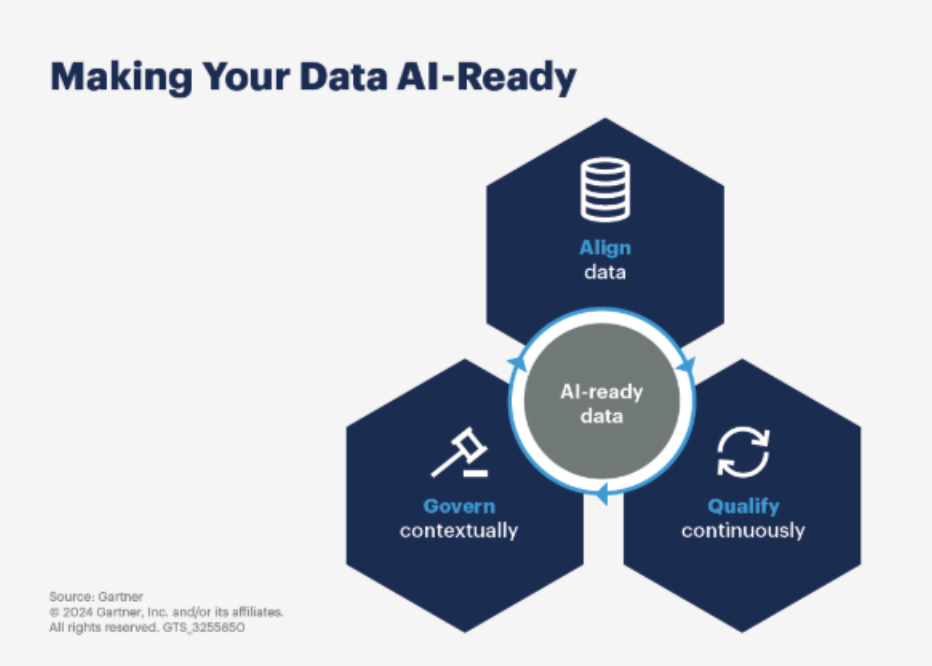
Image: Diagram showing how AI-ready data is created by aligning data, governing it contextually, and qualifying it continuously | Source: Gartner
This analysis points to why governance matters: without it, AI systems draw on data that may violate compliance standards, generate biased outcomes, or fail unpredictably when underlying data changes.
Investment in governance infrastructure pays off. Firms that embed responsible AI and data governance frameworks often report clearer accountability, fewer operational failures, and stronger confidence in AI outputs than peers who rely on ad-hoc controls.
Governance does more than protect against risk. It creates a shared foundation that teams can depend on as AI capabilities expand. It enables cross-team collaboration and reduces friction that arises when each group applies its own rules or assumptions.
Data Democratization Requires Deliberate Design
AI adoption depends on access. Teams across engineering, analytics, and business functions increasingly rely on data to generate insights. Simply opening access without structure increases risk and creates confusion rather than clarity.
Data democratization works when access expands within a designed framework of guardrails. Without guardrails, teams copy data into separate systems, calculate metrics differently, and expose the organization to compliance risk because data quality and ownership are unclear.
Where democratization is aligned with governance, teams gain autonomy while preserving trust. Clear data product definitions, explicit ownership, and well-documented usage rules ensure everyone works from the same understanding of data capabilities and limits.
Self-service analytics that include governance controls, not just access, accelerate adoption with reduced risk. Users know what datasets they can trust for which purposes, and leadership retains visibility into how data supports decisions across the enterprise.
Identity-Based Access Simplifies Risk and Scales Faster
As AI systems scale, controlling who can access what data becomes an operational priority. Traditional permission models tied to individual files or folders break down as datasets multiply and domains broaden.
Identity-based access patterns align permissions to roles and attributes of users or systems. This means access decisions follow organizational structure and responsibilities rather than being scattered across point solutions.
When identities and roles govern data access, teams can onboard faster, change responsibilities without manual reconfiguration, and revoke access consistently across all systems when needed. This reduces security risk and administrative burden while enabling governance to persist as the environment grows.
Identity-centric architecture makes it easier to apply governance policies consistently across datasets and AI assets. It also supports compliance reporting because access logs and policies tie back to clear organizational context rather than isolated permissions scattered across tools.
Vector-Based AI Introduces New Platform Constraints
Modern enterprise AI increasingly uses vector-based retrieval systems for search, recommendations, and generative experiences. These systems operate differently from traditional databases and introduce new infrastructure demands.
Vector workloads use memory and storage in ways that can drive up costs if unmanaged. They also create different performance profiles and reliability characteristics as usage increases. If infrastructure is only optimized for structured queries, AI systems relying on vectors may experience instability or inefficiency.
Architecture guidance emphasizes planning for vector storage, retrieval performance, and cost controls early in platform design rather than retrofitting these capabilities after systems are live.
By treating vector systems as fundamental elements of platform design, enterprises can avoid performance bottlenecks and budget surprises while expanding AI use cases that depend on high-speed retrieval and contextual understanding.
Measuring Enterprise AI Outcomes
One reason many AI initiatives lose organizational momentum is a misalignment in how success is measured. Prototype performance on benchmarks does not equate to business impact in everyday operations.
Leading organizations evaluate AI using operational indicators that align with business priorities. These include decision velocity, which tracks how quickly teams convert data into action; trust indicators that capture confidence in data quality, explainability, and governance; and operational efficiency measures that show reductions in manual effort, error rates, and cycle time.
A McKinsey global survey of enterprise AI adoption shows that adoption is increasing across functions, and organizations that report measurable benefits tend to use AI not as isolated tools but embedded in workflows that improve operational performance and decision processes. Respondents also reported cost reductions and revenue gains in the business units deploying AI, suggesting that measurement tied to business outcomes, not technical benchmarks, reflects real value realized from AI investments.
Image: Graph showing percentage of organizations using AI in at least one business function | Source: McKinsey
A separate enterprise study by Accenture found that companies with fully modernized, AI-led processes (measured by revenue growth, productivity increases, and scaling success) outperform peers that treat AI as a set of disconnected experiments. Compared with organizations still early in their AI journey, AI-led firms reported 2.5 times higher revenue growth, 2.4 times greater productivity, and 3.3 times greater success at scaling AI use cases across business functions.
Image: Infographic highlighting growth in AI-led organizations from 9% to 16% | Source: Accenture
What Enterprise Leaders Must Build First
AI magnifies the conditions in which it operates. Strong data platforms produce consistent, dependable outputs. Weak foundations amplify risk and inconsistency.
Enterprises targeting real AI outcomes must prioritize governed data platforms, identity-driven access, and intentional architecture. These elements create the conditions for AI to scale responsibly across teams and use cases.
Organizations that invest in these foundations see faster decision-making, stronger trust in data, and measurable improvements in operational efficiency. Organizations that delay often repeat pilots without capturing sustained value.
AI outcomes begin with architecture.
References:
- IBM Corporation. (2024, January 10). Data suggests growth in enterprise adoption of AI is due to widespread deployment by early adopters. https://newsroom.ibm.com/2024-01-10-Data-Suggests-Growth-in-Enterprise-Adoption-of-AI-is-Due-to-Widespread-Deployment-by-Early-Adopters
- Boston Consulting Group. (2024, October 24). AI adoption in 2024: 74% of companies struggle to achieve and scale value. https://www.bcg.com/press/24october2024-ai-adoption-in-2024-74-of-companies-struggle-to-achieve-and-scale-value
- Gartner, Inc. (2024). AI-ready data drives success: Insights on data management for enterprise intelligence. https://www.gartner.com/en/articles/ai-ready-data
- McKinsey & Company. (2024, May 30). The state of AI 2024: Trends in adoption, value creation, and enterprise performance. https://www.mckinsey.com/capabilities/quantumblack/our-insights/the-state-of-ai-2024
- Accenture. (2024, October 10). New Accenture research finds that companies with AI-led processes outperform peers. https://newsroom.accenture.com/news/2024/new-accenture-research-finds-that-companies-with-ai-led-processes-outperform-peers


You May Also Like

Leap Wallet to Shut Down by May 28 as Team Winds Down Apps and Validator

SoFi Big Business Banking: SOL Integration